VSAQ for Chapter 1 Geographical Diversity of India Class 7 Social Science NCERT
Important Questions1
Q1: Which countries form the Indian Subcontinent along with India?
Answer
The Indian Subcontinent includes India, Pakistan, Bangladesh, Nepal, Bhutan, Sri Lanka, and Myanmar.
VSAQ
2
Q2: What are the five main physical regions of India?
Answer
The five main physical regions of India are the Himalayas, the Gangetic Plains, the Thar Desert, the Southern Peninsula, and the Islands.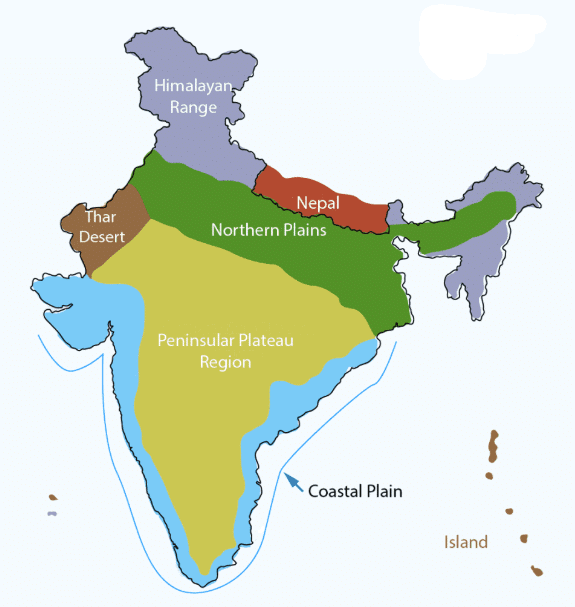
Physical features of India
VSAQ
3
Q3: Which natural feature protects India from the north?
Answer
The Himalayas protect India from the north.
VSAQ
4
Q4: What is the total length of the Himalayan range?
Answer
The Himalayan range stretches for about 2,500 kilometers.
VSAQ
5
Q5: Which major rivers originate from the Himalayas?
Answer
The Ganga, Indus, and Brahmaputra rivers originate from the Himalayas.
VSAQ
6
Q6: What is the highest part of the Himalayan range called?
Answer
The highest part of the Himalayan range is called the Himadri or Greater Himalayas.
VSAQ
7
Q7: Which Himalayan range is known for hill stations like Shimla and Darjeeling?
Answer
The Himachal or Lower Himalayas are known for hill stations like Shimla and Darjeeling.
VSAQ
8
Q8: What is the outermost Himalayan range called?
Answer
The outermost range is called the Shivalik Hills.
VSAQ
9
Q9: How were the Himalayas formed?
Answer
The Himalayas were formed when the Indian plate collided with the Eurasian plate around 50 million years ago.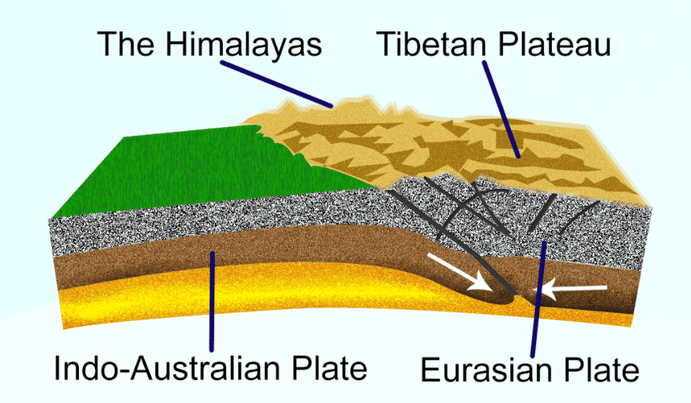
Formation of Himalayas
VSAQ
10
Q10: Why are the Himalayas called the "Water Tower of Asia"?
Answer
They are called the "Water Tower of Asia" because they feed many major rivers that supply water to millions.
VSAQ
11
Q11: What kind of desert is Ladakh?
Answer
Ladakh is a cold desert in India.
VSAQ
12
Q12: Name a famous salty lake in Ladakh.
Answer
Pangong Tso is a famous salty lake in Ladakh.
VSAQ
13
Q13: Which animal is very useful for the people of Ladakh?
Answer
The yak is very useful for the people of Ladakh.
VSAQ
14
Q14: Which festivals are celebrated in Ladakh?
Answer
Festivals like Losar and Hemis are celebrated in Ladakh.
VSAQ
15
Q15: What makes the soil of the Gangetic Plains fertile?
Answer
Minerals carried by rivers from the Himalayas make the soil fertile.
VSAQ
16
Q16: Which crops are mainly grown in the Gangetic Plains?
Answer
Rice and wheat are the main crops grown in the Gangetic Plains.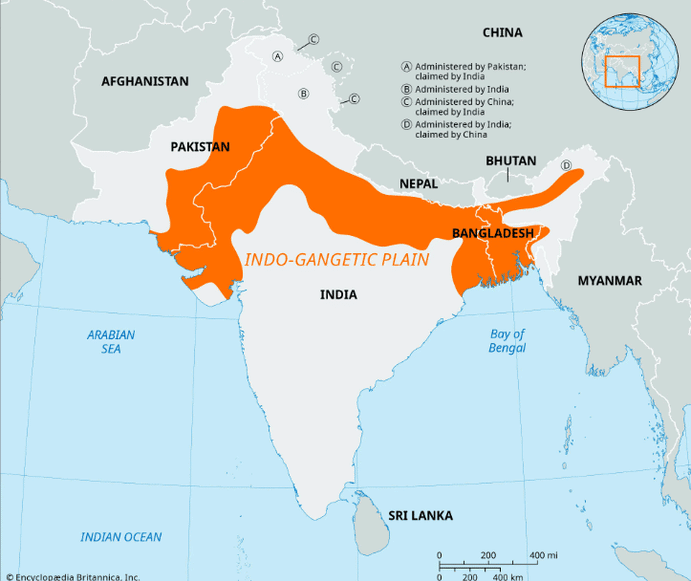
Gangetic Plain
VSAQ
17
Q17: What is the national bird of India found in the Gangetic Plains?
Answer
The peacock is the national bird of India found in the Gangetic Plains.
VSAQ
18
Q18: Which desert covers parts of Rajasthan, Gujarat, Punjab, and Haryana?
Answer
The Thar Desert covers parts of Rajasthan, Gujarat, Punjab, and Haryana.
VSAQ
19
Q19: What is a taanka used for in desert areas?
Answer
A taanka is used for harvesting and storing rainwater in desert areas.
VSAQ
20
Q20: What is the highest peak in the Aravalli Hills?
Answer
Mount Abu is the highest peak in the Aravalli Hills.
VSAQ
21
Q21: Name two minerals found in the Aravalli Hills.
Answer
Marble and zinc are two minerals found in the Aravalli Hills.
VSAQ
22
Q22: Which two rivers flow westward into the Arabian Sea?
Answer
The Narmada and Tapti rivers flow westward into the Arabian Sea.
VSAQ
23
Q23: What is the name of India’s only active volcano?
Answer
Barren Island is the name of India’s only active volcano.
VSAQ
24
Q24: Which delta is home to the Sundarbans mangrove forest?
Answer
The delta formed by the Ganga and Brahmaputra rivers is home to the Sundarbans.
VSAQ
25
Q25: Which village in Meghalaya is known as the cleanest village in Asia?
Answer
Mawlynnong Village in the East Khasi Hills is known as the cleanest village in Asia.
VSAQ
26
What is the approximate length of the Himalayas?
Answer
About 2,500 km.
VSAQ
27
Q27: What is the cleanest village in Asia?
Answer
Mawlynnong in Meghalaya.
VSAQ
28
Q28: Which hill stations are found in the Himachal range?
Answer
Shimla, Manali, Dharamshala.
VSAQ
29
Q29: Which mineral is extracted in Zawar mines of the Aravallis?
Answer
Zinc.
VSAQ