VSAQ for Chapter 3 Climates of India Class 7 Social Science NCERT
Important Questions1
Q1: What is weather?
Answer
Weather is the daily condition of the atmosphere, such as rain, sunshine, or wind.
VSAQ
2
Q2: What is climate?
Answer
Climate is the average weather pattern in a region over many years.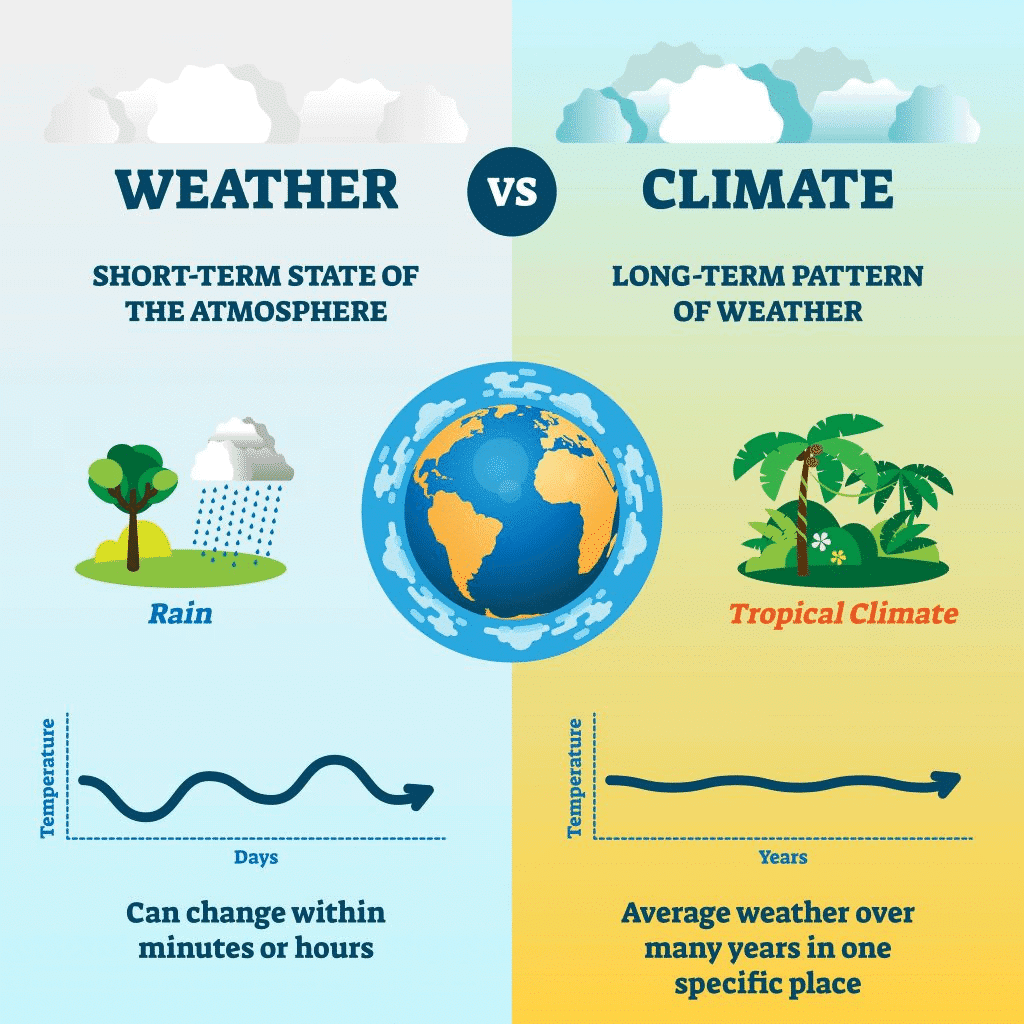
Difference between Weather and Climate
VSAQ
3
Q3: How many main seasons are there in India?
Answer
There are five main seasons in India, including the monsoon season.
VSAQ
4
Q4: What is the traditional Indian name for spring?
Answer
The traditional Indian name for spring is vasanta.
VSAQ
5
Q5: Why do animals grow thick fur in winter?
Answer
Animals grow thick fur in winter to stay warm in cold weather.
VSAQ
6
Q6: What type of climate does the Himalayas have?
Answer
The Himalayas have an alpine climate with snowy winters and cool summers.
VSAQ
7
Q7: Which Indian region has a subtropical climate?
Answer
The Northern Plains have a subtropical climate with hot summers and cold winters.
VSAQ
8
Q8: What is the climate like in the Thar Desert?
Answer
The Thar Desert has an arid climate with very hot days and cool nights.
VSAQ
9
Q9: Name one hill station in the Lower Himalayas.
Answer
Shimla is a hill station in the Lower Himalayas.
VSAQ
10
Q10: What kind of climate is found on India’s western coast?
Answer
India’s western coast has a tropical wet climate with heavy rainfall.
VSAQ
11
Q11: How does latitude affect climate?
Answer
Places near the Equator are hotter due to direct sunlight.
VSAQ
12
Q12: Which Indian city stays warm year-round because of its latitude?
Answer
Kanyakumari stays warm year-round due to its location near the Equator.
VSAQ
13
Q13: Why are hill stations cooler than plains?
Answer
Hill stations are cooler because higher altitude reduces temperature.
VSAQ
14
Q14: What is the effect of the sea on coastal climate?
Answer
The sea keeps coastal areas cooler in summer and warmer in winter.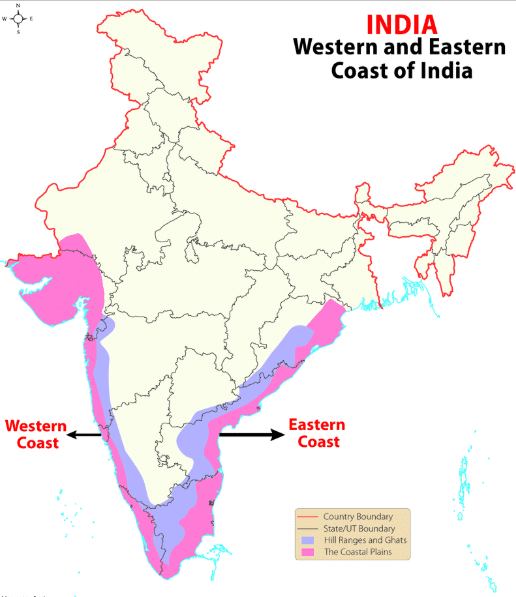
Coasts of India
VSAQ
15
Q15: Which inland city has extreme temperatures: Mumbai or Nagpur?
Answer
Nagpur has more extreme temperatures because it is inland.
VSAQ
16
Q16: What are hot, dry summer winds from the desert called?
Answer
Hot, dry winds from the desert are called heat waves.
VSAQ
17
Q17: What role do the Himalayas play in India’s climate?
Answer
The Himalayas block cold winds from Central Asia.
VSAQ
18
Q18: What is topography?
Answer
Topography refers to the shape and features of the land, like hills and plains.
VSAQ
19
Q19: What is a microclimate?
Answer
A microclimate is a small area with a different climate than its surroundings.
VSAQ
20
Q20: What causes the summer monsoon?
Answer
The summer monsoon is caused by pressure differences between land and ocean.
VSAQ
21
Q21: Which part of India gets winter monsoon rainfall?
Answer
East and south India get rainfall during the winter monsoon.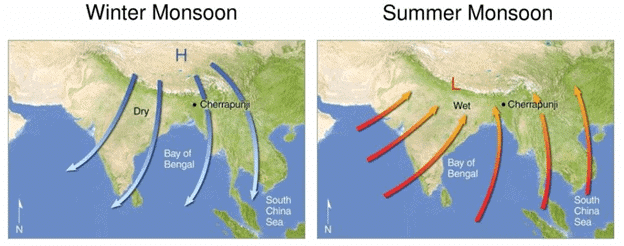
Wind Movement
VSAQ
22
Q22: What does the word “monsoon” mean?
Answer
The word “monsoon” comes from the Arabic word “mausim,” meaning season.
VSAQ
23
Q23: Which Indian village gets the world’s highest rainfall?
Answer
Mawsynram in Meghalaya receives the world’s highest rainfall.
VSAQ
24
Q24: What is a cyclone?
Answer
A cyclone is a storm with strong winds and rain caused by a low-pressure system.
VSAQ
25
Q25: Name one greenhouse gas that causes climate change.
Answer
Carbon dioxide (CO₂) is a greenhouse gas that causes climate change.
VSAQ
26
Q26: What does the word "monsoon" mean?
Answer
Monsoon comes from the Arabic word "mausim," meaning season.
VSAQ
27
Q27: What is a microclimate?
Answer
A small area’s unique climate different from its surrounding region.
VSAQ
28
Q28: Which climate is found in the Deccan Plateau?
Answer
Semi-arid climate.
VSAQ
29
Q29: What causes the monsoon rains in India?
Answer
Seasonal winds are the primary cause of monsoon rains in India.
VSAQ
30
Q30: Which region has the coldest climate in India?
Answer
The Himalayan region.
VSAQ