LAQ for Chapter 3 Climates of India Class 7 Social Science NCERT
Important Questions1
Q1: Explain how latitude and the Earth’s shape influence climate in different parts of India.
Answer
• Latitude determines how directly the sun’s rays hit a place.• Areas near the Equator, like Kanyakumari, receive more direct sunlight and are hotter.
• Places farther north, like Srinagar, receive slanted rays and are cooler.
• The Earth’s curve spreads sunlight unevenly, affecting temperatures.
• This results in India having tropical weather in the south and cooler conditions in the north.
• That’s why India has diverse climatic zones.
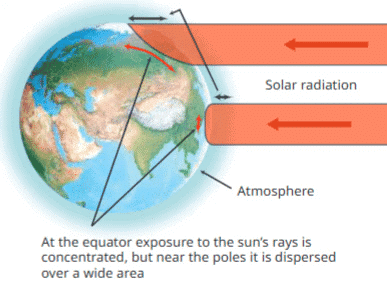
Effect of Latitude
LAQ
2
Q2: What are the characteristics of the summer and winter monsoons in India?
Answer
• The summer monsoon brings heavy rain from June to September, as moist winds blow from sea to land.• It starts in the south and spreads across the country.
• The winter monsoon, from October to January, involves dry winds moving from land to sea.
• Some moisture from the Bay of Bengal causes rain in east and south India.
• Together, both monsoons impact farming and water supply across India.
LAQ
3
Q3: How does India’s geography contribute to its climate diversity?
Answer
• India has mountains, plateaus, deserts, and coastal areas, each affecting the climate.• The Himalayas block cold winds and cause snowfall.
• The Thar Desert is hot and dry due to open terrain and low rainfall.
• Coastal regions get heavy rain because of the sea.
• The Deccan Plateau has moderate rainfall and heat.
• This diverse geography creates many different climates across the country.
LAQ
4
Q4: Describe how floods and glacial bursts impact different parts of India.
Answer
• Floods occur when rivers overflow or drainage fails during heavy rainfall.• In Himalayan regions, melting glaciers or cloudbursts can cause flash floods.
• Glacial lake bursts, like in Uttarakhand in 2013, destroyed villages and claimed lives.
• Lowland states like Bihar and Kerala also face monsoon floods.
• These disasters damage homes, crops, roads, and force people to relocate.
LAQ
5
Q5: What are the causes and effects of landslides in India?
Answer
• Landslides are sudden falls of rocks or soil in hilly areas like Himachal Pradesh or Sikkim.• Heavy rain, deforestation, or earthquakes can trigger them.
• Poor construction on unstable slopes increases risk.
• Landslides destroy roads, block rivers, and damage homes.
• They are dangerous for people living in mountain areas and require early warning systems for safety.
LAQ
6
Q6: How do forest fires affect the environment and people?
Answer
• Forest fires burn trees, destroy habitats, and kill wildlife.• They release smoke that pollutes the air and harms health.
• Fires can spread quickly due to wind, dry weather, or human carelessness.
• Regions like Uttarakhand and Madhya Pradesh face these fires often.
• People may lose homes or farmland, and animals lose shelter and food.
• Firefighting efforts and awareness can reduce these disasters.
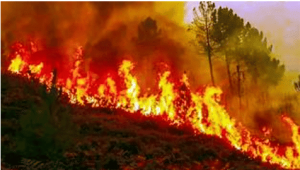
Forest Fires
LAQ
7
Q7: Explain how climate change is affecting India’s weather and agriculture.
Answer
• Climate change is causing unpredictable rainfall and rising temperatures.• Winters are getting shorter, and heatwaves are becoming common.
• Crops fail when rains are too little or come at the wrong time.
• Farmers suffer losses, and food prices rise.
• Poor communities are more vulnerable to these changes.
• Tackling climate change is essential to protect India’s agriculture and economy.
LAQ
8
Q8: What are some solutions to reduce the impact of climate change?
Answer
• One solution is reducing greenhouse gas emissions by using renewable energy like solar and wind.• Planting more trees helps absorb carbon dioxide.
• People can also save electricity, recycle, and reduce waste.
• Governments can promote eco-friendly laws and green technology.
• Adapting to climate change through better farming and city planning is also important.
• Together, these steps help fight global warming.
LAQ