SAQ for Chapter 3 Climates of India Class 7 Social Science NCERT
Important Questions1
Q1: How do seasons influence festivals in India?
Answer
Many Indian festivals are linked to the changing seasons and farming cycles. For example, Baisakhi celebrates the harvest in spring, while Onam marks the monsoon harvest in Kerala.
Seasons influencing festivals
SAQ
2
Q2: Why does the Deccan Plateau receive less rainfall than the Western Ghats?
Answer
The Western Ghats block monsoon winds, causing heavy rain on their western slopes. The Deccan Plateau lies in the rain shadow region, receiving less rainfall.
SAQ
3
Q3: How does altitude affect temperature in cities like Ooty and Coimbatore?
Answer
Though both cities are at the same latitude, Ooty is cooler because it is at a higher altitude. Higher places have cooler temperatures due to thinner air.
SAQ
4
Q4: Why do inland areas like Nagpur experience greater temperature variation than coastal cities like Mumbai?
Answer
Inland areas heat up and cool down faster, leading to extreme temperatures. The sea near coastal cities keeps the climate more stable.
SAQ
5
Q5: What is the role of sea winds in India’s climate?
Answer
Sea winds carry moisture that leads to rainfall during monsoons. They also help in regulating temperatures in coastal areas.
SAQ
6
Q6: How do people in the Thar Desert adapt to the arid climate?
Answer
People wear loose cotton clothes and build thick-walled houses. They store rainwater in tanks and use water carefully.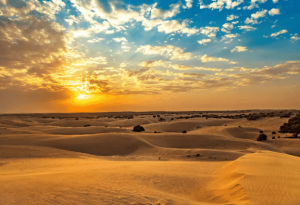
Thar Desert
SAQ
7
Q7: What is the difference between weather and climate?
Answer
Weather changes daily, like rain or sunshine, while climate is the average weather over many years. Climate gives a long-term pattern of a region.
SAQ
8
Q8: How do topographical features affect rainfall in India?
Answer
Mountains like the Himalayas block cold winds and help in snow formation. The Western Ghats force monsoon winds to rise, causing rainfall on one side and dry weather on the other.
SAQ
9
Q9: How do monsoons affect agriculture in India?
Answer
Most Indian farmers depend on monsoon rains to water their crops. A poor monsoon can lead to crop failure and food shortages.
SAQ
10
Q10: Why is understanding microclimates important for farmers?
Answer
Microclimates help farmers choose the right crops for small areas. Local weather differences can affect growth and harvesting times.
SAQ
11
Q11: What is traditional knowledge used for predicting monsoons?
Answer
Signs like fish surfacing or trees blooming have helped people predict rain for centuries. These signs are still used in some regions along with modern science.
SAQ
12
Q12: How does climate influence traditional art and culture in India?
Answer
Folk songs, dances, and rituals are often inspired by the changing seasons. Many communities pass down stories and customs related to rain, farming, or heat.
SAQ
13
Q13: What is the difference between weather and climate?
Answer
Weather refers to the short-term conditions of the atmosphere, while climate is the long-term average of these conditions over many years.
SAQ
14
Q14: How does altitude affect India’s climate?
Answer
Higher altitudes, like hill stations, have cooler climates, while lower areas experience warmer temperatures.
SAQ
15
Q15: Why are the Western Ghats important in determining the climate of India?
Answer
The Western Ghats influence monsoon rainfall by blocking moist air from the sea, leading to heavy rainfall on the western side.
SAQ
16
Q16: What role does latitude play in India’s climate?
Answer
Areas closer to the Equator, like Kanyakumari, remain warm year-round, while regions further north, like Srinagar, experience cooler climates.
SAQ
17
Q17: How does proximity to the sea influence the climate?
Answer
Coastal areas have milder temperatures due to the sea's ability to moderate both summer and winter temperatures.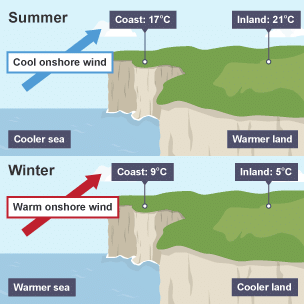
Proximity to Sea
SAQ