General Principles and Processes of Isolation of Elements
Book Solutions1
Answer
Copper has a higher reduction potential than zinc or iron. Thus, in hydro-metallurgy iron and zinc can be used to displace copper from its solution.Fe(s) + Cu2+(aq) ⇒ Fe2+ (aq) + Cu(s)
However, in-order to displace zinc a metal more reactive than it is required e.g. K, Ca, etc. The problem arising now is that all these metals react with water to liberate hydrogen gas. Thus, they cannot be used for the extraction of zinc using hydro-metallurgy.
2
Answer
The role of a depressant in forth floatation is to set apart two sulphide ores through selective prevention of one ore from frothing. E.g. NaCN is used to separate two sulphide ores , PbS and ZnS. NaCN forms a complex, Na2[Zn( CN )4], with zinc on the surface of zinc sulphide, thus selectively preventing ZnS from frothing. 4NaCN + ZnS ⇒ Na2[Zn( CN )4] + Na2S3
Answer
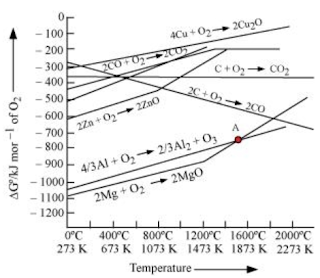
Hydrogen sulphite and carbon disulphite (CS2) has a larger ∆fG (Gibbs free energy of formation) than copper (I) sulphite. Thus, C and H2S will not be able to reduce Cu2S to Cu. Whereas, ∆fG of Cu2O is larger than carbon monoxide’s, thus C can reduce copper (I) oxide to copper. Therefore, it is more difficult to extract copper from pyrites than it is to extract from its oxide.4
(a) Zone refining
(b) Column chromatography.
Answer
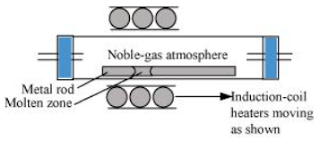
(a) Zone refining:
This method makes use of a principle according to which impurities are more soluble in molten metal than in a solid metal. In zone refining, a moving circular heater slowly moves over an impure metal rod/ bar. As the circular heater moves, the impurities move into the adjacent molten zone and the pure metal crystallizes out. This is repeated over several times, causing the segregation of impurities at one end of the bar. This impure end is then cut off. Boron, silicon, gallium etc. are purified this way.
(b) Column chromatography:
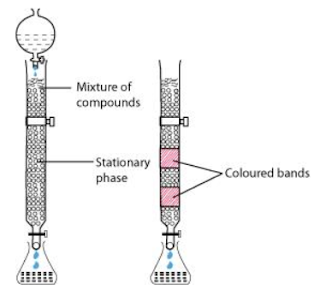
This is a very useful method of purifying elements present in minute amounts. Column chromatography is mostly used in order to take away those impurities which are not very different in chemical properties from the element which needs to be purified. This concept follows the principle various components of a mixture are adsorbed to different extents on an adsorbent.Chromatography includes two phases : mobile phase and stationary phase. This phase ( stationary ) is immiscible and immobile. A column of adsorbent e.g. Al2 O3 is used as the stationary phase. The mixture to be purified is dissolved in the mobile phase which can be a liquid, gas or supercritical fluid. This is then poured onto the top of the column. The component which is more strongly adsorbed by the adsorbent takes a greater amount of time to move through it than the component that is weakly adsorbed. This way the different components of the mixture are separated as they move through the stationary phase.
5
Answer
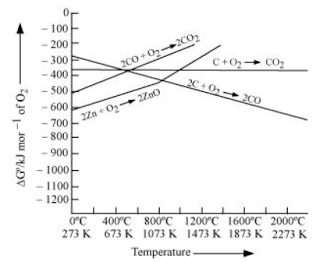
At 673 K ,CO is a more effective reducing agent because, at 673 K the value of ∆G( C,CO) is greater than the value of ∆G( CO,CO2 ), which means that CO is more easily reduced to CO2 than C to CO.6
Answer
Selenium, silver, tellurium, platinum, antimony and gold are the common elements present in the anode mud during the electrolytic refining of copper. As these metals are almost unreactive they are not affected during the purification method. Thus, they are present in the anode mud.7
Answer
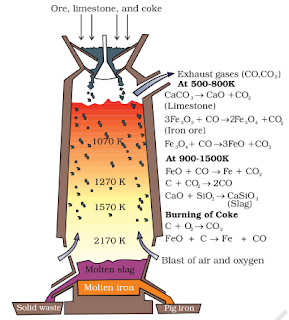
Inside a blast furnace iron oxide is reduced at different temperature ranges, as given below:
At 500 – 800 K
3Fe2O3 +CO → 2Fe3O4 + CO2
Fe2O3 +CO → 2FeO + CO2
At 850 K
Fe3O4 +CO → 3FeO + CO2
At 900 – 1500 K
FeO +CO → Fe + CO2
CO2 + C → 2CO
Above 1570 K
C+ O2 → CO2
FeO +C → Fe + CO
CaCO3(s) → CaO(s) + CO2(g)
SiO2 + CaO → CaSiO3 ( slag )
8
Answer
The various steps involved in zinc extraction are :
(1) Concentration of ore
Firstly, to remove the impurities of the ore, zinc blende is crushed and concentration is done by froth floatation.
(2) Conversion to oxide (Roasting)
In this step ZnS is roasted in excess of air in a furnace at a temperature below the melting point of zinc. This results in the formation of zinc oxide.
2ZnS + 3O2 ⇒ 2ZnO + 2SO2
(3) Extraction of Zn from ZnO (Reduction):
To extract zinc from zinc oxide it is mixed with powdered coke and then heated.
ZnO + C ⇒ Zn + CO
(4) Electrolytic Refining:
In this method, impure zinc becomes the anode while the cathode is a pure copper strip. The electrolyte is an acidic solution of zinc sulphate (ZnSO4) with dilute sulfuric acid. On passing a current, pure zinc deposits on the copper strip.
9
Answer
Copper pyrites are converted to a mixture of Cu2O and FeO during roasting. Acidic silica is added during smelting to separate the FeO from the mixture. SiO2 and FeO forms FeSiO3 ( slag )which floats on the molten matter. FeO + SiO2 ⇒ FeSiO3 (slag)10
Answer
Chromatography is a collective term used for a range of laboratory techniques for the purification, separation, characterization and identification of the species of a mixtures wether colored or colorless. The word has been obtained from two Greek words; ‘graphy’ meaning ‘to write’ and ‘chroma’ meaning ‘colour’.There are numerous chromatographic techniques like column chromatography, paper chromatography, gas chromatography, etc.11
Answer
The choice of stationary phase is done in a way that the elements of the mixture have different solubility in the phase. Thereby, different elements have different movement speed through the phase because of which they can be separated from each other.12
Answer
Mond’s process is technique used to refine nickel. In this method, heat is supplied to nickel in the presence of carbon monoxide to produce nickel tetracarbonyl, which is a volatile complex.
Ni + 4CO ⇒ Ni( CO)4 [330k – 350k]
The nickel tetracarbonyl so obtained is then decomposed by heating it at a higher temperature (450 − 470 K) to form pure nickel.
Ni( CO)4 ⇒ Ni + CO [450k – 470k]
13
Answer
Separation of alumina from silica in a bauxite ore associated with silica is as follows :
Firstly, concentrated NaOH solution is used to digest the powdered ore at 473 − 523 K and at a pressure of 35 − 36 bar. This causes alumina ( Al2O3 ) and silica ( SiO2 ) to leach as sodium aluminate and sodium silicate respectively, abandoning the impurities behind.
Al2O3 (s) + 2NaOH(aq) + 3H2O (f) ⇒ 2Na [ Al ( OH)4 ](aq)
Alumina sodium aluminate
SiO2 + 2NaOH(aq) ⇒ Na2SiO(aq) + H2O(l)
Silica Sodium silicate
Now, to neutralize the aluminate present in the solution, carbon dioxide gas is passed through the solution we obtained. This causes the sodium meta – aluminate to precipitate as hydrated alumina.
2Na [ Al ( OH)4 ](aq) + CO2 ⇒ Al2O3.xH2O(s) + 2NaHCO3(aq)
hydrated alumina
Sodium silicate cannot be precipitated so it is filtered off. The hydrated alumina is dried, heated and filtered to obtain pure alumina.
Al2O3.xH2O(s) ⇒ Al2O3(s) + xH2O( g) [1470 k]
14
Answer
Calcination is the conversion of carbonate and hydroxide ores to oxides by heating them at a temperature below their melting points and in the absence or in a very limited supply of air.
For example, carbonates of Ca, Mg, Zn are turned into their respective oxides through this process.
ZnCO3 ZnO + CO2
Fe2O3.3H2O ⇒ Fe2O3 + 3H2 [Heat]
Roasting is the conversion of sulfide ores into their metallic oxides by heating at a temperature below their melting points in excess presence of air.
For e.g, sulfide ores of Pb, and Zn are turned into their respective oxides through this process.
2Zns + 3O2 ⇒ 2ZnO + 2SO2
2Pbs + 3O2 ⇒ 2PbO + 2SO2
15
Answer
Pig iron is the iron obtained from blast furnace. It is 4% carbon and contains many other impurities like Si, P, S, Mn in lesser amounts.Cast iron is made by melting pig iron and coke with the help of a hot air blast. It has lower levels of carbon in it (3%). Unlike pig iron, cast iron is brittle and extremely hard.
16
Answer
Minerals are naturally available substances having metals or their compounds.Ores are rocks and minerals from which metals are economically and conveniently obtained.
For e.g., there are a lot of minerals that contain, but zinc cannot be conveniently and economically extracted from all of them. Zinc is extracted from calamine (ZnCO3), zinc blende (ZnS), etc. Hence, these minerals qualify as ores of zinc.
17
Answer
Copper matte has Cu2S and some FeS. So, when a hot blast of air is blown through a molten matte placed in a silica lined converter , FeS of the matte oxidizes to FeO. This FeO combines with SiO2 ( silica ) to produce FeSiO3 (slag).
2FeS + 3O2 ⇒ 2FeO + 2SO2
FeO + SiO2 ⇒ FeSiO3
When all of the iron has been removed as slag Cu2S is oxidized to Cu2O which then undergoes a reaction with Cu2S to give copper metal.
2Cu2S + 3O2 ⇒ 2CuO2 + 2SO2
2Cu2O + Cu2S ⇒ 6Cu + SO2
18
Answer
Na3AlF6 ( Cryolite ) has two basic roles:
1. The melting point of the solution is decreased from 2323 to 1140 K due to the presence of cryolite.
2. Cryolite makes alumina a good conductor of electricity.
19
Answer
When dealing with low grade copper ores, bacteria or acids are used in the presence of air to leach the copper. In this method, copper enters the solution as Cu2+ ions :
Cu + 2H+ + ½ O2 ⇒ Cu2+ + 2H2O
The solution so obtained is then treated with H2 or scrap iron to get copper metal.
Cu2+ + H2 ⇒ Cu + 2H+
20
Answer
As the standard Gibbs free energy of formation of CO to CO2 is higher than that of Zn to ZnO, CO will not be able to reduce ZnO to Zn. Thereby, zinc oxide reduction using CO isn’t used to extract zinc.21
Answer
As Cr2O3 has a higher value of formation ( −540 kJ mol−1 ) than Al2O3 ( −827 kJ/mol ), Al can thus reduce Cr2O3 to Cr.
Alternatively,
2Al + (3/2)O2 ⇒ Al2O3
2Cr + (3/2)O2 ⇒ Cr2O3
Subtracting equation (ii) from (i) , we have
2Al + Cr2O3 ⇒ Al2O3 +2Cr; ∆fGθ = -827 – ( -540 ) = -287kJ / mol
As ∆fGθ is negative for the reduction reaction of Cr2O3 by Al, the reaction can take place.
22
Answer
23
Answer
24
Answer
In Down process, chlorine is obtained as a byproduct. In this process fused mixture of CaCl2 and NaCl is electrolyzed at 873 K. Sodium is obtained the cathode and Cl2 is discharged at the anode. When an aqueous solution of NaCl is subjected to electrolysis, Cl2 is discharged at the anode. At the cathode, H2 is obtained ( in place of Na ). This is because the standard reduction potential of H2O (E° = − 0.83 V) is less negative than that of Na (E°= − 2.71 V). Thus, H2O will get a higher preference to get reduced at the cathode thereby discharging H2.NaCl ⇒ Na+ + Cl–
At cathode: 2H2O + 2e– ⇒ H2 + 2OH–
At anode: Cl– ⇒ Cl + e–
2Cl ⇒ Cl2
25
Answer
In the electrometallurgy of aluminum, the anode is graphite and the cathode iron is graphite lined .The O2 being liberated due to electrolysis reacts with the graphite anode to liberate CO2 and CO. Had it been any other metal besides graphite, the oxygen would have reacted with the aluminum during the electrolysis to form Al2O3. This would have resulted in the wastage of aluminium and as graphite is cheaper than aluminum it is expendable.This is the role of aluminum.
26
What are the principles of refining a metal by the following processes :
(a) Zone refining
(b) Electrolytic refining
(c) Vapour phase refining
Answer
(a) Zone refining :This method makes use of a principle according to which impurities are more soluble in molten metal than in a solid metal. In zone refining, a moving circular heater slowly moves over an impure metal rod/ bar. As the circular heater moves, the impurities move into the adjacent molten zone and the pure metal crystallizes out. This is repeated over several times, causing the segregation of impurities at one end of the bar. This impure end is then cut off. Boron, silicon, gallium etc. are purified this way.
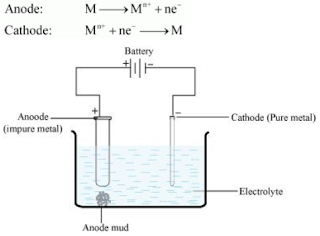
It is the refining of impure metals using electricity. In this method, the anode is the impure metal and the cathode is a thin sheet of pure metal. The electrolyte is a salt solution of the same metal.
On passing the electric current the metal ions from the electrolyte collect at the cathode as pure metal and the impure metal of the anode dissolves into the solution ( electrolyte ) in the form of ions. The impurities of the metal deposits below the anode. This is called the anode mud.
It is a method of metal refining by converting the metal into its volatile compound and then decomposing it to get the pure metal.
To achieve this:
(1) the metal should convert into a volatile compound with a reagent,
(2) the volatile compound of the metal has to be able to decompose easily so that the pure metal can be conveniently recovered.
Zirconium, titanium and nickel are refined through this method.
27
Answer
Above 1350°C, the standard Gibbs free energy of formation of Al2O3 from Al is less than that of MgO from Mg. Therefore, above 1350°C, Al can reduce MgO.