NCERT Revision Notes for Chapter 11 Transportation in Animals and Plants Class 7 Science
CBSE NCERT Revision Notes1
Answer
- Circulatory System
- Blood
- Lymph
- Blood vessels
- Heart
- Excretory system
- Transport in plants
- Excretion in plants
2
Answer

→ All multicellular organisms have a specialized system to transport nutrients and other necessary materials to the cell and the wastes away from the cell. This system is known as circulatory system.
→ Circulatory system is the transportation system of human body. It has three major parts:
(i) Blood
(ii) Blood vessel
(iii) Heart
3
Answer

→ It is a fluid connective tissue that is pumped throughout the body by heart.
Functions of Blood
→ It transports oxygen and nutrients to various parts of the body.
→ It also transports wastes for removal from the body.
Composition of Blood
→ It contains plasma, red blood cells, white blood cells, and platelets.
→ Plasma is the fluid part of blood.
→ Red blood cell contains a pigment called haemoglobin. It carries oxygen and transports it
to all parts of the body.
→ White blood cell protects body against infections. These are also known as leucocytes.
→ Platelets help in clotting of blood.
4
Answer

→ Lymph is a watery clear fluid. It is blood minus RBC.
→ This fluid distributes immune cells and other factors throughout the body.
→ It also interacts with the blood circulatory system to drain fluid from cells and tissues.
→ The lymphatic system contains immune cells called lymphocytes, which protect the body against foreign antigens (viruses, bacteria, etc.) that invade the body.
5
Answer
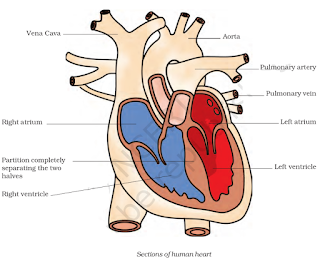
→ It pumps oxygen-rich blood to all parts of the body and carbon dioxide-rich blood to the lungs. .
→ Human heart is four chambered as shown in the figure below, and located in the chest cavity.
→ The upper two chambers are called atria while lower two chambers are called ventricles.
→ A muscular wall between the chambers prevents the mixing up of blood rich in oxygen and blood rich in carbon dioxide.
→ The rhythmic contraction and expansion of heart is the heart beat.
→ Doctors use stethoscope for listening to the heart sounds.
→ The human heart beats about 70 to 80 times per minute in an adult.
6
Blood vessels

Answer
here are three types of blood vessels:
(i) Arteries
(ii) Veins
(iii) Capillaries
Arteries
→ Arteries carry oxygen-rich blood from the heart to various organs of the body.
→ Pulmonary artery is the only artery that carries CO2-rich blood from heart to lungs.
→ The walls of arteries are thick and elastic in order to tolerate high pressure of the blood.
→ Pulse is the rhythmic contraction and expansion of arteries with each beat of heart.
→ The number of beats per minute is the pulse rate.
→ A resting person usually has a pulse rate between 72 to 80 beats per minute.
Veins
→ Veins carry CO2-rich blood from various organs towards the heart.
→ They are thin-walled, non-elastic vessels that do not possess valves.
→ Pulmonary veins carry oxygen-rich blood from lungs to heart.
Capillaries
Capillaries are thin-walled blood vessels. They connect arteries with veins.
7
Answer
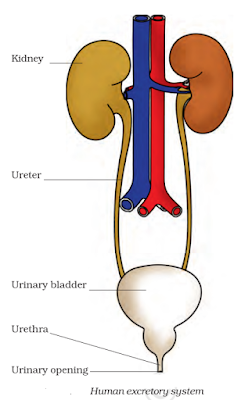
→ The organ system that performs the function of excretion is known as the excretory system.
Excretion
→ It is the process of removing harmful waste products produced in the cells of living organisms.
→ The excretory system in humans includes – a pair of kidneys, a pair of ureters, a urinary
bladder and a urethra.
Kidney
→ It is the main excretory organ of the human body.
→ It plays an important role in the formation of urine. Human kidney produces about 1 – 1.8L of urine in a day.
→ The urine consists of 95% water, 2.5% urea and 2.5% other waste products.
→ Nephrons are the basic filtering units of the kidneys.
→ The main components of a nephron are the glomerulus, Bowman’s capsule, and a long renal tube.
→ Ureter carries urine to the bladder.
→ Urinary bladder collects and stores urine.
→ Urethra carries urine out of the body.
→ Dialysis- The process of removing wastes using an artificial kidney is called dialysis.
8
Answer

→ Plants have specialized vascular tissues called xylem and phloem for the transport of water, minerals and food respectively to all parts.
Transport of Water in Plants
→ Plant roots have hair that increase the surface area for absorption of water and minerals.
→ Root hair are deficient in water as they continuously supply the absorbed water to the stems and leaves.
→ This creates a concentration gradient, which allows the active uptake of water by the root xylem thereby creating a column of water, which steadily pushes upwards.
9
Answer
→ Leaves prepare food for plant by the process called photosynthesis.
→ The prepared food is transported to remaining parts of the plants by a specialized vascular tissue known as phloem.
→ The phloem forms a network of channels that transports food to the stem and to the roots of the plant.
10
Answer

→ Plants get rid of the excess of water by transpiration.
→ In transpiration water evaporates into the atmosphere through stomata.
→ Stomata are the tiny openings or pores on the surface of leaves which help in the gaseous exchange and transpiration.