NCERT Revision Notes for Chapter 9 Soil Class 7 Science
CBSE NCERT Revision Notes1
Answer
- Introduction
- Soil Profile
- Soil Types and Its Classification
- Properties of Soil
- Soil and Crop
- Basic Crop production Practices
- Factors leading to Soil Pollution
2
Answer

→ Soil is a naturally occurring substance that is valuable in sustaining life on earth.
• Humus: It is a component of soil that is formed from the dead and decayed organic matter.
• Weathering: It is the process of formation of soil by breaking down of rocks. It occurs by the action of wind, water, and climate.
Note:- → Living organisms such as microbes, earthworm, and plant roots are found in soil.
3
Answer
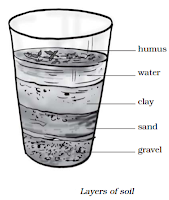
→ It is a vertical section through various layers of soil. These various layers are known as horizons.
• There are four types of horizons.
(i) A-horizon or topsoil: It is the top most soil, which is dark in colour and rich in humus. It is soft, porous, and has the ability to retain water.
(ii) B-horizon: It is the middle next layer of the soil profile. It has lesser humus and more minerals. The layer is harder and more compact.
(iii) C-horizon: It is the third layer made up of small lumps of rocks with cracks and crevices.
(iv) Bedrock: It is the lowermost hard layer and difficult to dig with a spade.
4
Answer

Soil Types
→ Soil is a mixture of rock particles and humus.
• Soil → Rock particle + Humus
→ Living organisms such as microbes, earthworm, and plant roots are found in soil.
Classification of soil
(i) Sandy soil
→ Sand particles are large that cannot fit together.
→ Larger spaces are present between particles.
→ It is light, well aerated, and dry.
(ii) Clayey soil
→ Clay particles are smaller and tightly packed together.
→ It has little space for air and can hold water between particles.
(iii) Loamy soil
→ It is the best top soil for the growth of plants.
→ It is the mixture of sand, clay, and silt.
→ It contains humus and has the right water holding capacity.
→ Toys, pots, and statues are made up of clayey soil.
5
Answer
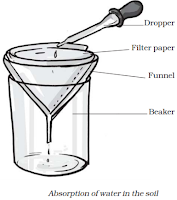
• percolation rate (mL/min) = amount of water (mL)/percolation time (min)
→ Percolation rate of water is highest in sandy soil and least in clayey soil.
→ The soil moisture and water absorption capacity of soil also varies among different soil types.
→ Loamy soil has the maximum accurate water holding capacity while sandy soil has the least.
→ Climatic factors such as wind, rainfall, temperature, light, and humidity affect the soil.
6
Answer
Crops Grown | Soil Types |
Wheat and gram | Clayey and loamy |
Paddy | Clayey soil |
Lentils (masoor) and other pulses | Loamy soil |
Cotton | Sandy-loam or loamy soil |
→ The soil capacity to hold water is important for the cultivation of various crops.
Crop
→ When same kinds of plants are cultivated on a large scale, it is called a crop.
It is of two types.
(i) Kharif crops
Crops that are sown in rainy season (June to September)
Examples – soyabean, paddy, maize
(ii) Rabi crops
Crops that are grown during winter season (October to March)
Examples – wheat, gram, pea
7
Answer
Preparation of soil
Sowing
Adding manure and fertilizers
Irrigation
Protection from weeds (weeding)
Harvesting
Storage
Food items | Nutrients |
Pulses such as gram (chana), black gram, green gram (moong) peas, pigeon pea (arhar) lentil (masoor), etc. | Proteins |
Soya bean, ground nuts, sesame, castor, mustard, sunflower, etc. | Fats or lipids |
Vegetables, spices, fruits | Vitamins and Minerals |
8
Answer

Various human activities and products pollute the soil. These pollutants destroy the fertility of the soil and harm the organisms living in the soil.
Some of the important soil pollutants are given below.
→ Polythene bags
→ Plastic products
→ Chemicals
→ Pesticides
• The preventive measures that can be adopted to reduce soil pollution are as follows.
→ Treating the waste products before disposal
→ Reducing the use of polythene bags
→ Minimizing the use of products made of plastic
→ Minimizing the use of pesticides
→ Plastic particles and polythene bags are banned to avoid soil pollution.