NCERT Revision Notes for Chapter 3 Reproductive Health Class 12 Biology
CBSE NCERT Revision Notes1
Answer
Reproductive Health: The complete well-being with respect to all aspects of reproduction like physical, emotional, behavioural and social. A society with people having physically and functionally normal reproductive organs as well as normal interactions with respect to behaviour and emotion among them is reproductively healthy.2
Answer
• Family planning measures were initiated in 1951 in India. The goal was to attain total reproductive health. These measures were periodically evaluated.
• Reproductive and Child Health Care (RCH) Programs are being operated with the aim of creating awareness among people about various reproduction related aspects and providing facilities and support for building a reproductively healthy society.
3
Answer
• Governmental and non-governmental agencies should use media-both print and audio-visual, to create awareness programs
• Responsible adults, parents, teachers, close relatives and friends should provide correct information and be willing to open dialogues with young adults and children to sensitise them about reproductive health
• Introduction of sex education in schools and colleges
• Create awareness about Sexually Transmitted Diseases or STDs.
• Educating people, especially fertile couples and marriageable individuals about birth control options, pre and post-natal care, infant and child care, importance of breast feeding, equal opportunities for males and females, will help in bringing up socially conscious and healthy families of desired size.
• Create awareness about problems of population explosion, sex abuse and sex related crimes.
• Provision and availability of strong infrastructural facilities, professional expertise and material support for successful implementation of health plans. These also help in providing medical facilities and care to people with reproduction related problems.
• Implementation of newer, better and upgraded facilities with respect to reproductive health
• Complete ban on foetal sex determination to check female foeticide.
•Large scale child immunization programs
For decreased maternal and infant mortality rates there should be:
• Better awareness of sex-related matters
• Increase in medically assisted deliveries
• Better post-natal care leads.
Improved reproductive health of the society is indicated by:
• Smaller families,
• Better detection and cure for STDs
• Overall increased medical facilities.
4
Answer
Population Explosion: The rapid growth of population of a particular species, specifically of the humans in the world since the end of World War II. This can be attributed to a constantly increasing birth rate, a decrease in child and infant mortality, and an increase in life expectancy. This will lead to increased stress on all resources.
Causes:
- Rapidly declining death rate
- Rapidly declining maternal mortality rate (MMR)
- Rapidly declining infant mortality rate (IMR)
- Increased life expectancy
- Increase in number of people in reproducible age
Methods to Control Population Explosion:
- Promote smaller families
- Promote use of contraceptive methods
- Raise the legal age for marriage (18 years for females and 21 years for males)
- Incentivise couples with smaller families.
Ideal Contraceptive:
- Should be easy to use
- Should be easily available
- Should be effective
- Should not have side effects
- Should be reversible
- Should not interfere with the sexual drive, desire or act of the individual
5
Answer
1. Natural or Traditional
2. Barrier Methods
3. Intra-uterine devices (IUDs)
4. Oral contraceptives
5. Injectable and implants
6. Surgical Methods
6
Answer
It works on the principle of avoiding the chances of sperm and egg meeting.
• Periodic Abstinence: In this method couples avoid coitus between 10th and 17th day of the menstrual cycle as during this period the chance of ovulation is maximum. Therefore, abstaining from coitus during this fertile period decreases the chance of pregnancy
• Withdrawal or Coitus interruptus: In this method the male withdraws the penis from the vagina during coitus just before ejaculation. Therefore, he prevents the release of semen and thus prevents insemination.
• Lactational amenorrhea: This is the period of absence of menstruation during the period of lactation. As there is no menstruation it is believed that during this period there is no ovulation and therefore decreased chances of pregnancy. However, this method is effective only up to six months after parturition during the period of intense lactation.
As no chemicals are used the chances of side effects are nil. However, success of contraception is also limited and therefore, chances of failure of contraception are also high.
7
Answer
In this method sperms and ovum are physically prevented from meeting with the help of barriers.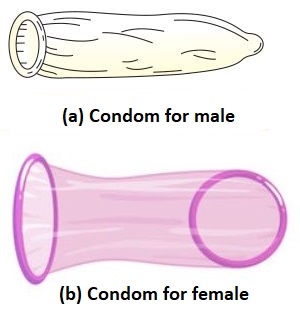
• Condoms: Barriers made of thin rubber or latex sheath that cover the penis in males and the cervix in females. Both male and female condoms are disposable.
• As use of condoms prevents contact of genital fluids it also helps in preventing STDs
• Reusable barriers like diaphragms, cervical caps and vaults are inserted into the female cervix during coitus to prevent the entry of sperms through the cervix.
• Spermicidal creams, jellies and foams are used with these barriers to increase the efficiency of these methods.
8
Answer
These devices are inserted into the uterus by doctors or expert nurses through the vagina.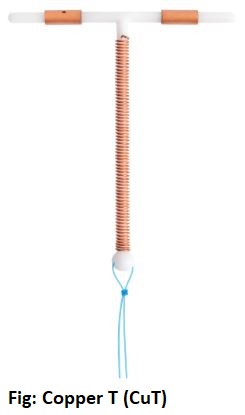
• Non-medicated IUDs like Lippes Hoopes increase phagocytosis of sperms
• Copper releasing IUDs like Copper-T, Copper-7, Multiload 375 decrease motility of sperms
• IUDs that release hormone like Progestasert, LNG-20 make the uterus unsuitable for implantation. They also make the cervix hostile to sperms.
These devices are ideal contraceptives for the females for family planning and are among the most widely used methods of contraception.
9
Answer
This involves the oral administration of progestogens or progesterone-oestrogen combinations in the form of pills. They are used by females for a period of 21 days starting within the first five days of the menstrual cycle.
After a gap of 7 days (during which menstruation occurs) the cycle is repeated until the female wishes to conceive.
Newer pills like Saheli are once a week non-steroidal pills with lesser side effects These pills work by inhibiting ovulation and implantation as well as altering the quality of cervical mucus to retard or prevent the entry of sperms.
10
Answer
Progesterone alone or in combination with oestrogens can be used by females as injections or implants under the skin. Such injectables and implants are functionally similar to pills and their effective period is much longer.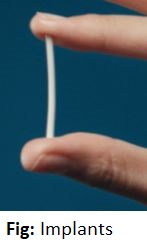
11
Answer
Surgical intervention functions by blocking the transport of gametes and thereby prevent conception. They are terminal methods of contraception and are therefore also called as sterilisation. Sterilisation in males is called as vasectomy and in females is called as tubectomy.
• Vasectomy: Vas deferens is tied up or removed through a small incision in the scrotum
• Tubectomy: A small part of the fallopian tube is tied up or removed through a small incision in the abdomen or the vagina.
These methods are highly effective but their reversibility is very poor.
Contraceptive methods help in checking population explosion. However different methods of contraception may also have some side effects like nausea, abdominal pain, breakthrough bleeding, irregular menstruation, breast cancer, etc.
12
Answer
Termination of pregnancy before the completion of full term intentionally or voluntarily is called medical termination of pregnancy (MTP) or induced abortion. MTP has a significant role in decreasing population though it is not meant for that purpose. The Government of India legalised MTP in 1971 with some strict provisions to prevent its misuse.
Why MTP?
- To prevent unwanted pregnancies
- In cases where continuation of pregnancy is harmful or even fatal to the mother or foetus or both. MTPs are safe in the first trimester. However MTPs during the second trimester are riskier.
A dangerous trend is that MTPs are performed by quacks or unqualified doctors which may turn fatal for mother. Also use of amniocentesis or other methods of pre-natal sex determination may lead to female foeticide as the preference for male child is very high.
13
Answer
Diseases or infections of the reproductive tract which are transmitted through sexual activities and intercourse are called sexually transmitted diseases (STD) or venereal diseases (VD) or reproductive tract infections (RTI).
Gonorrhoea, syphilis, genital herpes, chlamydiasis, genital warts, trichomoniasis, hepatitis-B, HIV leading to AIDS are some of the common STDs. Among these, HIV infection is most dangerous.
Hepatitis-b and HIV can also be transmitted by sharing of injections or surgical implements with infected persons, transfusion of infected blood, transmission from infected mother to foetus, etc.
Except for Hepatitis-B, genital herpes and HIV infections, other STDs are curable if detected early.
Some common symptoms for STDs include itching, fluid discharge, slight pain, swellings, etc.
Individuals may remain asymptomatic for a long time. This coupled with the stigma associated with STDs are the major reasons many STDs remain undetected.
This could lead to complications later, which include pelvic inflammatory diseases (PID), abortions, still births, ectopic pregnancies, infertility or even cancer of the reproductive tract. STDs are a major threat to attaining a healthy society. Hence prevention along with early detection and cure of these diseases are given prime importance under reproductive health-care programmes.
14
Answer
• Avoid sex with unknown/multiple partners
• Always use condoms during coitus
• If in doubt, go to a qualified doctor for early detection and treatment for diseases.
15
Answer
Infertility is the inability to produce children in spite of unprotected sexual co-habitation.
Reasons could be physical, congenital, diseases, drugs, immunological or even psychological.
Often female is blamed for being childless but the fault could more often than not lie with the male as well.
Specialised health care units like infertility clinics could help in corrective treatment of some of these disorders.
In case corrective treatments are not possible couples could be helped with Assisted Reproductive Technology (ART).
- In vitro Fertilisation (IVF): This involves fertilisation of gametes outside the body in conditions that mimic body conditions. The fertilised zygote is then induced to divide to form the embryo. The embryo is then transferred in to the uterus of the female.
- Zygote Intra Fallopian Transfer (ZIFT): The zygote or early embryo (up to 8 blastomeres) can be transferred into the fallopian tube of the female.
- Intra-Uterine Transfer (IUT): Embryos with more than 8 blastomeres can be transferred directly into the uterus
- Gamete Intra Fallopian Transfer (GIFT): The ovum from the donor is collected and transferred into another female who cannot produce one but can provide conditions for fertilisation and further development.
- Intra cytoplasmic sperm injection (ICSI) is a specialised procedure that forms an embryo in the laboratory by directly injecting a sperm into the ovum.
- Artificial insemination (AI) technique: In this technique, the semen collected either from the husband or a healthy donor is artificially introduced either into the vagina or into the uterus (IUI – intra-uterine insemination) of the female.
All these methods require certified experts handling the procedures with high precision. They also need expensive instrumentation. Legal adoption is another good method for couples looking for parenthood.