NCERT Revision Notes for Chapter 4 Principles of Inheritance and Variation Class 12 Biology
CBSE NCERT Revision Notes1
Answer
Heredity is a process of transmission of traits from parents to their offspring’s either via asexual reproduction or sexual reproduction. These characteristics or traits are located on the chromosomes in the form of genes.
Gregor Johann Mendel is known as- “Father of genetics”. He proposed 3 main laws which are known as Mendel’s laws.
2
Answer
Mendel’s perform a set of experiment on Garden pea using seven contrasting characters. He selected the characters that has two opposing traits. He conducted these hybridization experiment on 14 true-breeding pea plant varieties.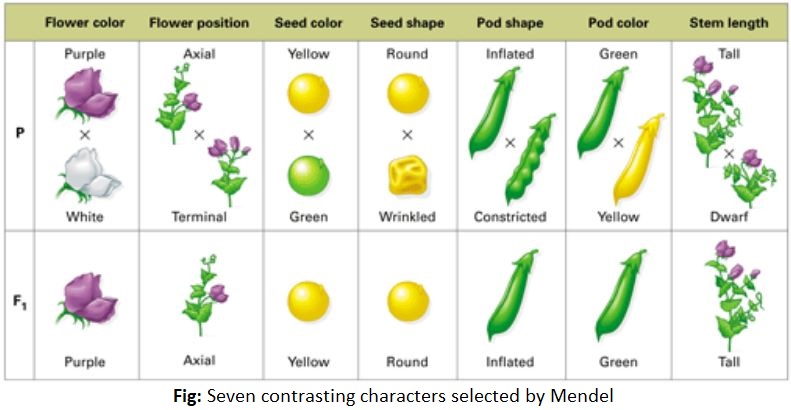
3
Answer
There were 3 laws that were proposed by Mendel-
1 Law of dominance- The dominant allele masks the effect of recessive allele. Only dominant allele expresses its phenotype.
For example: “Allele for tallness is dominant over allele for dwarfism”.
2 Law of segregation of genes- Individuals possesses two alleles of a gene and each allele separates or segregates at the time of meiosis, that is, during the formation of gametes. The monohybrid cross for flower colour in the given figure explains how segregation of gametes occurs.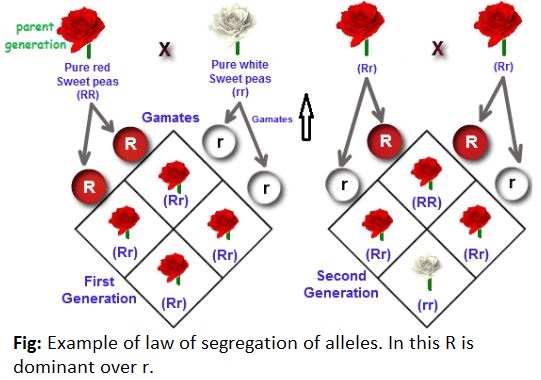
3 Law of independent assortment– It states that alleles for separate traits are passed independently from parents to the offspring. Mendel used dihybrid (cross of two different traits) cross in order to explain independent assortment.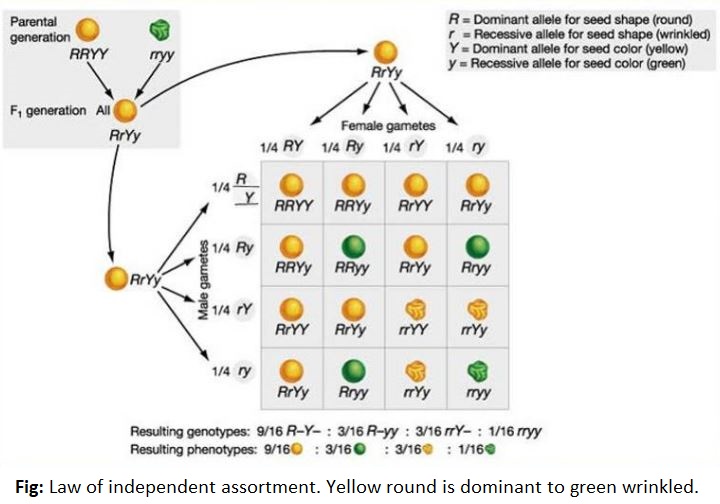
4
Answer
Inheritance of one gene can be explained using Mendel one of the hybridization experiment such as crossing between tall and dwarf plants. When the tall and dwarf plants are crossed, the resulting first hybrid generation is known as Filial progeny or first-generation progeny. Mendel observed that all the plants formed are tall. Then the F1 plants were self-pollinated and produce F2 generation. The progeny obtained has three tall plants and one dwarf. The resulting ratio is 3:1.5
Answer
When the dominant allele is not completely dominant over recessive allele and the F1 hybrid forms are intermediate of the two parents, the phenomenon is called incomplete dominance. The figure given below explains when red flowers (dominant) were crossed with white flowers (recessive), the F1 generation contain flowers which are pink in colour (intermediate).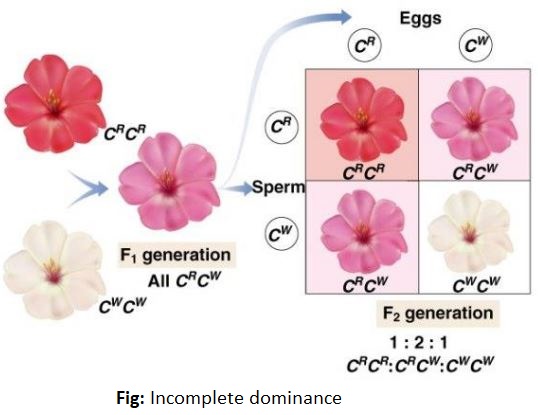
For example: Flower color in Mirabilis jalapa, (4’O clock plant). The phenotypic and the genotypic ratio observed is 1:2:1.
6
Answer
When a gene exists in more than two allelic forms, the phenomenon is known as multiple allelism.
For example: “multiple alleles are the inheritance of A, B and O blood groups in human being”. The gene for blood group occurs in three allelic forms IA, IB and i. An individual can possess any two of these alleles. The gene IA codes for glycoprotein A which is responsible for A blood group and gene IB codes for glycoprotein B which is responsible for blood group B.
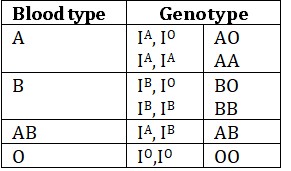
The gene ‘i’ do not produce any glycoprotein and so the person who is homozygous for it, will have O group blood. The genes IA and IB are dominant over ‘i’. IA and IB alleles are equally dominant and produce both glycoproteins A and B and the blood group is AB. Such alleles are known as co-dominant alleles.
7
Answer
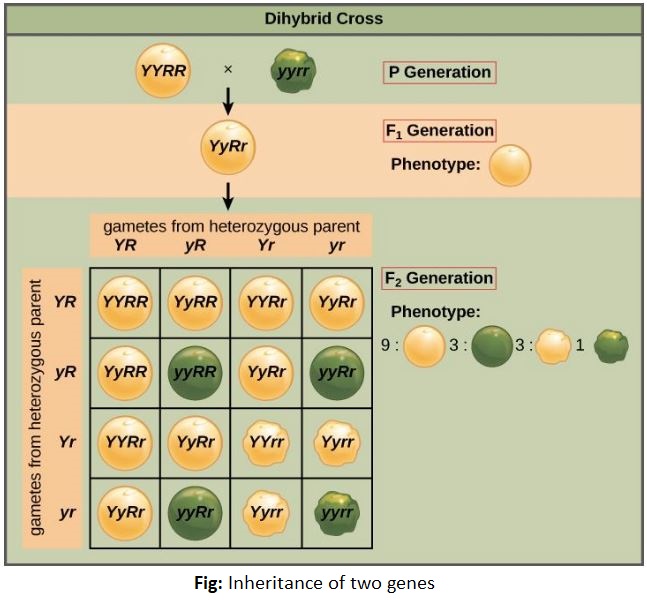
Mendel also worked with pea plants that differ in two characters. He had chosen the colour and the shape of the seed to explain the inheritance of two genes. Y represents the dominant yellow colour seed colour, y represents recessive green colour. R represents round shape of the seed, r represents the wrinkled shape of the seed. The genotype of the parents can then be written as RRYY and rryy. The gametes RY and ry unite on fertilization to produce the F1 hybrid RrYy. Inheritance of two genes was also used to explain the Law of Independent Assortment. Based on the crosses, the F2 ratio was found to be 9:3:3:1.
8
Answer
Chromosomal theory of inheritance is also known as Boveri-Sutton chromosome theory. According to this theory-
- Genes are located at specific locations on the chromosomes.
- Homologous chromosomes separate during meiosis.
- Fertilization restores chromosome number to diploid condition.
- Chromosomes segregate as well as assort independently.
9
Answer
T.H. Morgan conducted different experiments to understand the process of linkage and recombination. He carried out several dihybrid crosses in Drosophila to study genes that were sex-linked. For example, Morgan hybridized yellow-bodied, White-eyed females to brown-bodied, red-eyed males and intercrossed those F1 progeny. He observed that the two genes did not segregate independently of each other and the F2 ratio deviated very significantly from the 9:3:3:1 ratio (expected when the two genes are independent). This leads to the conclusion, that genes are linked. Such genes which are physically linked, this process is known as linkage.
Recombination is defined as rearrangement of genetic material, for example by crossing over is known as recombination.
It is responsible for the formation of recombinants (progeny formed by the combination of two parents). It is responsible for the variation.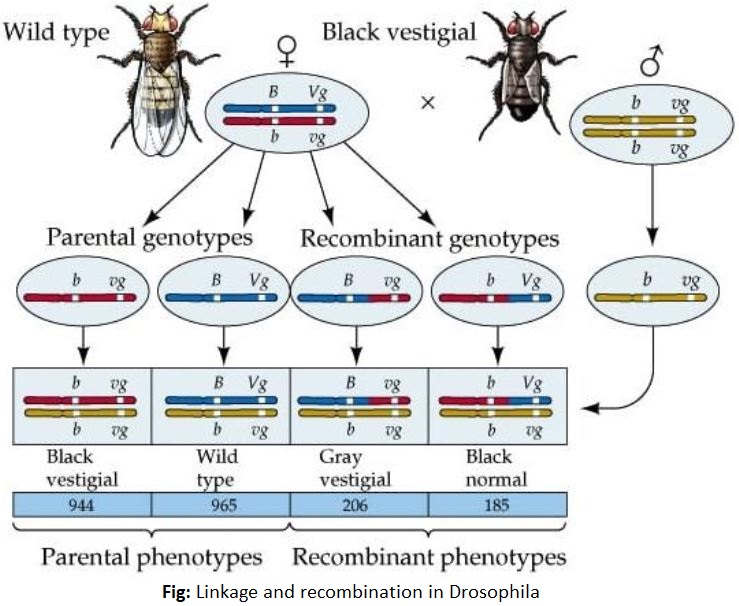
10
Answer
Sex determination is a system that determines the development of sexual characteristics in an organism. Different organism has different types of sex determination. In insects, the mechanism of sex determination is of XO type. In this, eggs have X chromosomes, but sperms may have one X chromosome, some do not have any X chromosome. As X chromosome is determining the sex of an individuals, X chromosome is known as sex chromosomes. Chromosomes other than the sex chromosome is known as autosomes. Mammals including man has XX-XY type of sex determination. Females carry X chromosomes in their eggs whereas males have either X chromosomes or Y chromosomes. That is why females are said to be homogametic (same type of gametes) and males to be heterogametic (different types of gametes).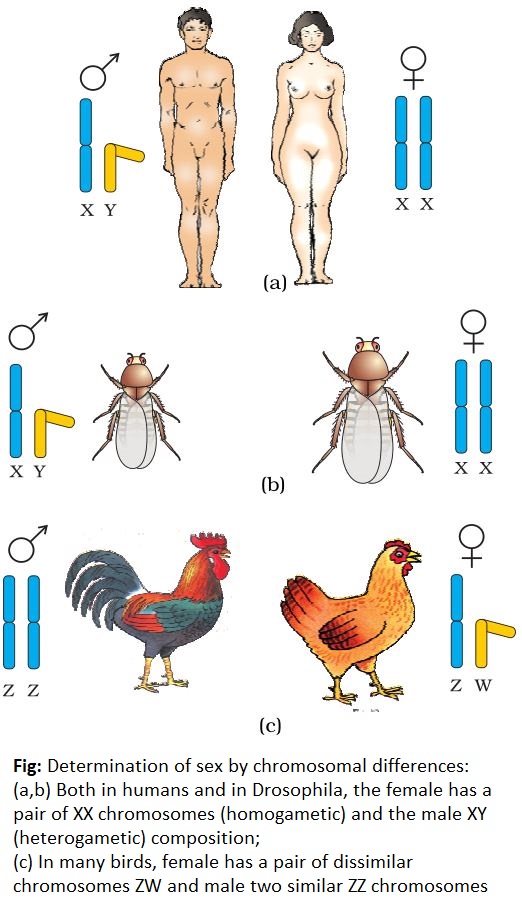
11
Answer
Any change in the DNA sequence is known as mutation. It causes a heritable change in the DNA. The genotype as well as phenotype will be affected due to mutation. There are different types of mutation such as frameshift mutations, deletions, insertions, substitutions, duplications, etc. Some mutations are harmful, but some are not harmful.
- Frameshift mutations causes loss or addition of DNA bases which changes the reading frame.
- Addition of DNA bases is known as insertions.
- Removal of DNA bases is known as deletions.
- A piece of DNA, if copied more than one time is known as duplications.
Thus, these mutations change the DNA sequence which ultimately leads to the formation of wrong protein.
12
Answer
1. Pedigree analysis
Charts used to understand the inheritance pattern in a family, is known as pedigree. It is also used to find out the genetic disorders in the family also. All the family members are mapped in the form of a tree.
2. Mendelian disorders
Genetic disorders are grouped into two categories- Mendelian disorders and chromosomal disorders. Mendelian disorders are based on alteration or mutation in the single gene. Most common of these are Hemophilia, Cystic fibrosis, Sickle-cell anemia, Color blindness, Phenylketonuria, Thalassemia, etc. Such Mendelian disorders can be dominant or recessive. Trait can also be linked to sex chromosome, such as hemophilia and color blindness.
3. Chromosomal disorders
When disorders are caused due to absence or excess or abnormal arrangement of one or more chromosomes. Improper segregation of chromatids during cell division cycle results in the gain or loss of a chromosome(s), called aneuploidy. For example, Down’s syndrome results in the gain of extra copy of chromosome 21. Similarly, Turner’s syndrome results due to loss of an X chromosome in human females. Absence of cytokinesis after telophase stage of cell division results in an increase in a whole set of chromosomes in an organism and, this phenomenon is known as polyploidy. This condition is often seen in plants.