NCERT Revision Notes for Chapter 3 Plant Kingdom Class 11 Biology
CBSE NCERT Revision Notes1
Answer
Whittaker classified the whole living organism into five kingdoms based on the complexity of cell structure (Prokaryotic and Eukaryotic), complexity of body (unicellular and multicellular) and mode of nutrition (autotrophs and heterotrophs).
Classification of plant kingdom:
All the classification system, starting from that of Aristotle to the 20th century, can be divided into three types- Artificial, Natural and Phylogenetic.
- Artificial system: Classification based on few morphological characters.
Theophrastus, Pliny and Linnaeus used artificial system of classification. - Natural system: Classification based on all the important related characters. Both external and internal.
Bentham and hooker, Adanson, Candolle used natural system of classification. - Phylogenetic system: Classification based on evolutionary relationship of plants.
Eichler, Blessy, Whittaker, Engler and Prantl, Hutchinson used phylogeny.
Numerical taxonomy: Taxonomy based on statistical methods with equal importance using computer.
Cytotaxonomy: Taxonomy based on cytology or cell structure (chromosome number, shape, behaviour etc).
Chemotaxonomy: Taxonomy based on chemical constituents of plants (nature of protein, DNA sequence, taste, smell etc).
2
Answer
Based on flowering, divided into two- Cryptogamae (non-flowering, seedless plants) and Phanerogamae (flowering, seed bearing plants).
Based on plant body, Cryptogamae divided into Thallophyta, Bryophyta and Pteridophyta.
Thallophyta: Plant body is thallus like (undifferentiated plant body)
Bryophyta: plant body with root like structure, stem like structure, vascular tissues are absent).
Pteridophyta: Plant body is differentiated into true root, stem and leaves. Vascular tissues are present so called vascular cryptogams.
Thallophytes again divided into
- Algae (pigmented thallophytes)
- Fungi (nonpigmented thallophytes)
- Lichens: Symbiotic association between algae and fungi.
Phanerogamae divided into:
- Gymonosperma (naked seed plants) and
- Angiosperma (covered seeded plants)
Angiosperms are again divided into:
- Monocots (have single cotyledon, fibrous root system and parallel venation)
- Dicots (have two cotyledons, tap root system and reticulate venation).
Pteridophytes, Gymnosperms and Angiosperms are called Tracheophytes due to the presence of vascular tissue.
Bryophyta, Pteridophyta, Gymnosperms and Angiosperms are called Embryophyta as they have embryo.
3
Answer
Phycology: Branch of Biology which deals with the study of algae.
- Phycos = sea weed
- Logos = study
Fritch is the father of phycology. M.O.P. Iyengar is the father of Indian phycology.
Algal members are pigmented thallophytes.

Habitat
- Hydrophytes- Water is their habitat
- Xerophytes: In desert habitat
- Mesophytes- in medium habitat
- Epiphytes-on plants
- Lithophytes- on rocks
- Halophytes- in salty areas.
- In aquatic habitat-fresh water (Spirogyra) and marine (Sargassum).
- Floating- Chlamydomonas, Spirogyra
- Benthophytes - (attached to the bottom) –Chara (stone worts)
- Epiphyte-growing on plant body (Cladophora)
- Epizoic-growing on animal body (Trichophillus)
- Moist soil-terrestrials (Fritschiella).
4
Answer
The vegetative plant body is a haploid gametophyte. Unicellular, flagellated (Chlamydomonas) or non-flagellated (Chlorella).
Multicellular:
(a) Coenobium-a colony with fixed number of cells and division of labour. Eg: Volvox
(b) Aggregation-indefinite colony. Eg: Tetraspora
(c) Filamentous-unbranched .Eg: Ulothrix
(d) Filamentous branched. Eg: Cladophora
(e) Siphonous- multinucleate. Eg: Vaucheria
(f) Parenchymatous. Eg: Ulva
(g) Branched like higher plants. Eg: Sargassum, Chara
Nutrition:
- Autotrophs - Photosynthetic (most of them)
- Parasitic forms (rare) - Eg: Cephaleuros.
Pigments:
- Chlorophyll- a, b, c, d.
- Carotenoids- carotene and xanthophyll-fucoxanthin (dominating pigment in brown algae).
- Phycobillins- phycocyanin and phycoerythrin.
Reproduction:
Vegetative reproduction- Reproduction using the vegetative parts.
Different types are:
- Fission
- Fragmentation
- Budding
- Tubers
Asexual reproduction- without the fusion of gametes.
- Zoospores within sporangia
- Aplanospores
- Akinete
- Hypnospores
- Endospore
- Exospore
- Monospore
Palmella stage-spores become colonial and appear like the algae named Palmella. Eg: Ulothrix, Chlamydomonas.
Sexual reproduction:
- Homogametes-similar gametes
- Heterogametes-dissimilar gametes
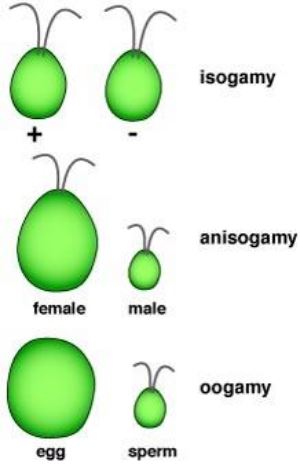
- Isogamy: fusion of morphologically and physiologically similar gametes. Flagellated (Chlamydomonas ) and nonflagellated (Spirogyra).
- Anisogamy: fusion of morphologically or physiologically dissimilar gametes.
Morphologically dissimilar–eg: Chlamydomonas
Physiologically dissimilar –eg: Spirogyra. - Oogamy- fusion of morphologically and physiologically dissimilar gametes. Small motile male gamete + large nonmotile female gamete. Eg: Fucus, Volvox.
Exceptional cases:
Unicellular antheridium and oogonium .Eg: Oedogonium.
Special reproductive structures:
Conceptacles –Eg: Sargassum
Globule (antheridium) and nucule (oogonium) Eg: Chara
Spirogyra has a special type of sexual reproduction called conjugation.
The life cycle has two phases -haploid and diploid and some of them exhibit alternation of generation. The haploid phase alternates with the diploid phase.
Classification of algae:
- Chlorophyceae
- Phaeophyceae
5
Answer
The plant body is unicellular as in Chlamydomonas or colonial as in Volvox or filamentous as in Spirogyra.
Different shapes for the chloroplast:
- Ribbon shaped and spiral in Spirogyra
- Girdle shaped in Ulothrix
- Cup shaped chloroplast in Chlamydomonas
- Star shaped in Zygnema
- Disc shaped in Caulerpa
- Reticulate in Oedogonium.
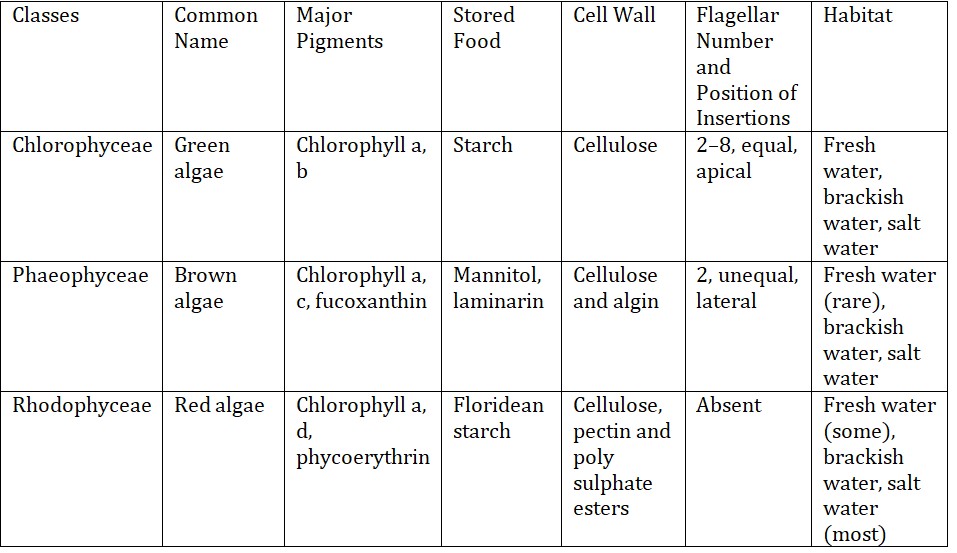
Photosynthetic pigments are chlorophyll a and b. Store food in the form of starch and some store in the form of oil droplets. Pyrenoids which are the storage bodies are present.
Cell wall is made up of an inner layer of cellulose and an outer layer of pectose.
The members reproduce:
- Vegetatively by fragmentation
- Asexually by flagellated zoospores
- Sexually by isogamy, anisogamy and oogamy.
Common Chlorophycean members are Chlamydomonas, Chlorella, Volvox, Ulothrix, Ulva, Caulrepa, Chara, Acetabularia etc.
6
Answer
They are marine. Simple, branched and filamentous as in Ectocarpus, or flat ribbon shaped in Sargassum, Laminaria, Fucus etc.
Kelps which are the giant brown algae are the largest sea plants, some are free floating as in Sargassum and some are epiphytes on other plants like Ectocarpus.
Plant body has three parts:
- fixing structures called hold fast
- stalk like structure called stipe
- leaf like structure called frond
Pigments are chlorophyll a, c, carotenoids and xanthophylls.
Food is stored in the form of laminarin and mannitol which are complex carbohydrates.
Cell wall is made up of cellulose and is covered by a gelatinous coating called algin on the outer part which is a phycocolloid (hydrocolloid) and they prevents the thallus from drying in low tide.
Cell consists of cell organelles and centrally is the vacuole which helps the thallus to float.
Vegetative reproduction is by Fragmentation:
Asexual by biflagellated zoospores which are pear shaped with two flagella attached laterally.
Sexual reproduction is by the fusion of gametes-
- Isogamy
- Anisogamy
- Oogamy
Gametes are pear shaped with 2 laterally attached flagella.
The common brown algae are Ectocarpus, Laminaria,Dictyota, Sargassum and Fucus.
7
Answer
Commonly called as red algae.
They are mostly marine and rarely fresh water. Eg: Betrachospermum.
They occur in well lighted region and also in depths of oceans.
The thallus is multicellular.
Pigments present are chlorophyll a, d and phycoerythrin.
Red colour is due to the presence of red pigment called r-phycoerythrin.
Food is stored in the form of floridean starch which is similar to amylopectin and glycogen in structure.
8
Answer
Vegetative reproduction by fragmentation
Asexual by nonmotile spores
Sexual by Oogamy and has complex post fertilization developments.
The common red algae are Polysiphonia, Porphyra, Gracilaria, Gelidium, Betrachospermum etc.
9
Answer
• Algae are the primary producers in the food chain. They form the basis of the food cycles of all aquatic animals. Half of the total carbon dioxide fixation on earth is carried out by algae by photosynthesis. Helps in purification of air and water.
- Some are edible. Eg- Chlorella, Spirulina, Laminaria, Porphyra, Sargassum, Ulva
- Some are used as fodder. Eg; Laminaria, Sargassum, Fucus.
• Food supplement for space travellers like Chlorella, Spirulina,
• Hydrocolloids or water holding substances like algin and carrageen are obtained from red algae.
• Agar is obtained by Gelidium and Gracilaria. It is used to grow microorganisms.
• Used in the preparation of culture media in tissue culture experiments.
• Medicinal- Antibiotics: Chlorella, Polysiphonia.
• Source of minerals: Polysiphonia, Laminaria
• Biological research: Chlorella, Acetabularia.
• Common names of algae:
- Water silk-Spirogyra
- Sea lettuce- Ulva
- Umbrella plant-Acetabularia ( Largest unicellular algae)
10
Answer
Simplest non vascular land plants with undifferentiated plant body.
- Bryology- Study of Bryophyta
- Hedwig- Father of bryology
- R.Kashyap-Father of Indian bryology
Bryophytes are known as the amphibians of the plant kingdom.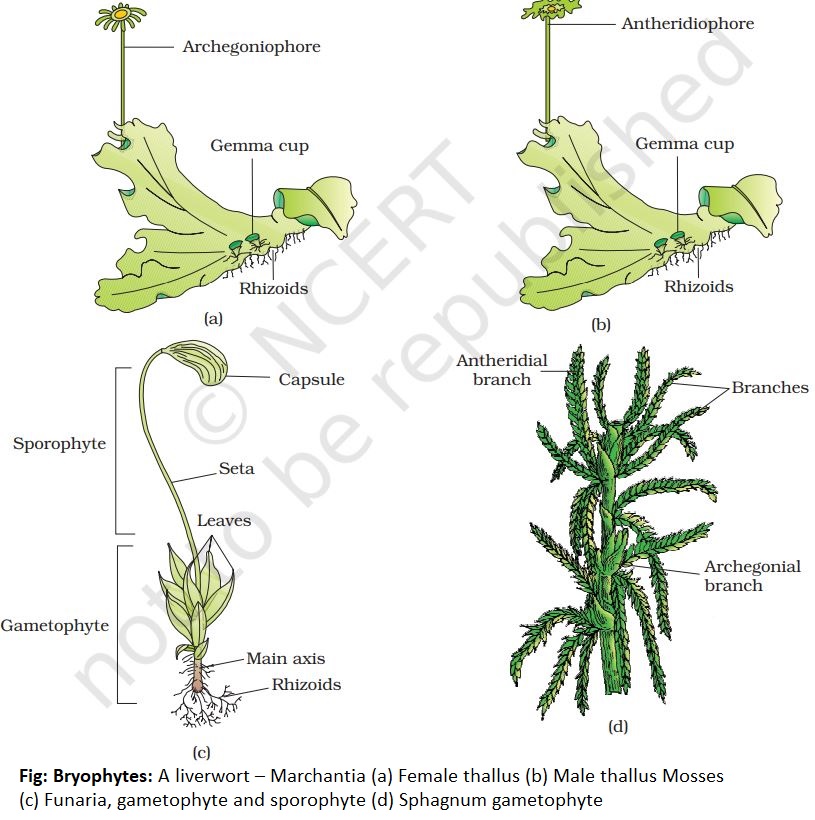
Bryophytes grows in dense patches on the moist shady places like walls, damp soil, tree trunks etc.
Features:
- Habitat: Mainly terrestrial
- Some are aquatic. E.g- Riccia fluitans
- E.g: Radula
- Plant body, Thallus like and Prostrate. Eg: Riccia, Anthoceros, Marchantia or
- Eg- Moss.
- Root like structures called rhizoids fix them to the soil.
- Plant body is differentiated into stem like and leaf like structures.
- Vascular tissues are absent.
- Vegetative reproduction by fragmentation, budding, tubers etc.
Asexual by Gemmae- asexual buds in liver worts.
Sexual reproduction-The vegetative plant body is the gametophyte and all members are homosporous.
Multicellular sex organs present and are found in clusters.
Male reproductive organs is the club shaped antheridium and the female part is the flask shaped archegonium.
Anthredium produce biflagellated antherozoids which are motile and archegonium produce the egg.
Antherozoid fuses with the egg to form the zygote.
The sporophyte is not free living and it derives nourishment from the photosynthetic gametophyte.
Haploid spores are formed in the sporophyte after meiosis and the spore germinates to form the gametophyte.
Alternation of generation present- haploid phase alters with the diploid phase.
Both phases are multicellular.
The dominant photosynthetic free living stage is gametophyte.
The sporophyte is short lived and depends on the gametophyte. Water is essential for fertilization.
Classification of Bryophytes:
- Hapticospida (liver worts)
- Anthocerotopsida (Horn worts)
- (Moss)
11
Answer
Plant body is photosynthetic, flat, dorsiventral thallus .E.g.: Riccia, Marchantia
The rhizoids help the thallus to get attached to the soil.
Vegetative reproduction is by fragmentation. E.g.: Riccia, Marchantia
In some bryophytes, by the gemmae formation. E.g.: Marchantia
Gemmae are green multicellular, asexual buds which develop into small receptacles called gemma cups.
It gets detached from the parent body and germinate to form the new thallus.
Sexual reproduction: Sex organs are antheridia and archegonia. They are formed either on the same thalli or on different thalli.
Sporophyte is differentiated into three parts-foot, seta and capsule. Meiosis takes place in the capsule to form the haploid spores which germinate into free living thalloid gametophyte.
Antheropsida or Horn worts: E.g.: Anthoceros, Notothylas.
Anthoceros is commonly known as hornworts
They contain pyrenoids
Symbiotic nitrogen fixation is present.
12
Answer
They are higher bryophytes
The gametophyte consist of two stages-protonema and leafy stage.
Protonema are green filamentous, branched, creeping structures directly developed from the spore on germination and they bears branched rhizoids and lateral buds.
Leafy stage is developed from the secondary protonema as a lateral bud.
Plant body consist of root like, stem like and leaf like structures. Eg: Funaria.
Rhizoids are multicellular and branched. Leafy stages bears the sex organs.
Vegetative reproduction takes place by fragmentation and budding in the secondary protonema.
Spore dispersal mechanism is elaborate in mosses. Eg: Funaria, Polytrichum, Sphagnum etc.
Economic Importance
- They are food for herbaceous animals.
- Sphagnum (Moss) - in form of peat is used as fuel.
- It is also used for trans-shipment of living material because of its water holding capacity
- Prevent soil erosion.
- Along with lichens they are the first colonizers on barren rocks.
- They decompose rocks making substrate for the growth of higher plant (Succession).
13
Answer
First terrestrial plant possesses vascular tissue like xylem and phloem. So they are known as vascular cryptogams.
Commonly known as botanical snake.
Plant body differentiated into true root, stem and leaf.
Plant body is the sporophytic generation.
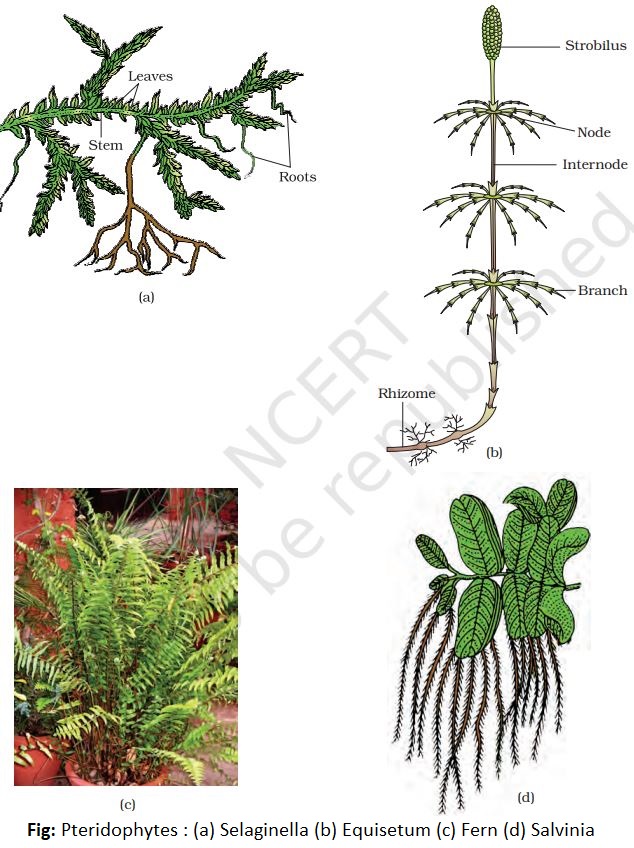
Stem is rhizomatous and regenerate when aerial parts are destroyed.
Leaves may be small (microphyll) as in Selaginella or large (macrophyll) as in ferns.
Coiling of youg leaves - Circinate vernation is seen in pteridophytes.
Leaves are of two types vegetative and fertile. Fertile leaves are the spore bearing leaves called sporophylls.
Spores are formed inside the sporangia.
In Sporangia, the spore mother cells give rise to spores after meiosis.
Spores germinate to form haploid gametophytic, photosynthetic heart shaped multicellular structure called prothallus which bears antheridia and archegonia.
Prothallus requires cool, damp shady areas for growth and water is essential for fertilization.
The antheridia bear antherozoids and archegonia bears the egg cell respectively which on fertilization form zygote which on germination forms the sporophyte.
Most of pteridophytes produce similar kinds of spores hence called homosporous.
Genera like Selaginella and Salvinia produce two kind of spores, macro or large spores and small or micro spores and are said to be heterosporous. Microspore and macrospore germinate and gives rise to male and female gametophyte respectively.
In heterosporous condition the female gametophyte is not free living, it is retained in the parent sporophyte till the beginning of the embryo development.
Seed bearing plants are evolved from heterosporous pteridophyte.
Pteridophytes further classified into four classes:
- Psilopsida (Psilotum)
- Lycopsida (Selaginella)
- Sphenopsida (Equisetum)
- Pteropsida (Pteris)
Economic importance:
- Some members are Medicinal- Dryopteris
- Helps in Soil binding
- Used as Ornamental plants
- Edible plants- Marcelia
- Used in Crop rotation- Azolla
- Helps in Symbiotic nitrogen fixation.
- Play an important role in plant succession on bare rocks or soil.
- Sphagnum is used to keep seedlings in gardens and cut plant parts moist during transportation and propagation.
Common names:
- Creeping pine/Club moss- Lycopodium
- Spike moss(Resurrection plant- Selaginella
- Water fern- Azolla (smallest pteridophyte)
- Walking fern (Maiden hall fern)- Adiantum
- Adder’s tongue fern- Ophioglossum
- Fossil pteridophyte- Cooksonia
- Leafless Pteridophyte- Psilotum
- Horse tail- Equisetum
14
Answer
Have naked seeds as the ovules are not enclosed by any ovary wall and remain exposed (no fruit covering).
Flowerless seed bearing plants.
Ovules are not enclosed by ovary wall.
Dominant plants during the Jurassic period.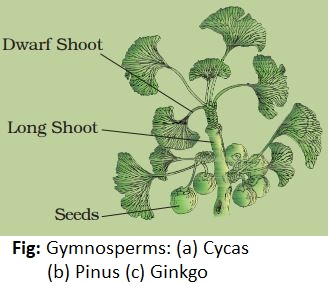
Gymnosperm includes medium-sized trees or tall trees and shrub.
Tap root system is generally present. May be associated with mycorrhiza-Association between fungus and roots of higher plants. Eg: Pinus.
Coralloid roots with nitrogen fixing bacteria as in Cycas.
Stem is branched (Pinus), or unbranched (Cycas).
Leaves are adapted for extreme temperature, humidity and wind-needle like leaves with thick cuticle, sunken stomata. Eg: Pinus.
Leaves may be simple or compound.
Stem is unbranched as in Cycas. Branched in Pinus and Cedrus.
Well-developed vascular system –xylem without vessels.
15
Answer
Sporophylls are aggregated to form strobuli or cone. They are generally monosporangiate or of two types- male and female cones.
Male cones are short lived and female ones are long lived.
Male strobili or male cone – microsporophylls which bear microsporangia having microspores which develop into reduced gametophyte called pollen grain.
Female cone or female strobili – megasporophylls which bear megasporongia having megaspores which are enclosed within the megasporangium (Nucellus).
One megaspore develops into female gametophyte bearing two or more archegonia.
Pollen grains are carried by wind and reach the ovules.
They form pollen tube which reaches the archegonia and release male gametes into the ovule.
Fusion of the gametes takes place and zygote is formed which produce embryos. Ovules develop into seeds which are not covered.
The endosperms in gymnosperms is a prefertilisation product and haploid in nature.
The dominant photosynthetic independent stage is the sporophyte. The gametophyte is single to few celled and not free living.
Classified into four classes:
- Cycadopsida Eg: Cycas
- Coniferopsida eg: Pinus
- Gnetopsida: Eg: Gnetum.
- Gingopsida- Ginko
Economic importance:
- Timbers for furniture, Pulp wood, Pencil box, Musical instruments etc.
- Production of resins, Turpentine etc.-E.g.-Pinus
- Edible seeds: Eg- Cycas, Pinus, Ginkgo.
- Medicinal Eg: Ephedrine from Ephedra (used for respiratory problems)
- Taxol – from Taxus species to freeze cancer cells.
Common names:
- Maiden hair tree- Ginkgo
- Sago palm /Panda of the plant kingdom- Cycas
- Largest gymnosperm- Sequoia
- Smallest gymnosperm- Zamia
- Gymnosperm with xylem vessels- Ephedra, Gnetum.
16
Answer
Angiosperms are known as flowering plants and have covered seeds.
They are divided into two classes –
- Dicotyledons (have two cotyledons)
- Monocotyledons (have one cotyledon).
Smallest angiosperm: Wolfia (microscopic).
Large tree: Eucalyptus over 100 meters.
Reproductive organs developed in flowers. The male sex organs in a flower are called stamens or androecium.
It has filament and anther. Anthers on meiosis produce pollen grains. Pollen grains have two male gametes. Female reproductive part is the pistil or gynoecium. It has stigma, style and ovary. Ovary has one or many ovule in which female gametophyte (embryo sac) develops by meiosis.
Embryo sac has 7 cells and 8 nuclei.
- 1 egg cell
- 2 synergids
- 3 antipodal
One central cell having two polar nuclei.
Pollen grain are carried by various agents like wind, water, birds, insects etc. and reaches the stigma. Pollen grains produces pollen tube which contains two male gametes and enters into the embryo sac.
One male gamete fuses with egg cell to form zygote and is called syngamy which develops into embryo. Other male gamete fuses with secondary nucleus (formed by fusion of two polar nuclei) which forms triploid primary endosperm nucleus (PEN) and is called triple fusion. PEN develops into endosperm which nourishes the developing embryo. As two fertilization (syngamy and triple fusion) takes place inside the embryo sac at the same time, it is called double fertilization.
Endosperm is triploid.
Ovules develop into seeds and ovaries into fruits.
17
Answer
There is an alternation of a haploid gamete producing gametophytic and spore producing sporophytic generation.
Three types-
1. Haplontic life cycle: In this type the dominant, photosynthetic phase is a free living gametophyte produced by haploid spores. The gametophyte produces gametes by mitosis and the gametes fuse to form the zygote which represents the sporophytic generation. Zygote undergoes meiosis to form haploid spores. Here the Gametophytic phase is dominant. e.g., Chlamydomonas.
2. Diplontic life cycle: Here the diploid sporophyte is the dominant photosynthetic independent phase of the plant. The gametophyic phase is represented by one to few celled haploid gametophyte. Here sporophytic phase is dominant. e.g., Angiosperms and Gymnosperms.
3. Haplo-Diplontic life cycle: In this type both haploid and diploid phases are multicellular and often free living. Seen in bryophytes and pteridophytes.
Although most algal genera show haplontic life cycle, some of them such as Ectocarpus, Polysiphonia, Kelps, etc. exhibit haplo-diplontic life cycle. Fucus a brown alga exhibits diplontic life cycle.
18
Answer
1. Plant Kingdom Divided into two- Cryptogamae (non flowering seedless plants) and Phanerogamae (flowering, seed bearing plants).
2. Based on plant body Cryptogamae divided into Thallophyta, Bryophyta and Pteridophyta.
3. Thallophytes again divided into:
- Algae (pigmented thallophytes)
- Fungi (nonpigmented thallophytes)
- Lichens: Symbiotic association between algae and fungi.
4. Phanerogamae divided into two
- Gymonosperma (naked seed plants) and
- Angiosperma( covered seeded plants)
5. Angiosperms are again divided into two
- Monocots (have single cotyledon, fibrous root system and parallel venation)
- Dicots (have two cotyledons, tap root system and reticulate venation).
6. Algae are simple, thalloid, autotrophic and largely aquatic organisms.
7. Depending on the type of pigment possessed and the type of stored food, algae are classified into three classes namely Chlorophyceae, Phaeophyceae, and Rhodophyceae.
8. Vegetative reproduction- fragmentation, asexual - formation of different types of spores and sexually by the formation of gametes which show isogamy, anisogamy and oogamy.
9. Bryophytes are plants which can live in soil but are dependent on water for sexual reproduction. Their plant body is more differentiated than that of algae.
10. Thallus like plant body, prostrate or erect, and fixing structures are called rhizoids. They possess root like, leaf like, and stem like structures.
11. The bryophytes are divided into liver worts, hornworts and mosses.
12. Liverworts have thalloid plant body and dorsiventral.
13. Mosses have upright and slender axis bearing spirally arranged leaves.
14. The plant body is a gametophyte and after fusion of the gametes the zygote produce a multicellular body called the sporophyte.
a
15. In pteridophytes, plant body is a sporophyte with root, stem and leaves.
16. The sporophyte in Pteridophyte bear sporangia which produce spores which on germination form gametophyte.
17. Gametophyte in Pteridophyte bears male and female sex organs called antheridia and archegonia.
18. Water is needed for fertilization.
19. The gymnosperms are the plants which produce naked seeds. After fertilization the seed remains exposed.
20. Gymnosperms produce microsporophyll and megasporophyll. Microsporangia and Megasporangia are borne on the sporophylls.
21. Sporophylls-Microsporophyll and megasporophyll.
22. The pollen tube produced by the pollen grain releases the male gamete into the ovule, where it fuses with the egg cell in archegonia. Following fertilization, the zygote develops into embryo and the ovules into seeds.
23. In angiosperms, the male sex organs or stamen and the female sex organ the pistil are born in a flower.
24. Stamen consists of anther and filament.
25 Pistil contains ovary, style and stigma.
26. The pollen grain produces two male gametes. One male gamete fuses with the egg and is called syngamy and forms zygote which develops to form the embryo.
27. The other male gamete fuses with the polar nuclei and is called triple fusion and forms the primary endosperm nucleus which develops to form the endosperm which gives nourishment for the developing embryo.
28. As two fertilization are taking place inside the embryo sac at the same time –syngamy and triple fusion, it is called double fertilization.
29. Angiosperms are divided into two classes-Monocotyledons and Dicotyledons.