NCERT Revision Notes for Chapter 8 Microbes in Human Welfare Class 12 Biology
CBSE NCERT Revision Notes1
Answer
Microbes are beneficial as well as detrimental to the welfare of human beings. Microbes are utilized in many ways for human beings as explained below-2
Answer
Microbes are used to synthesize different products that are useful for humans. Beverages and antibiotics are the most common product obtained from microbes. For large scale production and use of microbes in industries, special vessels are used, known as fermenters.
Fermented beverages are being used from time immemorial such as wine, whisky, brandy etc. Saccharomyces cerevisiae commonly known as brewer’s yeast is the most common microbe used for fermentation. It has been used for fermenting malt based cereals and fruit juices to produce ethanol. Different alcoholic drinks are produced based on type of fermentation and raw material used. Whisky, brandy and rum are produced by distillation of the fermented broth whereas wine and beer are produced through distillation.
Antibiotics are chemical substances produced using microbes against any disease-causing microbe. The first antibiotic discovered was Penicillin obtained from mould known as Penicillium notatum. Antibiotics discovered helps in the treatment of different diseases such as Whooping cough, leprosy, diphtheria, plague etc.
Some antibiotics produced by different bacteria: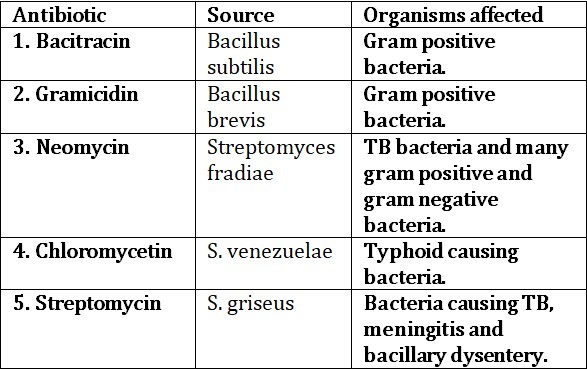
Microbes were also used for the production of certain chemicals such as alcohols, enzymes, organic acids etc. For example, Aspergillus niger is used to produce citric acid, Acetobacter aceti is used to produce acetic acid, and Lactobacillus is used to produce lactic acid. Lipase enzyme can also be prepared using microbes. Streptokinase produced by the bacterium Streptococcus and modified by genetic engineering is used as a ‘clot buster’ for removing clots from the blood vessels of patients who have undergone myocardial infarction leading to heart attack. An immunosuppressive agent known as cyclosporin A, is obtained from the fungus known as Trichoderma polysporum is used during organ transplant.
3
Answer
Lactobacillus is a bacterium that is found in curd. It is responsible for conversion of milk into curd. This bacterium produces lactic acid that partially digest milk protein and coagulate it to form curd. A small inoculum of curd is needed in milk to begin the process of formation of curd. The curd is rich in Vitamin B12.
The process of formation of alcohol from sugar is known as fermentation. It is a process that occurs in absence of oxygen. So, it is an anaerobic process. Louis Pasteur discovered the process of fermentation. The dough used in making of food items such as idli, dosa, etc. is also formed by the action of bacteria. Bacteria cause fermentation of the dough to form the final batter. The dough is puffed-up due to production of carbon-dioxide. The bread is also formed by fermentation. The dough is fermented by a yeast known as Saccharomyces cerevisiae. Many different drinks are being produced by the same process of fermentation.
Cheese is produced by Propionibacterium sharmanii which is a fermenting bacteria. This bacterium is used to prepare Swiss cheese. The ‘Roquefort cheese’ are ripened by growing a specific fungus on them, which gives them a particular flavour. Different varieties of the cheese are known based on their texture, taste, and flavour. These characteristics are based on different microbes used.
4
Answer
A major component of this waste water is human excreta. This municipal waste-water is also called sewage. It contains large amounts of organic matter and microbes. The excreta are very harmful, so it should be treated before to be released to minimize the pollution. Heterotrophic bacteria naturally present in waste water is used to treat the sewage.
It occurs in two stages- primary treatment and secondary treatment.
Primary treatment- physical removal of small and large particles through filtration and sedimentation begins the process of primary treatment. Firstly, sequential filtration removes debris. Then sedimentation removes the soil and small pebbles. The left over known as effluent is taken for secondary treatment.
Secondary treatment- effluent is transferred through the aeration tanks with continuous aeration. Aeration allows vigorous growth of aerobic microbes that help in aerobic breakdown of organic matter. The aerobic microbes form flocs.
Flocs are masses of bacteria associated with fungal filaments to form mesh like structures. This reduces the biological oxygen demand (BOD). Once the BOD of the sewage is reduced, it is passed into settling tank where the bacterial flocs are allowed to sediment. This sediment is known as activated sludge. Then the small part of activated sludge is pump back into aeration tank to serve as inoculum. The remaining major part of the sludge is pumped into large tanks called anaerobic sludge digesters. During this process, different gases are produced such as carbon-dioxide, methane and hydrogen sulphide. Now the waste can be discharged into rivers, streams etc. The Ministry of Environment and Forests has initiated Ganga Action Plan and Yamuna Action Plan to save these major rivers of our country from pollution. One of the major proposals discussed in these plans is to build a large number of sewage treatment plants so that only treated sewage may be discharged in the rivers.
5
Answer
Biogas is a mixture of different gases; methane percentage is highest. Some bacteria, which grow anaerobically on cellulosic material, produce large amount of methane along with CO2 and H2. These bacteria which produce methane as a result of anaerobic respiration are collectively called methanogens. Methanobacterium is an example of a methanogenic bacteria.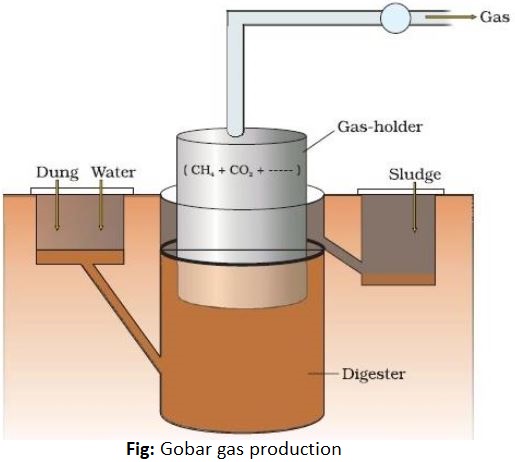
6
Answer
Biocontrol is defined as use of biological methods to control plant diseases and pests. Conventionally, pesticides and insecticides are being used for the control of diseases and pests. But these chemicals are extremely toxic and harmful.7
Answer
Bacillus thuringiensis (Bt) is a bacterium that is used as a biocontrol agent against insects/pests. It produces an endotoxin that paralyzes the gut of the insect/pest that consumes it. Bt cotton is an example of such plant produced Trichoderma is a fungus used in controlling plant pathogens. Baculoviruses are also used to attack insects and arthropods. Baculoviruses are pathogens of insects and other arthropods. Most of the baculoviruses used as biocontrol agents belong to the genus Nucleopolyhedrovirus. These viruses are an ideal choice for narrow spectrum actions such as for species-specific insecticidal purposes. It has been demonstrated that they have no negative impacts on other organisms like plants, mammals, birds, and fish or even on non-target insects. Some microbes are also used as bio-fertilizers. Rhizobium is a gram-negative bacterium found as an endosymbiont in leguminous plants that helps in nitrogen fixation.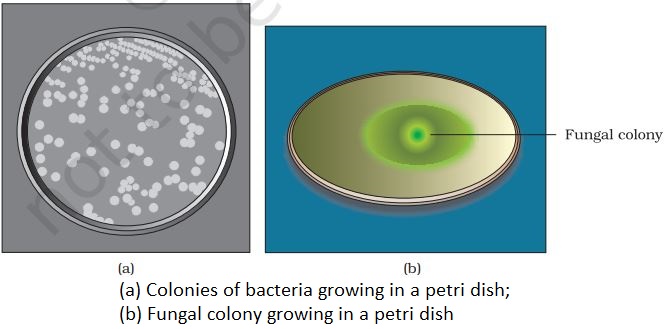
8
Answer
Human body colonize different microbes in different parts of the body such as skin, gut, reproductive tract etc. The most important microbes found in human body are gut microflora.
The stomach microflora includes Streptococcus, Staphylococcus etc. These bacteria are able to survive the acidic conditions of the stomach.
The intestinal flora belong to Enterobacteriaceae. This flora is helps in the function of digestion and absorption. It increases the efficiency of process of digestion and the utility of the gut.
These microbes help the gut in preventing another microbe’s colonization. They also secrete certain substances that are required for the digestion of the food.
Viruses are used as a vector for transmission of required gene during recombinant DNA technology.
9
Answer
The excess use of chemicals and their harmful effect has forced the farmers to switch to organic farming. Organic farming use biofertilizers. Biofertilizers are organisms that enrich the nutrient quality of the soil. Biofertilizers contain bacteria, fungi and cyanobacteria. Rhizobium bacteria is found in leguminous plants such as pea, bean, etc. This bacterium helps in absorption of nitrogen required by the plants. Other bacteria can also fix nitrogen such as Azospirillum and Azotobacter. Fungi when forms a symbiotic relationship with roots of higher plants, it is known as mycorrhiza. Fungus absorbs phosphorous from the soil and passes it to the plant. Cyanobacteria are autotrophic microbes. They are widely distributed in both aquatic and terrestrial environments. Many of them can fix atmospheric nitrogen, e.g. Anabaena, Nostoc, Oscillatoria, etc. Therefore, cyanobacteria serve as an important biofertilizer especially in paddy fields. Blue green algae also add organic matter to the soil and increase its fertility.