NCERT Revision Notes for Chapter 6 Evolution Class 12 Biology
CBSE NCERT Revision Notes1
Answer
Evolutionary biology is the study of history of life forms on the Earth.
• To understand the evolution in flora and fauna over a period of millions of years on the earth, we must understand the origin of life beginning with the evolution of the earth, of stars, and the universe itself.
• Origin of life is believed to be a unique event in the history of universe.
• The Big Bang Theory attempts to explain to us the origin of universe.
2
Answer
• A singular huge explosion of very dense matter from a point of singularity.
• This caused the universe to expand and the temperature to fall drastically.
• After some time hydrogen and helium were formed.
• The gases condensed due to gravitation. They later formed the galaxies in the universe. The Earth is believed to have been formed about 4.5 billion years back in the solar system of the Milky Way galaxy.
3
Answer
• The Earth formed 4.5 billion years back.
• There was no atmosphere on early earth.
• Water vapor, methane, carbon dioxide and ammonia released from molten mass covered the surface. The UV rays from the sun caused decomposition of water into hydrogen and oxygen. Hydrogen gas being lighter escaped into space.
• Oxygen that remained behind combined with ammonia and methane to form water, CO2 and other compounds.
• The ozone layer was formed.
• As the water vapor cooled, it fell as rain, to fill all the depressions and form oceans.
• Life appeared around 500 Million years after the earth was formed.
4
Answer
• Early Greek believed that units of life called spores were brought to different planets including earth. This theory is called as Panspermia and is still a favored by many astronomers.
• For a long time it was also believed that life could originate from decaying and rotting matter like straw, mud etc.
• This was the theory of spontaneous generation. It was disproved by Louis Pasteur by his swan-neck flask experiment.
5
Answer
• Careful experimentation demonstrated that life comes only from pre-existing life.
• He showed that in flasks that were sterilized prior to the experiment, life did not originate from killed yeast. At the same time, if a similar flask was left open to air, new living organism arose from “killed yeast”.
• This disproved the theory of spontaneous generation.
6
Answer
• Oparin of Russia and Haldane of England proposed that the first forms of life originated from pre- existing non-living organic molecules (e.g. RNA, protein etc.).
• Formation of life was preceded by chemical evolution i.e. formation of diverse organic molecule from inorganic constituents.
• In 1953, S.L. Miller, an American scientist demonstrated the same experimentally in a laboratory scale
7
Answer
The Conditions of the Earth were –
- High Temperature.
- Volcanic Storms.
- Reducing atmosphere containing CH4, NH3 etc.
In 1953 S.L.Miller an American scientist created similar conditions in laboratory scale.
- To simulate conditions of primitive earth he created electric discharge in a closed flask. This raised the temperature up to 800oC.
- Used CH4, H2, NH3 and water vapor inside the flask.
He observed the formation of amino acids.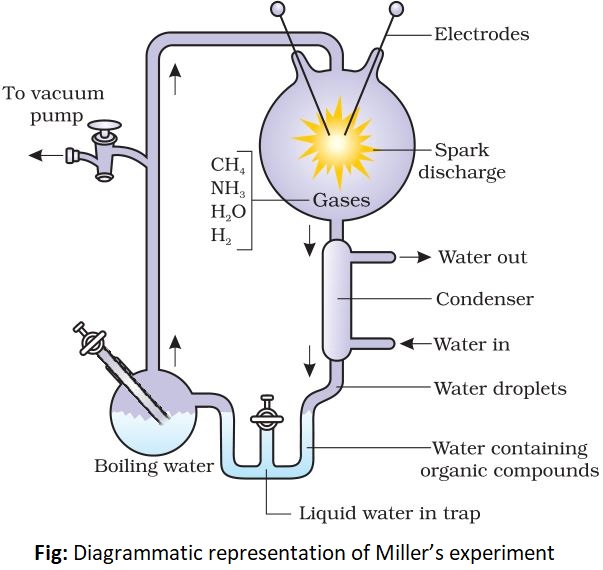
8
Answer
• Miller observed the synthesis of amino acids from simple inorganic chemicals. He did this by recreating the conditions that were believed to exist on primitive earth in the laboratory.
• In similar experiments formation of sugars, nitrogen bases, pigment and fats were also observed by other scientists.
• Analysis of meteorite content showed the presence of similar compounds. This indicates that similar processes are occurring elsewhere in space.
9
Answer
• In observations made during a sea voyage in a sail ship called H.M.S. Beagle round the world, Charles Darwin concluded that existing life forms share similarities to varying degrees not only among themselves but also with life forms that millions of years ago.
• Many such life forms don’t exist anymore. Due to various reasons there have been extinctions of different life forms in the past. There also have been the emergence of new forms of life at different periods of history of earth.
• There has been gradual evolution of life forms.
• All populations of organisms have variations in characteristics.
• Individuals with characteristics that allow better adaptability survive better in natural conditions (climate, food, physical factors, etc.) and would therefore outbreed others with less favourable characteristics. This ensures that the survival of the variety that is most adaptable to change. It leads to the survival and propagation of the fittest organisms in the population as it can survive and outlast change.
• Survival of the fittest: The fitness according to Darwin refers ultimately to the ability to survive a change. Therefore only the fittest organisms survive and produce more progeny then others.
• These, therefore, have better survival capacities and hence are selected by nature. He called it as natural selection.
• Alfred Wallace, a naturalist who worked in Malay Archipelago had also come to similar conclusions around the same time.
• The geological history of earth is closely related to the biological history of earth.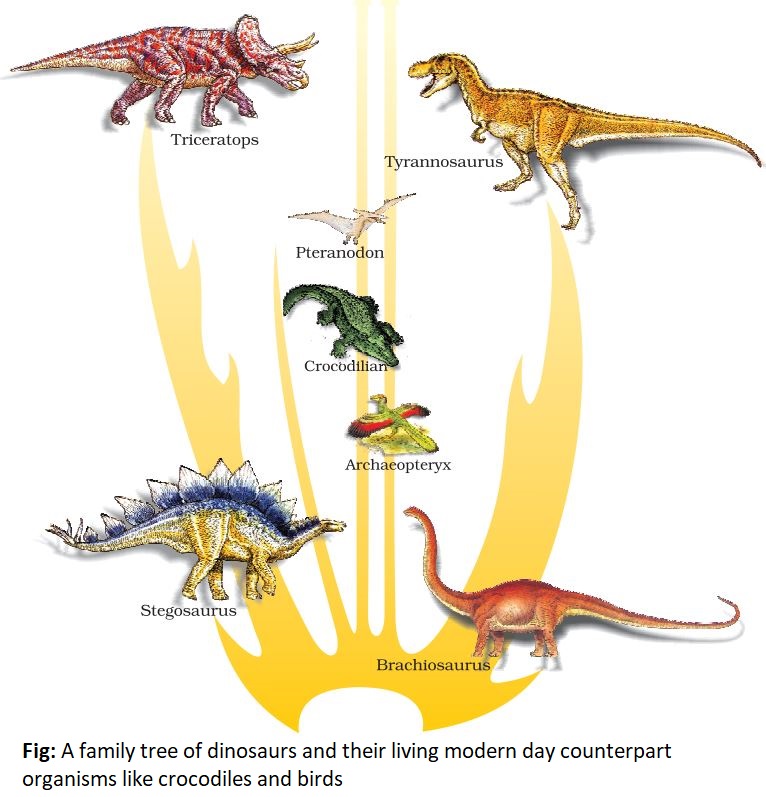
10
Answer
Different evidences of Revolution are:
- Paleontological evidence
- Comparative anatomy and morphological evidence
- Divergent evolution
- Convergent Evolution
- Biochemical evidences
11
Answer
• Fossils are remains of hard parts of life-forms found in rocks.
• Different-aged rock sediments contain fossils of different life-forms who probably died during the formation of the particular sediment.
• They represent the extinct organisms (e.g. Dinosaurs).
• A study of different sedimentary layers in which fossils were present indicates the geological period in which they existed.
• The study showed that life-forms varied over time and certain life forms are restricted to certain geological time-span.
• Hence new forms of life are believed to have originated at different times in the history of earth.
• All this called Paleontological evidence.
12
Answer
• Comparative anatomy and morphology shows similarities and differences among organisms of today and those that existed years ago.13
Answer
• Different mammals like bats, whales, cheetah and humans share similarities in the pattern of bones of forelimbs.
• These forelimbs perform different functions in these animals but they have similar anatomical structure – all of them have humerus, radius, ulna, carpals, metacarpals and phalanges in their forelimbs.
• Thus it can be seen that the same structure developed along different directions due to adaptation to different needs.
• This direction of evolution is called as divergent evolution and these structures are homologous to each other.
• Homology indicates common ancestry.
• Other examples of homologous organ are vertebrate hearts and brains.
• Thorn of Bougainvillea and tendrils of Cucurbita represent homology.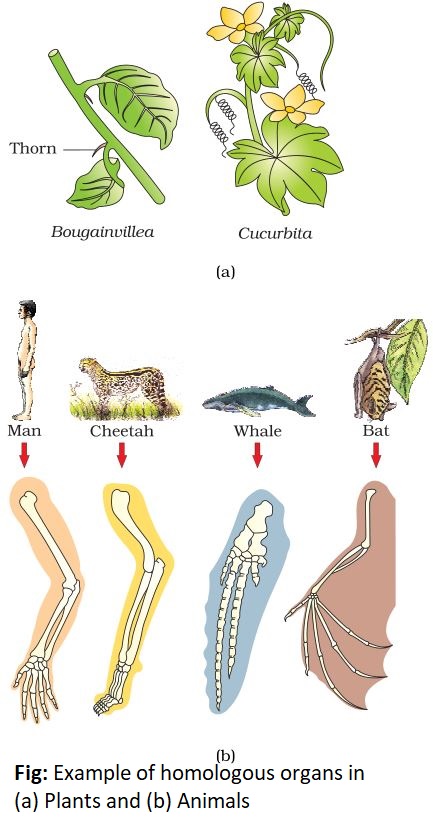
14
Answer
• Wings of butterfly and of birds both appear similar.
• Anatomically they do not have similar structure though they perform similar function.
• Hence analogous structures are a result of convergent evolution.
• Eyes of different organisms like that of octopus of mammals.
• Flippers of Penguins and Dolphins.
• Sweet potato (root modification) and potato (stem modification) for storage of food.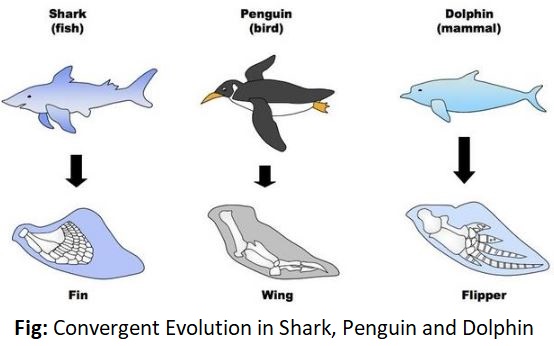
15
Answer
• Similarities in proteins and genes performing a specific function among different organisms give clues regarding common ancestry.16
Answer
• Ernst Heckel proposed this evidence as evolution based on observation of certain common features during embryonic stage of all vertebrates but are absent in adult.
• All vertebrate embryos including human embryo develop a row of vestigial gill slits just behind the head. It is seen that it is a functional organ only in fish. Gills are not found in any other adult vertebrates.
• The embryological evidence was disregarded and disproved by Karl Ernst von Baer on the basis of careful study performed by him. He noted that the similarities in embryos never pass through the adult stages of other animals.
17
Answer
• A popular example is the change in frequency of moth population in England in 1850.
• Before industrialization set in more white-winged moths were observed on trees than dark winged or melanised moths.
• After industrialization i.e. 1920, the proportion was reversed as there were more dark-winged moths in the same area.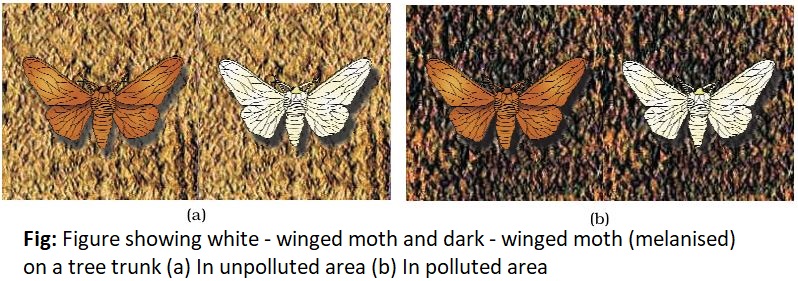
18
Answer
• Excess use of herbicides, pesticides etc., has resulted in selection of the resistant varieties in a much lesser time scale.
• This has also been observed for microbes against which we use antibiotics or drugs.
• Hence resistance in organisms/cells are now appearing in a time scale of months or years and not in centuries.
• These are the examples of evolution by anthropogenic action.
• Evolution is a stochastic process. This is because it is based on random and chance events in nature and chance mutation in the organisms.
19
Answer
• Darwin’s theory was based on observation of certain birds in the Galapagos Islands. The small black birds he observed have since been called Darwin’s Finches.
• He observed that there were many varieties of finches in the same island.
• All the varieties he came across had evolved on the island itself.
• They were originally adapted with seed-eating features. From these many other forms evolved with altered beaks depending on the food habit. This enabled them to become insectivorous and vegetarian finches
• This process of evolution of different species in a given geographical area starting from a point and radiating to other areas of geography is called as adaptive radiation.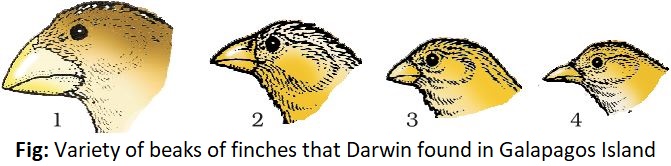
20
Answer
• In Australia it was seen that a number of marsupials had evolved from an ancestral stock. These marsupials were all different from each other.
• When more than one adaptive radiation appears to have occurred in an isolated geographical area (representing different habitats), it can be called as convergent evolution.
• Placental mammals in Australia were also seen to exhibit adaptive radiation. They seem to be evolved from a marsupial into various placental mammals. The placental mammals are showed similarities to the ancestral marsupial (e.g. placental wolf and Tasmanian wolf-marsupial).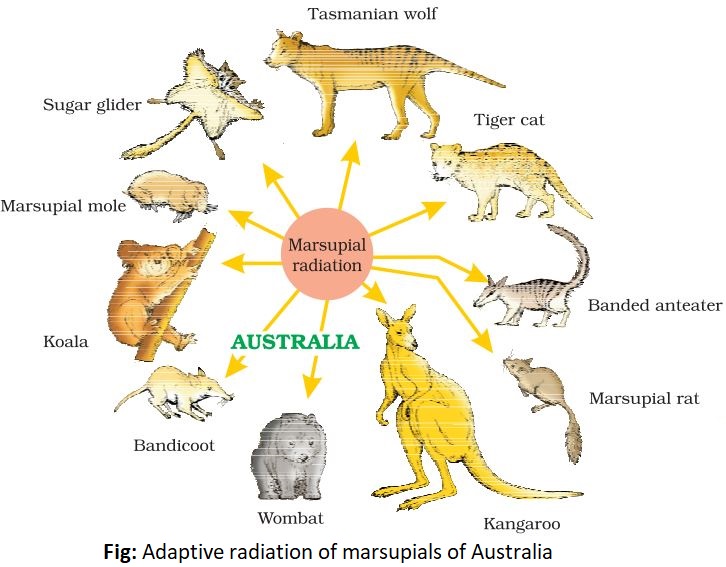
21
Answer
• Natural selection is the essence of Darwinian Theory about evolution.
• The rate of appearance of new forms is related to the life cycle or the life span.
• For variations to get selected and evolve there has to be a genetic basis.
• Organisms with favourable variations are better adapted to survive in a hostile environment.
• Variations result in adaptability. They have a genetic basis and are therefore inherited.
• Fitness is the ability to adapt to changing environment and thus get selected by the nature.
• The key concepts of Darwinism are:
- Natural selection: Survival of the fittest by the nature in face of changing environment.
- Theory of Common Descent: Organisms are descended from common ancestors due to accumulation of variations
22
Answer
• French Naturalist Lamarck proposed that evolution of life forms occurs due to use and disuse of organs.
• He explained this theory using giraffes as an example. He claimed that giraffes formed long necks in an attempt to forage leaves on tall trees. Therefore, this character was acquired based on a need to adapt and survive.
• This acquired character was passed to succeeding generations.
• Giraffes, therefore, came to develop long necks slowly over the course of many years.
23
Answer
• Hugo de Vries worked on evening primrose. He gave the idea of mutations.
• Mutation is the difference arising suddenly in a population.
Hugo de Vries theory of mutation differs from Darwin’s theory of natural selection.
• He stated that mutation causes evolution and not the minor variations that as suggested by Darwin.
• Mutations are sudden, random and directionless while Darwinian variations are small and directional.
• Evolution according to Darwin was slow and gradual whereas Hugo de Vries believed that mutation caused large changes that led to speciation. He therefore called it saltation (single step large mutation).
• Saltation: It is a large and an abrupt evolutionary change that has been brought about due to sudden large scale mutation.
24
Answer
• For given population the frequency of occurrence of alleles of a particular gene present on a specific locus can be calculated.
• This frequency is usually fixed and remains the same throughout different generations.
• Hardy-Weinberg principle expressed the same using algebraic equations. This is called as the Hardy-Weinberg Principle.
• The principle states that allele frequencies in a population are stable and are constant from generation to generation.
• The gene pool (total genes and their alleles in a population) remains a constant. This is called genetic equilibrium.
• Sum total of all the allelic frequencies is 1.
• The principle can be represented mathematically as follows:
- (p + q)2 = p2 + 2pq + q2 = 1.
p and q represent the individual allele frequencies.
• Therefore, p2 = frequency of homozygous condition represented by p
And q2 = frequency of homozygous alleles represented by q
And pq = frequency of heterozygous condition
• Difference in values of p, q and pq indicate the extent of evolutionary change.
• Disturbance in genetic equilibrium (Hardy Weinberg equilibrium) or change of frequency of alleles in a population can then be interpreted as accumulation or change in variations that results in evolution.
• Five factors are known to affect Hardy-Weinberg equilibrium:
- Gene migration or gene flow.
- Genetic drift.
- Mutation
- Genetic recombination.
- Natural selection.
• Gene migration: When a section of population migrates to another place gene frequencies will change in the original as well as in the new population. New genes /alleles will be added to the new population and the same are lost from the old population.
• Gene flow: When gene migration occurs frequently it is termed as gene flow.
• Genetic drift: Change in gene frequency that occurs due to a random event or by chance.
• Founder effect: Sometimes the change in allelic frequency is so drastic that in the new sample of population the variants form a different species. The original drifted population from which the variants arose becomes founder species and this effect is called founder effect.
25
Answer
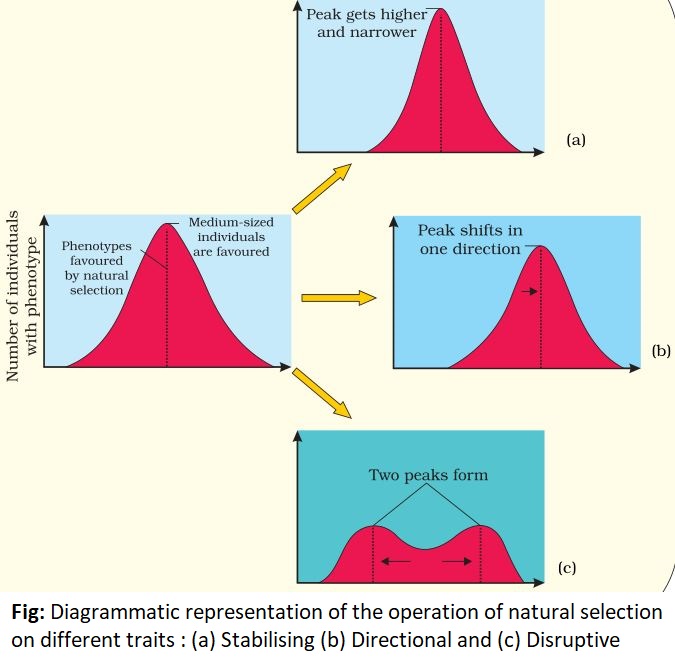
• Natural selection can lead to:
- Stabilization: In which more individuals acquire mean character value.
- Directional changes: Occurs when more individuals acquire value other than the mean character value.
- Disruption: more individuals acquire peripheral character value at both ends of the distribution curve.
26
Answer
• Approximately 2000 million years ago (mya) the first forms of life appeared on earth. They were cellular.
• Certain cellular forms developed the ability to photosynthesize and thus release O2. The atmosphere slowly became rich in oxygen. This in turn promoted the development and evolution of more aerobic forms of organisms.
• Slowly and gradually the single cell organisms started to form multi-cellular life forms.
• Around 500 mya invertebrates were formed.
• The first fish evolved from invertebrates around 350 mya. They were probably jawless fish.
• At around 320 mya sea weeds and few plants evolved and existed.
• Coelacanth a lobe finned fish was discovered in South Africa in 1938. It is believed to have evolved into the first amphibious organisms that lived on both land and water. These amphibians were the ancestors of modern day frogs and salamanders.
• The amphibians slowly and gradually evolved into reptiles.
• Reptile eggs do not dry up in sun unlike those of amphibians.
• Giant ferns (Pteridophytes) present on land fell and got buried in soil. As more sediments accumulated on top they started to form coal deposits slowly.
• Some of the reptiles retreated back into water to evolve into fish like reptiles probably 200 mya (Ichthyosaurs).
• The biggest land reptiles were the dinosaurs.
• The largest dinosaur Tyrannosaurus rex was about 20 feet in height and had huge fearsome dagger like teeth.
• About 65 mya the dinosaurs suddenly underwent mass extinction from the earth. Some of them evolved into birds.
• The first mammals were small and shrew-like. They had small sized fossils.
• Mammals evolved to become viviparous. This protected their unborn young inside the mother’s body.
• Pouched mammals of Australia survived because of lack of competition from any other mammals. This lack of competition was a result of Continental Drift.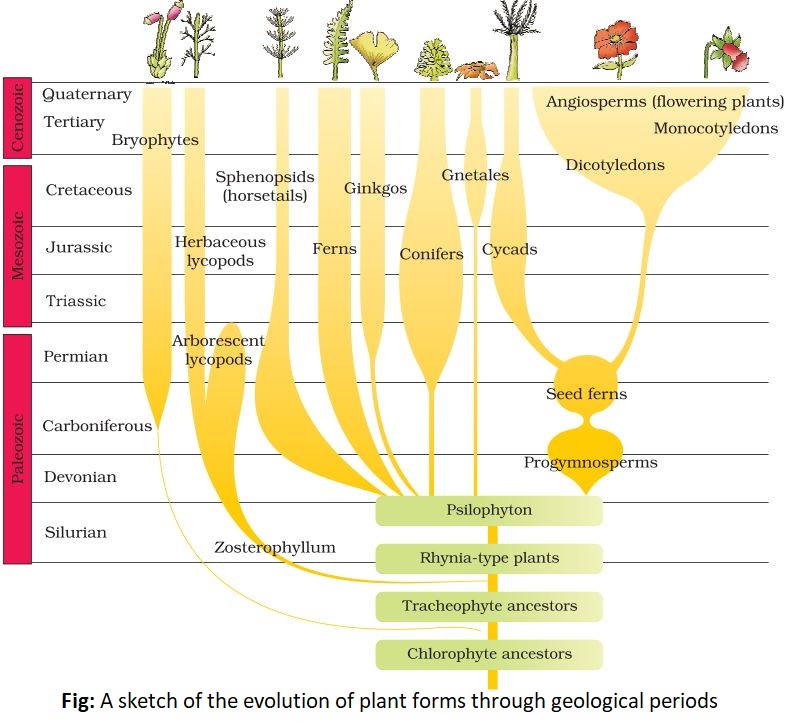
27
Answer
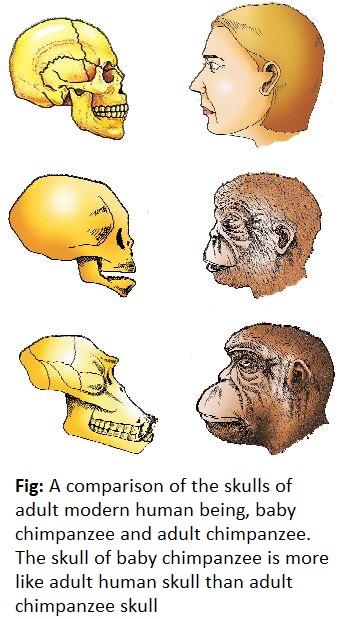
• About 15 mya primates such as Dryopithecus and Ramapithecus existed. They appeared to be similar to gorillas and chimpanzees in their appearance and walking.
• Ramapithecus was more similar to man whereas Dryopithecus was more similar to apes.
• Few fossils of bones that resemble human bones have been discovered in Ethiopia and Tanzania.
• Two mya Australopithecines existed. They most likely lived in East African grasslands.
- They used stone weapons for hunting.
- Essentially had a fruit-based diet.
• The first human-like organism was the hominid and was called Homo habilis.
- Brain capacity was 650 – 800 cc.
- They also survived on plant-based diet and did not eat meat.
• Fossils discovered in Java in 1891 seemed to be of the next stage i.e. Homo erectus. They evolved about 1.5 mya.
- Had large brain with capacity around 900 cc.
- Probably ate meat.
Neanderthal man:
- Brain size was around 1400 cc.
- Lived in east and central Asia between 1, 00,000-40,000 years back.
- They developed use of animal hides to protect their body.
- Buried their dead.
Homo sapiens:
- Arose in Africa and migrated across continents and developed distinct races.
- During ice age 75,000-10,000 years ago modern Homo sapiens arose.
- Pre historic cave art developed about 18,000 years ago.
- Agriculture came around 10,000 years back and human settlement started.