NCERT Revision Notes for Environmental Issues Class 12 Biology
CBSE NCERT Revision Notes1
Answer
Pollution is any undesirable change in physical, chemical or biological characteristics of air, land, water or soil. Agents that bring about such an undesirable change are called as pollutants. In order to control environmental pollution, the Government of India has passed the Environment (Protection) Act, 1986 to protect and improve the quality of our environment.2
Answer
There are different sources of pollution. They are:
- Storm water runoff from roads, residential yards, industrial/manufacturing operations
- Contaminated soil or groundwater.
- Combined sewer system overflows system overflows.
- Storm water runoff.
- Municipal sewage/wastewater and Industrial wastewater.
- Direct discharges
- Air deposition
3
Answer
Air pollution is harmful for both plants and animals. Air pollution affects the growth and yield of the crops. They affect the respiratory system of the humans. Particulate and gaseous air pollutants are released from thermal power plants, smelters and other industries. These pollutants are very harmful, they should be filtered out before it should be released into the environment. The most widely used method for the removal of the particulate matter is electrostatic precipitator. Particulate matter if inhaled causes breathing and respiratory symptoms, inflammations, irritations, and premature deaths.
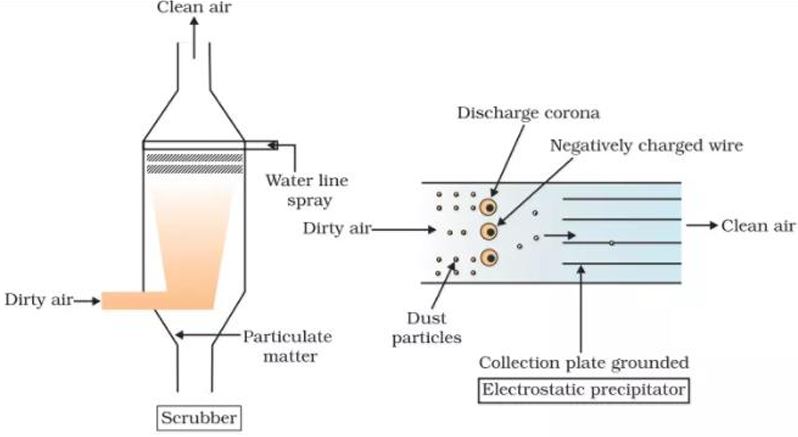
Automobiles are another major cause of atmospheric pollution in metro cities. To prevent the emission of poisonous gases from automobiles, catalytic converters, having expensive metals namely platinum-palladium and rhodium as the catalysts are fitted into automobiles. Use of unleaded petrol or diesel can reduce toxic emissions. The Air (Prevention and Control of Pollution) Act came into force in 1981 in India. It was amended in 1987 to include noise as an air pollutant.
4
Answer
Delhi leads the country in its level of air pollution. Air pollution in Delhi became so severe that a public interest litigation (PIL) was filed in the Supreme Court of India. The supreme court had advised the public vehicles to switch from diesel to compressed natural gas (CNG). CNG is preferred because, it is cheap, burns efficiently, very little of it is left unburnt. Other methods were also used to reduce pollution in Delhi such as use of unleaded petrol, phasing out of old vehicles, use of low Sulphur petrol etc.5
Answer
With the increase in pollution in water, the government has passed Water (Prevention and Control of Pollution) Act, 1974 to safeguard our water resources.6
Answer
0.1% percent impurities make domestic sewage unfit for human use. Solids are easy to remove, but dissolved salts such as nitrates, phosphates and other nutrients are difficult to remove. Domestic sewage primarily contains biodegradable organic matter which can be decomposed using microorganisms. Biological oxygen demand can be used to measure amount of biodegradable organic matter in sewage water. Presence of large amounts of nutrients in waters also causes excessive growth of planktonic (free-floating) algae, called an algal bloom which imparts a distinct colour to the water bodies.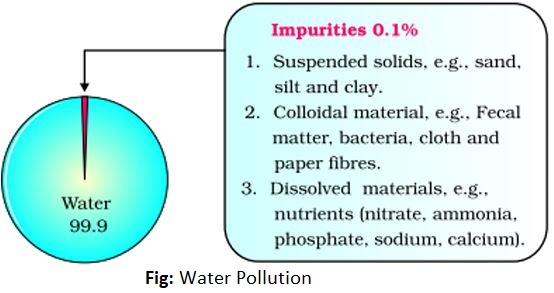
Biomagnification refers to the increase in concentration of toxicant at successive trophic levels. It occurs because the toxicant itself cannot be digested by an organism and is therefore is passed on to the next trophic level on consumption.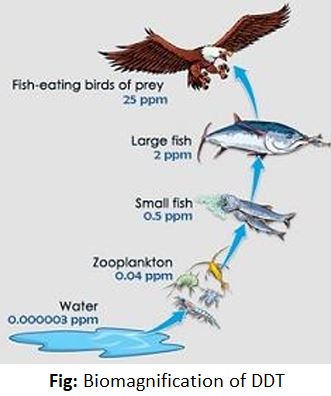
Eutrophication is defined as ageing of the lakes due to nutrient enrichment. A young lake is cold and clear. Nutrients are introduced into the lake from different sources like surface run-off, streams, etc. This increases the fertility of the lake and promotes the growth of aquatic organisms. Over the course of time the lake becomes shallower due to the deposition of silt and organic debris. Warm water plants and marsh plants take over the lake. Slowly the lake is populated by floating plants and eventually the lake is converted to land.
Depending on climate, size of the lake and other factors, the natural aging of a lake may span thousands of years.
Pollutants from human activities like industrial and domestic effluents can radically accelerate the aging process. This phenomenon has been called Cultural or Accelerated Eutrophication. The pollutants like nitrates and phosphates promote rapid growth of algae. This decreases the amount of dissolved oxygen available to other aquatic organisms. Thus, due to increased water pollution a lake can choke to death.
7
Answer
There are two sources of water pollution-
- Point sources are those sources which arises from single, identifiable source. For example, pipe or ditch.
- Non-point sources are those sources that arises from diffuse contaminants from more than one point or source. For example, nutrient run-off from the agriculture land
8
Answer
- Death of aquatic animals due to depletion of oxygen.
- Imbalance of ecosystem.
Contaminated water causes various diseases. Polluted water causes some of the deadly diseases like cholera, dysentery, diarrhoea, tuberculosis, jaundice, etc. Approximately 80 per cent of diseases associated with stomach in India are caused by polluted water.
9
Answer
Artificial and natural processes are used for the waste water treatment. It involves-
- Conventional sedimentation followed by filtering and chlorine treatment.
- After the first step, the biologists formed a series of six connected marshes spread over 60 hectares of marshland.
Appropriate plants, algae, fungi and bacteria were seeded into this area. They neutralize, absorb and assimilate the pollutants. Hence the water gets purified naturally as it flows through the marshes.
10
Answer
Waste from the offices, schools, stores, hospitals constitute the municipal solid wastes. Dumping of these wastes give birth to flies and rats. Sanitary landfills consist of depression or trench where waste is dumped. Waste is categorized as biodegradable, non-biodegradable and recyclable.
Biodegradable wastes can be buried in soil and allowed to decompose into harmless by-products.
Non-biodegradable wastes cannot be naturally broken down. Their use therefore must be reduced.
Recyclable wastes are substances that can be used to retrieve at least few useful substances. Non-biodegradable wastes must be recycled as much as possible.
Hospital wastes are hazardous. They must be properly incinerated so as to prevent contamination and spread of dangerous pathogens and chemicals.
Electronic waste must be recycled to obtain useful metals. In developing countries, this process is still manual. This increases the risk of exposure of the workers towards the toxic substances.
Case study of remedy for plastic waste
Ahmed Khan, a plastic sack manufacturer in Bangalore developed a solution to the ever-increasing plastic waste. He developed Polyblend. Polyblend is a fine powder made of recycled plastic waste. It can be mixed with bitumen and used for laying roads. This increases the water repellant properties of bitumen and therefore increases the life of the road.
11
Answer
Use of fertilizers and pesticides has increased manifold for crop production. Overuse of chemical fertilizers causes harm to soil fertility and crop yield. They cause soil, water and air pollution.12
Answer
Integrated organic farming is an eco-friendly and cyclical procedure that generates and zero-waste. In this waste products from one process are cycled in as nutrients for other processes. This allows the maximum utilization of resource and increases the efficiency of production. Crop waste can also be used as natural fertilizer in the form of compost.13
Answer
Radiations emitted from the nuclear waste is extremely harmful. It affects both plants and animals as it causes mutations.
At high doses, nuclear radiation is lethal but at lower doses, it creates various disorders, the most frequent of all being cancer. Therefore, nuclear waste is an extremely potent pollutant and has to be dealt with utmost caution.
14
Answer
Sun rays reaches the earth and warms the earth atmosphere. The earth atmosphere traps the sun rays which increases the temperature of the earth. This is known as greenhouse effect. Carbon-dioxide, methane, nitrous acid, water vapour acts as greenhouse gases. Increase in the concentration of these gases traps more sunlight which raises the earth’s temperature. This is known as global warming. As the temperature is raised, it causes melting of glaciers, changes the weather, oxygen depletion, climate change will affect the food production and agriculture also.15
Answer
Ozone is present in the stratosphere which protects the atmosphere from the harmful ultraviolet radiations. Ultraviolet radiations are very harmful for living organisms. They are harmful for DNA and proteins present in the living organisms.
Dobson unit is used to measure the thickness of the ozone layer in a column of air from the ground to the top of the atmosphere.
Oxygen when absorbs ultraviolet rays, it breaks into oxygen atoms. Oxygen atoms when combine with oxygen, they form ozone.
The major cause of ozone depletion is a group of chemicals called as chlorofluorocarbon (CFCs) such as Freon. CFCs are used in refrigerators. These CFCs in atmosphere absorbs ultraviolet rays and forms chlorine free radical.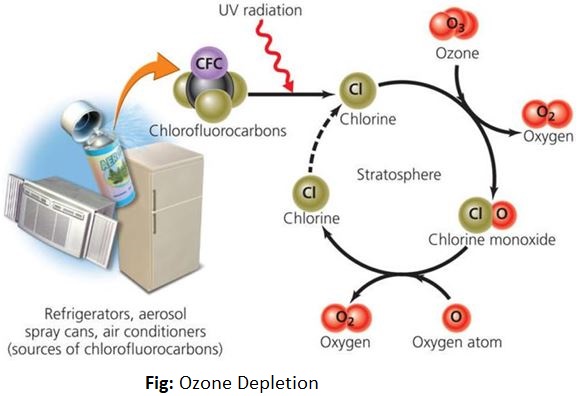
Ozone is depleted due to chlorofluorocarbons which are widely used in refrigerators. Degradation of ozone causes ozone hole. UV radiations that have wavelengths shorter than UV-B are completely absorbed by the atmosphere. UV-B rays are dangerous and damages living organisms. They cause skin cancers, inflammation of cornea, cataract, etc. Recognizing the deleterious effects of ozone depletion, an international treaty, known as the Montreal Protocol, was signed at Montreal (Canada) in 1987 (effective in 1989) to control the emission of ozone depleting substances.
16
Answer
Soil erosion and desertification: Fertile top soil takes centuries to form. Soil erosion takes place due to human activities like over-grazing, over-cultivation, deforestation and poor irrigation practices. This leads to loss of top soil and formation of arid land. This will eventually lead to desertification. Rapid urbanization is a major threat to soil integrity.
Water logging and soil salinity: Improper drainage of water leads to water logging of the soil. Accumulation of water also causes attraction and dissolution of water soluble salts. These salts are then deposited on the soil surface as a thin crust or collected around the plant roots. Increased soil salinity affects plant growth and damages agriculture. Green revolution has played a major role in increased water logging and soil salinity.
17
Answer
The complete removal of forest and tree cover due to reckless felling of trees is called deforestation. It is the result of human activities.
Causes of deforestation:
1. Conversion of forests to farmlands: Forests are cleared by cutting of trees and burning of stumps. The land is used for cultivation and the ash is used as fertilizer. After cultivation of crops the land is left fallow to allow the soil nutrients to regenerate. With increasing population lands do not get enough time to recover and form forests.
2. Urbanization: Rapid urbanization has led to indiscriminate clearing of forests for various purposes such as agriculture, housing, industrialization, etc.
18
Answer
It is the process of restoring forest cover to a place where forests once existed but were cleared off. With sufficient time it can occur naturally. The process can be sped up by human intervention involving planting plants and trees.19
Answer
Bishnoi/Amrita Devi Bishnoi: The Bishnoi community peacefully co-exist with nature. In 1731, a forest nearby their village was ordered to be cleared by the King of Jodhpur. Amrita Devi, her family and around 200 members of her village died protecting the trees. In her honor, the Government of India instituted an award called as “Amrita Devi Bishnoi Wildlife Protection Award”. This is awarded to individuals or communities that show exemplary courage and dedication in protecting wildlife.
Chipko Movement: Local women of Garhwal region in 1974 protected the trees against felling by hugging them.
Joint Forest Movement: It is an initiative by Government of India in 1980s. It aims towards the involvement of local communities and people in sustainable development of forests.