NCERT Revision Notes for Chapter 12 Ecosystem Class 12 Biology
CBSE NCERT Revision Notes1
Answer
Ecosystem is the functional unit of nature in which living organisms interact with each other as well as their surrounding physical environment.
Biosphere: Biosphere is a global ecosystem consisting of all local ecosystems on earth.
Types of ecosystem:
- Aquatic ecosystem: Forest, grassland, desert, etc.
- Terrestrial ecosystem: Pond, lake, wetland, river, estuary, etc.
These are the natural ecosystems.
Ecosystem can be artificial or man-made like the croplands, aquarium, etc.
2
Answer
Biotic Factors: All the living organisms in an ecosystem
Abiotic factors: All the non-living factors in an ecosystem like sunlight, humidity, wind, etc.
The characteristic physical structure of an ecosystem depends on the interaction of biotic and abiotic factors.
Stratification: It is the vertical as well as horizontal distribution of different varieties that occupy different levels. For example, trees occupy top vertical strata or layer of a forest, shrubs the second and herbs and grasses occupy the bottom layers.
The following factors are important for an ecosystem to function as a unit.
- Productivity
- Decomposition
- Energy flow
- Nutrient cycling
The function of an ecosystem is the conversion of inorganic into organic material by the following steps:
- Use of the radiant energy of the sun by the autotrophs
- Consumption of the autotrophs by various heterotrophs
- Decomposition and mineralisation of all the dead organic matter to release the nutrients back into the soil for reuse by the autotrophs.
- These events are repeated again and again.
Energy moves in a unidirectional manner as we move along the trophic levels. Energy dissipates and lost as heat to the environment. Example: Pond ecosystem
- Abiotic factors: Water with all dissolved inorganic and organic nutrients, soil rich in nutrients at the bottom of the pond, solar input, day-length, temperature and other climatic factors.
- Biotic Factors: Producers/ autotrophs: Algae, phytoplankton, floating, submerged and marginal plants in the pond.
- Consumers/ heterotrophs: Zooplankton, free-living and bottom dwelling forms.
- Decomposers: Fungi, bacteria and flagellates abundant in the bottom of the pond
3
Answer
A constant input of solar energy is the basic requirement for any ecosystem.
Primary Production: It is the amount of biomass produced per unit area in a given time period by plants during photosynthesis. It is expressed in terms of weight (g-2) or energy (kcal m-2).
Productivity: It is the rate of biomass production. It is expressed as g-2yr-1 or kcal m-2yr-1.
Gross primary productivity (GPP): GPP of an ecosystem is the rate of production of organic matter during photosynthesis.
Net primary productivity (NPP): Gross primary productivity minus respiration losses (R), is the net primary productivity (NPP).
GPP – R = NPP
Net primary productivity is the available biomass for the consumption to heterotrophs (herbivores and decomposers).
Secondary productivity: It is defined as the rate of formation of new organic matter by consumers.
Primary productivity of an ecosystem depends on the plant species and various environmental factors and therefore, varies from place to place.
The annual net primary productivity of the whole biosphere is approximately 170 billion tons (dry weight) of organic matter. Despite occupying nearly 70 per cent of the earth’s surface the productivity of the oceans is only around 55 billion tons.
4
Answer
Decomposition: Break down of complex organic matter into simpler inorganic substances like carbon dioxide, water and nutrients by the action of decomposers.
Detritus: Dead remain of plants and animals such as leaves, barks, flowers, faecal matter of animals, etc. constitute detritus.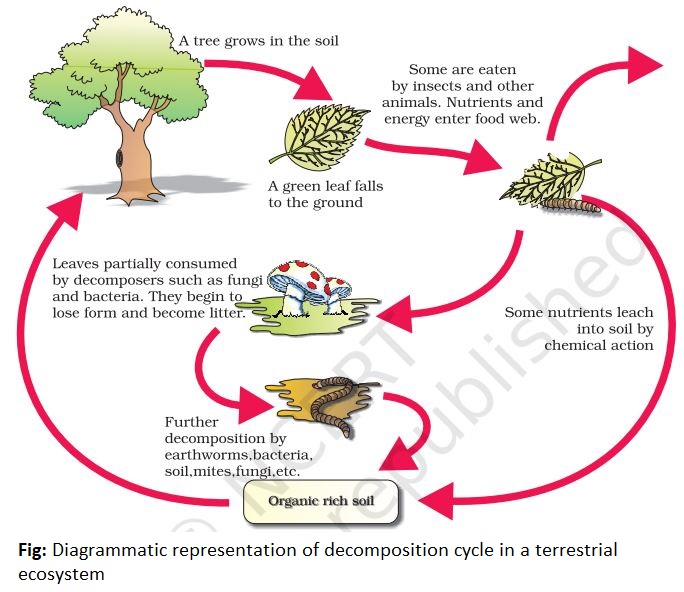
Detritivores: Organisms that feed on detritus are called detritivores. Earthworm, fungi etc. are examples of detritivores.
Steps in Decomposition:
- Fragmentation
- Leaching
- Catabolism
- Humification
- Mineralisation
1. Fragmentation: It is the breakdown of detritus into smaller particles by the action of detritivores.
2. Leaching: It is the process by which water soluble nutrients move downwards to the soil horizon and are precipitated as unavailable salts.
3. Catabolism: It is the breakdown of detritus into simple inorganic nutrients by the action of bacterial and fungal enzymes.
4. Humification: It is the formation and continuous deposition of a dark coloured organic amorphous substance called humus. Humus undergoes very slow decomposition and is highly resistant to microbial action. It is colloidal in nature and therefore serves as a reservoir of nutrients. Humification and mineralisation occur in the soil.
5. Mineralisation: It is the process by which some microorganisms further breakdown humus to form simple inorganic nutrients.
All steps of decomposition occur simultaneously on detritus.
Decomposition is largely an oxygen-requiring process:
- The rate of decomposition depends on the chemical composition of detritus and climatic factors. In a particular climatic condition, decomposition rate is slower if detritus is rich in lignin and chitin, and quicker, if detritus is rich in nitrogen and water-soluble substances like sugars.
- The most important climatic factors that regulate decomposition are temperature and soil moisture. They affect the activities of soil microbes. Decomposition is favoured in warm and moist environment. Decomposition is inhibited by low temperature and anaerobiosis. This results in build-up of organic materials.
5
Answer
• Sun is the ultimate source of energy for all ecosystems on earth (except for the dep sea hydrothermal ecosystem).
• Photosynthetically Active Radiation (PAR): The solar radiations that can be utilised by plants for photosynthesis. Of all incident solar radiation only 50% is PAR. The plants are able to capture only 2-10% of the PAR and it is this energy that sustains all life on earth.
• There is unidirectional flow of energy from the sun to producers and then the consumers. Therefore, all organisms are directly or indirectly dependent on the sun.
• All ecosystems follow First and the Second Law of thermodynamics.
First Law of Thermodynamics:
- The First Law of Thermodynamics states that energy can be converted from one form to another with the interaction of heat, work and internal energy, but it can neither be created nor destroyed, under any circumstances.
- The unidirectional flow of energy shows the First law of Thermodynamics as energy from sun converted into chemical energy by the producers which are then utilised by the consumers. Energy is neither created nor destroyed at any level.
Second Law of Thermodynamics:
- The Second Law of Thermodynamics states that the state of entropy of the entire universe, as an isolated system, will always increase over time. The second law also states that the changes in the entropy in the universe can never be negative.
- To counteract the universal tendency toward increasing disorderliness ecosystems need a constant supply of energy so as to synthesise the molecules they require.
Energy flow in the ecosystem occurs in the form of food chain.
6
Answer
An arrangement of the organisms of an ecological community according to the order of predation in which each uses the next usually lower member as a food source.
Producers: All the green plants in the ecosystem that utilise solar energy for photosynthesis. They are always autotrophic.
Consumers: All heterotrophs are directly or indirectly dependent on plants for food and hence they are all called consumers. Depending on their position in the food chain they can be primary, secondary, tertiary or quaternary.
- Primary Consumers/herbivores: The organisms that are directly dependent on the producers. In the above food chain, grasshopper is the primary consumer.
- Secondary Consumers/Primary carnivores: The organisms that are dependent on the primary consumers. Frog in the above example is a secondary consumer.
- Tertiary consumers/Secondary carnivores: The organisms that are dependent on the secondary consumers.
- Quaternary Consumers/Tertiary carnivore: The organisms that are dependent on the tertiary consumers. They are usually the top carnivore in a food chain.
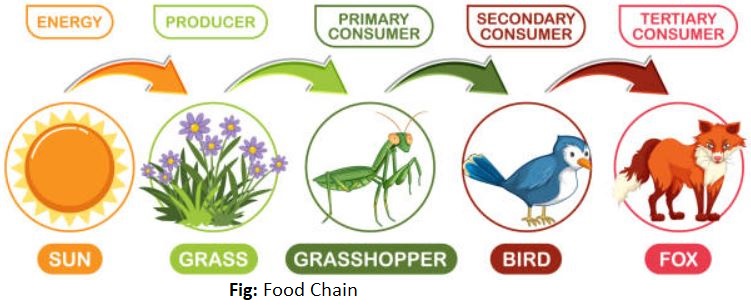
A food chain cannot have more than a quaternary consumer as there won’t be enough energy left. The detritus food chain (DFC) starts with dead organic matter. It is consists of decomposers which are heterotrophs and are mainly fungi and bacteria. They breakdown dead organic matter or detritus to meet their energy and nutrient requirements. These are also known as saprotrophs (sapro: to decompose). They secrete digestive enzymes outside their body to breakdown dead and waste organic materials into simple, inorganic materials. These simpler substances are subsequently absorbed by them.
• The detritus food chain (DFC) starts with dead organic matter. It is consists of decomposers which are heterotrophs and are mainly fungi and bacteria. They breakdown dead organic matter or detritus to meet their energy and nutrient requirements. These are also known as saprotrophs (sapro: to decompose). They secrete digestive enzymes outside their body to breakdown dead and waste organic materials into simple, inorganic materials. These simpler substances are subsequently absorbed by them.
• In an aquatic ecosystem, Grazing Food Chain (GFC) is the major conduit for energy flow. As against this, in a terrestrial ecosystem, a much larger fraction of energy flows through the detritus food chain than through the GFC.
• Detritus food chain could be connected with the grazing food chain as follows: some of the organisms of DFC are prey to the GFC animals. Also in a natural ecosystem, some animals like cockroaches, crows, etc., are omnivores.
• Food Web: It is system of interlocking and interdependent food chains.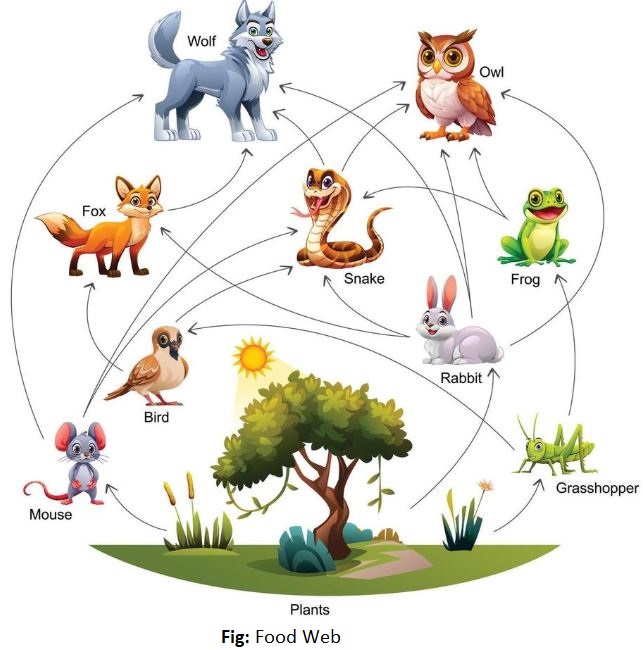
7
Answer
The specific place in the food chain occupied by an organism based on the source of their nutrition or food is called as the trophic level.
- First trophic level: Producers occupy the first trophic level.
- Second trophic level: The primary consumers
- Third trophic level: The secondary consumers
- Fourth trophic level: The tertiary consumers
- Fifth trophic level: The quaternary consumers
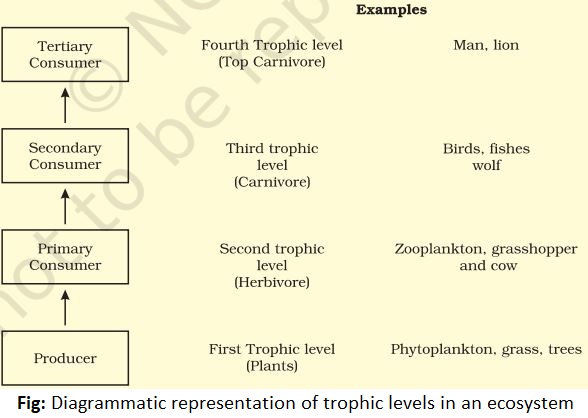
A food chain can have a maximum of five trophic levels as beyond that the amount of energy is insufficient to sustain another consumer. The amount of energy decreases at successive trophic levels.
• When an organism dies it is converted into detritus which serves as a source of energy for the decomposers.
• Standing crop: The total mass at a trophic level at a given time. It is measured as mass of living organisms (biomass) or the number in a unit area.
• Biomass may be expressed as fresh or dry weight. However, use of dry weight is more accurate.
• 10 percent Law: This law states that only 10% of energy of a trophic level is transferred to the next level.
8
Answer
An ecological pyramid is a representation in a graphical manner of the relationship between different organisms in an ecosystem. Each of the bars of the pyramid represents a specific trophic level as well as their order. The order depends on who eats whom. This represents the flow of energy.
The base of each pyramid represents the producers or the first trophic level while the apex represents tertiary or top level consumer. The three commonly studied ecological pyramids are:
- Pyramid of number
- Pyramid of biomass and
- Pyramid of energy
Any calculations of energy content, biomass, or numbers must include all organisms at that trophic level. It is not possible to generalise based only a few individuals at any trophic level.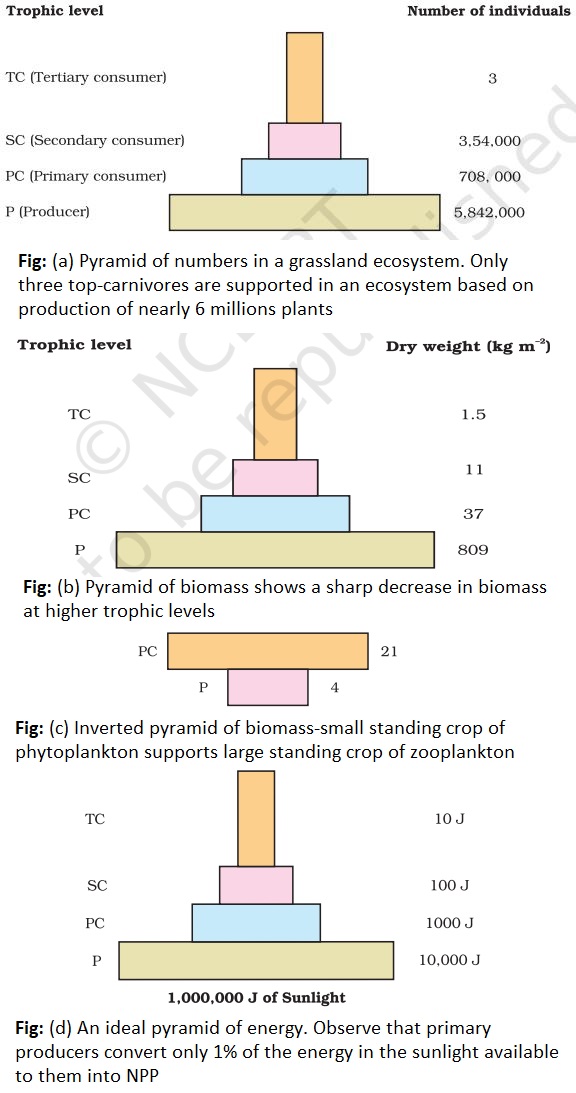
• An organism can be a part of more than one food chains and therefore belong to different trophic levels.
• The pyramids of energy, biomass and number are upright in most ecosystems. That is, the producers are more in number than the herbivores, the herbivores are more than the carnivores, etc.
• Pyramids of number and biomass can be inverted in some cases but the pyramid of energy is always upright. This is because when energy flows from one level to another some amount of energy is always lost as heat.
• Ecological pyramids can accommodate only food chains and not food webs. They can also never depict saprotrophs.
9
Answer
Ecological succession is the process of change in the species structure of an ecological community over time. The time scale can be decades, or even millions of years after a mass extinction. This change is orderly and sequential, parallel with the changes in the physical environment.
- Pioneer Species: The species that invades a bare area
- Pioneer Community: The community that invades a bare area
- Climax community: A community that is in near equilibrium with the environment.
- Sere: A sequence of ecological communities arising in an area from the initial pioneer community to the final climax community
Primary succession: Primary succession is a type of biological and ecological succession of plant life. It occurs in an environment in which new substrate is deposited. This new substrate is devoid of vegetation and other organisms. It also usually lacks soil and organic matter. It occurs in places such land after a lava flow or area left from retreated glacier.
Secondary succession: Secondary succession is a type of biological and ecological succession of plant life which takes place on a habitat that has been previously populated but has since been disturbed or damaged. For example, areas which have been cleared of existing vegetation (due to tree-felling in a woodland or destructive events such as fires).
10
Answer
• Hydrarch: A succession originates in a water body (aquatic environment) is called Hydrosere or Hydrarch Succession.
• Xerarch: Xerosere is a plant succession that is limited by water availability. It includes the different stages in a xerarch succession. Xerosere originates in extremely dry situations such as sand deserts, sand dunes, salt deserts, rock deserts etc.
In secondary succession the invasion of species depends on the availability of water, conditions of the soil, and the environment. It also depends on whether any seeds or other propagules are present. Since soil is already present, the succession rate is much faster and therefore the climax community is attained sooner.
• Succession always proceeds towards the mesic community.
11
Answer
• The movement of nutrients through the various components of an ecosystem is called nutrient cycling. It is also called as biogeochemical cycles (bio: living organism, geo: rocks, air, and water).
Types of nutrient cycles:
(a) Gaseous and
(b) sedimentary.
• Standing state: The total amount of various nutrients like nitrogen, carbon, phosphorus, calcium, etc., present in the soil at any given time, is referred to as the standing state. It varies in different kinds of ecosystems and also on a seasonal basis.
• The reservoir for gaseous nutrient cycles (carbon and nitrogen) exists in the atmosphere.
• The reservoir for the sedimentary nutrient cycle (sulphur, phosphorus, etc.) exists in the earth’s crust.
• Environmental factors regulate the rate of release of nutrients into the atmosphere.
• The reservoir functions to meet with the deficit occurring due to imbalance between influx and efflux.
12
Answer
Most of the chemicals that make up living tissue contain carbon. When organisms die the carbon is recycled so that it can be used by future generations. The movement of carbon through the various components of ecosystem is called as the carbon cycle.
1. Carbon enters the atmosphere as carbon dioxide as a result of respiration and combustion.
2. Carbon dioxide is absorbed by producers for photosynthesis to make carbohydrates.
3. Animals feed on the producers. The food chain causes carbon to move along various trophic levels. Most of the carbon consumed is exhaled as carbon dioxide during respiration. The animals and plants eventually die.
4. The dead organisms are broken down by decomposers. This causes the carbon in their bodies to be returned to the atmosphere as carbon dioxide. In some extraordinary conditions decomposition is blocked. The plant and animal material may then be turned to fossil fuel for use in the future for combustion.
5. Marine animals may convert some of the carbon in their diet to calcium carbonate which is then used to make the shells for their bodies. Over time these shells of dead organisms collect on the seabed and form limestone. Due to various activities and movement of earth this limestone may eventually become exposed to the air where it is subjected to weathering. This causes the carbon to be released back into the atmosphere as carbon dioxide.
Volcanic action may also release carbon dioxide.
6. Human activities have significantly influenced carbon cycle. Rapid deforestation and massive burning of fossil fuels have increased the rate of release of carbon dioxide into the atmosphere.
13
Answer
The phosphorus cycle is the process by which phosphorus moves through the lithosphere, hydrosphere, and biosphere.
Steps in Phosphorus Cycle:
- Weathering
- Fertilizer
- Excretion and Decomposition
- Dissolved Phosphates
- Geologic Uplift
1. Weathering: Weathering of uplifted rocks contributes phosphates to the land. Some phosphates eventually reach the ocean again.
2. Fertilizers: Phosphate fertilizers from fields may run off directly into streams. These may then become part of a soil pool or be absorbed by plants
3. Excretion and decomposition: Excretion by animals (land or in the ocean) and decomposition of both animals and plants release phosphates on land or in water
4. Dissolved phosphates: Dissolved phosphates contribute to forming the ocean sediments by precipitation. Conversion of these sediments into phosphate rocks is a very slow and gradual process.
5. Geological uplift: Geologic forces can slowly lift up phosphate rocks from the ocean floor (the rocks thick with phosphate in them) to form mountains.
Difference between carbon cycle and Phosphorus Cycle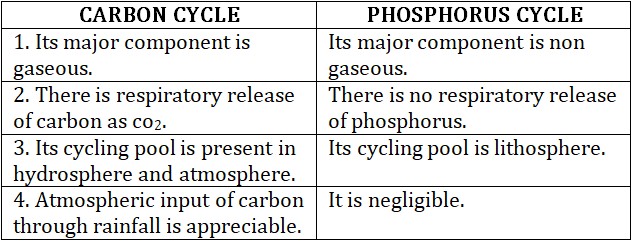
14
Answer
The products of ecosystem processes are called ecosystem services.
Services of healthy forest ecosystems:
- Purification of air and water
- Mitigation of droughts and floods
- Cycling of nutrients
- Generation of fertile soils
- Providing habitats to wildlife
- Maintenance of biodiversity
- Pollination of crops
- To provide storage site for carbon
- Providing aesthetic, cultural and spiritual values.
The average price tag of these ecosystem services are estimated to be US $ 33 trillion annually.
This is nearly twice the value of the global gross national product GNP (US $ 18 trillion).
Out of the total cost of various ecosystem services:
- Soil formation accounts for about 50 per cent
- Recreation for about 10 percent
- Nutrient cycling about 10 per cent.
- The cost of climate regulation and habitat for wildlife are about 6 per cent each.