NCERT Revision Notes Chapter 5 Coal and Petroleum Class 8 Science
CBSE NCERT Revision Notes1
Answer
• Introduction
• Inexhaustible Natural Resources
→ Renewable Resources
• Exhaustible Natural Resources
→ Non-renewable resources
• Coal
→ Story of Coal
→ Uses of coal
• Products from coal
→ Coke
→ Coal tar
→ Coal gas
• Petroleum
→ Petroleum and its uses
• Cracking
• Natural Gas
2
Answer
→ There are two types of resources:
(i) Inexhaustible Natural Resources (Renewable sources of energy)
(ii) Exhaustible Natural Resources (Non-renewable sources of energy)
3
Answer

→ They are renewable sources of energy that are replenished at a rate faster than that at which they are consumed.
→ These resources are present in unlimited quantity in nature and are not likely to be exhausted by human activities.
→ Tidal energy, wave energy, ocean thermal energy.
→ Solar energy: Solar cooker, solar water heater (very efficient for small scale electricity production)
→ Geothermal energy: Heat energy inside the earth
→ Nuclear energy: Not dependent on solar energy, never-ending source, very efficient source, more environment friendly.
4
Answer

They are non-renewable sources of energy are those that are consumed at a rate faster than that at
which they are replenished. The amount of these resources in nature is limited which can be exhausted by human activities.
Examples:
→ Forests, wildlife, minerals, coal, petroleum, natural gas etc.
→ Fossil fuels: Coal, petroleum and natural gas
Advantages of using fossils fuels:
Easy availability
Generate heat that is easily converted into electricity.
→ Coal, petroleum, and natural gas were formed from the dead remains of living organisms. Hence, they are known as fossil fuels
→ Resources such as coal and petroleum are limited. Burning of such fuels is the major cause of air pollution. Therefore, these fuels should be used only when necessary.
→ Burning of fossil fuels releases gases like carbon dioxide which cause greenhouse effect.
5
Answer
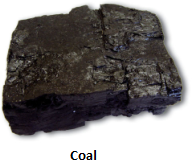
• Story of Coal
→ Due to natural processes, the dense forests got buried under the soil.
→ Under high temperature and high pressure, dead plants got slowly converted to coal.
→ The slow process of conversion of dead vegetation into coal is called carbonisation.
• Uses of Coal
→ It is used as fuel to cook food. Earlier, it was used in railway engines to produce steam.
→ It is used in thermal power stations to generate electricity.
→ Coke, coal tar, and coal gas are the products of coal.
6

Answer
→ It is a tough, porous and black substance.
→ It is the pure form of carbon and is used in the extraction of steel and many other metals.
7
Answer
→ It is black, thick liquid with unpleasant smell.
→ It is the mixture of about 200 substances.
→ The products obtained from coal tar are used as starting materials for dyes, drugs, paints, perfumes, etc.
8
Answer
→ It is obtained during the processing of coal to obtain coke.
→ It is used as a fuel in many industries situated near the coal processing plants.
9
Answer
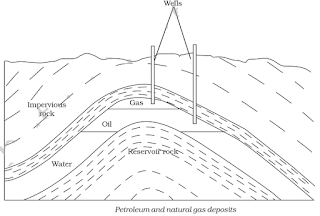
→ Petroleum was formed from the dead organisms present in the sea.
→ Petrol, diesel, kerosene, paraffin wax, lubricating oil, and petroleum gas are the products of petroleum.
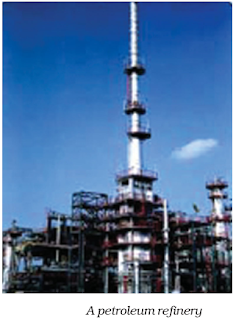
→ The process of separating various constituents of petroleum is known as refining.
→ Refining of petroleum is done in fractionating column.
→ Components with higher boiling points are collected at the bottom of the fractionating column.
→ Components with lower boiling points are collected at the top of the column.
10
Answer
Constituents of Petroleum | Uses |
Petroleum Gas in Liquid form (LPG) | Fuel for home and industry. |
Petrol | Motor fuel, aviation fuel, solvent for dry cleaning |
Paraffin wax | Candle, Vaseline, Ointments etc. |
Diesel | Fuel for heavy motor vehicles, electric generators |
Kerosene | Fuel for stoves, lamps. |
Lubricating oil | Lubrication. |
Bitumen | Paints, road surfacing |
11
Answer
→ Complete combustion of hydrocarbons lead to formation of carbon dioxide and water, while incomplete combustion of hydrocarbons yield carbon monoxide and water.
→ Carbon dioxide as well as carbon monoxide are responsible for pollution in our environment.
→ The test used to determine the amount of carbon monoxide in vehicle's exhaust gases is known as emission test.
→ Gas analyzer is used in detection of carbon monoxide in exhaust gases.
→ Petroleum is a natural resource
→ The formation of petroleum takes place over a period of millions of years.
→ Petroleum reserves are limited i.e. they are found only in a few places on the Earth.
→ The ever increasing population has further increased the demand for petroleum and its products.
→ In India, the Petroleum Conservation Research Association (PCRA) advises people on the various methods that can be adopted to conserve petrol/diesel.
12
Answer
→ Heating higher alkanes to sufficiently high temperatures in absence of oxygen, in order to obtain lower hydrocarbons is known as cracking or pyrolysis.13
Answer
→ Natural gas is formed from dead organisms which decompose in the absence of air under conditions of high pressure and temperature.
→ It is stored under high pressure as compressed natural gas (CNG). It is used as a fuel for vehicles because it is a cleaner fuel (less polluting).