Thermodynamics
Book Solutions1
Choose the correct answer. A thermodynamic state function is a quantity
(i) used to determine heat changes
(ii) whose value is independent of path
(iii) used to determine pressure volume work
(iv) whose value depends on temperature only.
Answer
A thermodynamic state function is a quantity whose value is independent of a path.
Functions like p, V, T etc. depend only on the state of a system and not on the path.
Hence, alternative (ii) is correct.
2
For the process to occur under adiabatic conditions, the correct condition is:
(i) ΔT = 0
(ii) Δp = 0
(iii) q = 0
(iv) w = 0
Answer
A system is said to be under adiabatic conditions if there is no exchange of heat between the system and its surroundings. Hence, under adiabatic conditions, q = 0.Therefore, alternative (iii) is correct.3
The enthalpies of all elements in their standard states are:
(i) unity
(ii) zero
(iii) < 0
(iv) different for each element
Answer
The enthalpy of all elements in their standard state is zero.
Therefore, alternative (ii) is correct.
4
ΔUθof combustion of methane is – X kJ mol–1. The value of ΔHθ is
(i) = ΔUθ
(ii) > ΔUθ
(iii) < ΔUθ
(iv) = 0
Answer
Since ΔHθ = ΔUθ + ΔngRT and ΔUθ = –X kJ mol–1,
ΔHθ = (–X) + ΔngRT.
⇒ ΔHθ < ΔUθ
Therefore, alternative (iii) is correct.
5
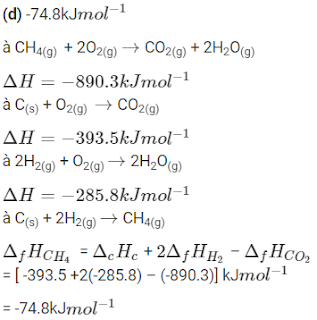
The enthalpy of combustion of methane, graphite and dihydrogen at 298 K are, –890.3 kJ mol-1 –393.5 kJ mol–1, and –285.8 kJ mol–1 respectively. Enthalpy of formation of CH4 (g) will be
(i) +52.27 kJ mol–1 (ii) –52.27 kJ mol–1
(iii) +74.8 kJ mol–1 (iv) –74.8 kJ mol–1.
Answer
6
A reaction, A + B → C + D + q is found to have a positive entropy change. The reaction will be
(i) possible at high temperature
(ii) possible only at low temperature
(iii) not possible at any temperature
(iv) possible at any temperature
Answer
For a reaction to be spontaneous, ΔG should be negative.
ΔG = ΔH – TΔS
According to the question, for the given reaction,
ΔS = positive
ΔH = negative (since heat is evolved)
⇒ ΔG = negative
Therefore, the reaction is spontaneous at any temperature.
Hence, alternative (iv) is correct.
7
Answer
According to the first law of thermodynamics,
ΔU = q + W (i)
Where,
ΔU = change in internal energy for a process
q = heat
W = work
Given,
q = + 701 J (Since heat is absorbed)
W = –394 J (Since work is done by the system)
Substituting the values in expression (i), we get
ΔU = 701 J + (–394 J)
ΔU = 307 J
Hence, the change in internal energy for the given process is 307 J.
8
The reaction of cyanamide, NH2CN(s),with dioxygen was carried out in a bomb calorimeter, and ΔU was found to be –742.7 kJ mol–1at 298 K. Calculate enthalpy change for the reaction at 298 K.
NH2CN(g) +3/2O2(g) → N2(g) + CO2(g) + H2O(l)
Answer
Enthalpy change for a reaction (ΔH) is given by the expression,
ΔH = ΔU + ΔngRT
Where,
ΔU = change in internal energy
Δng = change in number of moles
For the given reaction,
Δng = ∑ng (products) – ∑ng (reactants)
= (2 – 1.5) moles
Δng = 0.5 moles
And,
ΔU = –742.7 kJ mol–1
T = 298 K
R = 8.314 × 10⁻³ kJ mol–1 K–1
Substituting the values in the expression of ΔH:
ΔH = (–742.7 kJ mol–1) + (0.5 mol) (298 K) (8.314 × 10⁻³ kJ mol–1 K–1)
= –742.7 + 1.2, ΔH = –741.5 kJ mol–1
9
Answer
From the expression of heat (q),
q = m. c. ΔT
Where,
c = molar heat capacity
m = mass of substance
ΔT = change in temperature
Substituting the values in the expression of q:
q=(6027 Exercise
10
Calculate the enthalpy change on freezing of 1.0 mol of water at 10.0°C to ice at –10.0°C. ΔfusH = 6.03 kJ mol–1 at 0°C.
Cp[H2O(l)] = 75.3 J mol–1 K–1
Cp[H2O(s)] = 36.8 J mol–1 K–1
Answer
Total enthalpy change involved in the transformation is the sum of the following changes:
(a) Energy change involved in the transformation of 1 mol of water at 10°C to 1 mol of water at 0°C.
(b) Energy change involved in the transformation of 1 mol of water at 0° to 1 mol of ice at 0°C.
(c) Energy change involved in the transformation of 1 mol of ice at 0°C to 1 mol of ice at –10°C.
ΔHtotal=Cp[H2OCl]ΔT+ΔHfreezingCp[H2Os]ΔT
= (75.3 J mol–1 K–1) (0 – 10)K + (–6.03 × 10³ J mol–1) + (36.8 J mol–1 K–1) (–10 – 0)K
= –753 J mol–1 – 6030 J mol–1 – 368 J mol–1
= –7151 J mol–1
= –7.151 kJ mol–1
Hence, the enthalpy change involved in the transformation is –7.151 kJ mol–1.
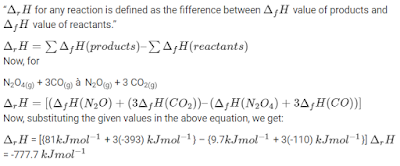
11
Answer

12
Answer
13
Answer
“Standard enthalpy of formation of a compound is the enthalpy that takes place during the formation of 1 mole of a substance in its standard form, from its constituent elements in their standard state.”
Dividing the chemical equation given in the question by 2, we get
(0.5)N2(g) + (1.5)H2(g) → 2NH3(g)
Therefore, Standard Enthalpy for formation of ammonia gas
= (0.5)
= (0.5)(-92.4
= -46.2
14
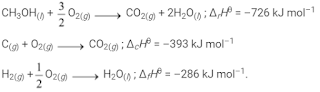
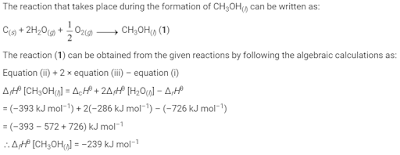
Determine Standard Enthalpy of formation for CH3OH(l) from the data given below:
Answer
15
Calculate the enthalpy change for the process
CCl4(g) → C(g) + 4Cl(g)
and calculate bond enthalpy of C–Cl in CCl4(g).
ΔvapHθ (CCl4) = 30.5 kJ mol–1.
ΔfHθ (CCl4) = –135.5 kJ mol–1.
ΔaHθ (C) = 715.0 kJ mol–1, where ΔaHθ is enthalpy of atomisation
ΔaHθ (Cl2) = 242 kJ mol–1
Answer

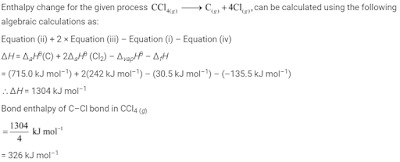
16
Answer
ΔS will be positive i.e., greater than zero
Since ΔU = 0, ΔS will be positive and the reaction will be spontaneous.
17
For the reaction at 298 K,
2A + B → C
ΔH = 400 kJ mol–1 and ΔS = 0.2 kJ K–1 mol–1
At what temperature will the reaction become spontaneous considering ΔH and ΔS to be constant over the temperature range?
Answer
Now,
Let, the given reaction is at equilibrium, then
T =
= 400
Therefore, T = 2000K
Thus, for the spontaneous,
18
For the reaction,
2Cl(g) → Cl2(g), what are the signs of ΔH and ΔS ?
Answer
ΔH and ΔS are negative
The given reaction represents the formation of chlorine molecule from chlorine atoms. Here, bond formation is taking place. Therefore, energy is being released. Hence, ΔH is negative.
Also, two moles of atoms have more randomness than one mole of a molecule. Since spontaneity is decreased, ΔS is negative for the given reaction.
19
For the reaction
2A(g) + B(g) → 2D(g)
ΔUθ = –10.5 kJ and ΔSθ= –44.1 JK–1.
Calculate ΔGθ for the reaction, and predict whether the reaction may occur spontaneously.
Answer
For the given reaction,
2 A(g) + B(g) → 2D(g)
Δng = 2 – (3)
= –1 mole
Substituting the value of ΔUθ in the expression of ΔH:
ΔHθ = ΔUθ + ΔngRT
= (–10.5 kJ) – (–1) (8.314 × 10⁻³ kJ K–1 mol–1) (298 K)
= –10.5 kJ – 2.48 kJ
ΔHθ = –12.98 kJ
Substituting the values of ΔHθ and ΔSθ in the expression of ΔGθ:
ΔGθ = ΔHθ – TΔSθ
= –12.98 kJ – (298 K) (–44.1 J K–1)
= –12.98 kJ + 13.14 kJ
ΔGθ = + 0.16 kJ
Since ΔGθ for the reaction is positive, the reaction will not occur spontaneously.
20
Answer
From the expression,
ΔGθ = –2.303 RT logKeq
ΔGθ for the reaction,
= (2.303) (8.314 JK–1 mol–1) (300 K) log10
= –5744.14 Jmol–1
= –5.744 kJ mol–1
21
What can be said about the thermodynamic stability of NO(g), given
(1/2)N2(g) + (1/2)O2(g) → NO(g); ΔrHθ = 90 kJ mol–1
NO(g) + (1/2)O2(g) → NO2(g); ΔrHθ= –74 kJ mol–1
Answer
The positive value of ΔrH indicates that heat is absorbed during the formation of NO(g). This means that NO(g)has higher energy than the reactants (N2 and O2). Hence, NO(g) is unstable.
The negative value of ΔrH indicates that heat is evolved during the formation of NO2(g) from NO(g) and O2(g). The product, NO2(g) is stabilized with minimum energy.
Hence, unstable NO(g) changes to stable NO2(g).
22
Answer
Thus, the same heat will be absorbed by surrounding. Qsurr = +286
Now,
=
Therefore,