Thermal Properties of Matter
Book Solutions1
11.1. The triple points of neon and carbon dioxide are 24.57 K and 216.55 K respectively. Express these temperatures on the Celsius and Fahrenheit scales.
Answer
Kelvin and Celsius
scales are related as:
TC = TK – 273.15 … (i)
Celsius and Fahrenheit scales are related as:
TF = (9/5)TC + 32 ....(ii)
For neon:
TK = 24.57 K
∴ TC = 24.57 – 273.15 = –248.58°C
TF = (9/5)TC + 32
= (9/5) × (-248.58) +32
= 415.440 F
For carbon dioxide:
TK = 216.55 K
∴ TC= 216.55 – 273.15 = –56.60°C
TF = (9/5)TC + 32
= (9/5) × (-56.60) +32
= -69.880 C
2
Answer
Triple point of water on absolute scaleA, T1 = 200 A
Triple point of water on absolute scale B, T2 = 350 B
Triple point of water on Kelvin scale, TK = 273.15 K
The temperature 273.15 K on Kelvin scale is equivalent to 200 A on absolute scale A.
T1 = TK
200 A = 273.15 K
∴ A = 273.15/200
The temperature 273.15 K on Kelvin scale is equivalent to 350 B on absolute scale B.
T2 = TK
350 B = 273.15
∴ B = 273.15/350
TA is triple point of water on scale A.
TB is triple point of water on scale B.
∴ 273.15/200 × TA = 273.15/350 × TB
Therefore, the ratio TA : TB is given as 4 : 7.
3
11.3. The electrical resistance in ohms of a certain thermometer varies with temperature according to the approximate law:
R = Ro [1 + α (T – To)]
The resistance is 101.6 Ω at the triple-point of water 273.16 K, and 165.5 Ω at the normal melting point of lead (600.5 K). What is the temperature when the resistance is 123.4 Ω?
Answer
It is given that:
R = R0 [1 + α (T – T0)] … (i)
where,
R0 and T0 are the initial resistance and temperature respectively
R and T are the final resistance and temperature respectively
α is a constant
At the triple point of water, T0 = 273.15 K
Resistance of lead, R0 = 101.6 Ω
At normal melting point of lead, T = 600.5 K
Resistance of lead, R = 165.5 Ω
Substituting these values in equation (i), we get:
R = Ro [1 + α (T – To)]
165.5 = 101.6 [ 1 + α(600.5 - 273.15) ]
1.629 = 1 + α (327.35)
∴ α = 0.629 / 327.35 = 1.92 × 10⁻³ K-1
For resistance, R1 = 123.4 Ω
R1 = R0 [1 + α (T – T0)]
where,
T is the temperature when the resistance of lead is 123.4 Ω
123.4 = 101.6 [ 1 + 1.92 × 10⁻³( T - 273.15) ]
Solving for T, we get
T = 384.61 K.
4
11.4. Answer the following:
(a) The triple-point of water is a standard fixed point in modern thermometry. Why? What is wrong in taking the melting point of ice and the boiling point of water as standard fixed points (as was originally done in the Celsius scale)?
(b) There were two fixed points in the original Celsius scale as mentioned above which were assigned the number 0 °C and 100 °C respectively. On the absolute scale, one of the fixed points is the triple-point of water, which on the Kelvin absolute scale is assigned the number 273.16 K. What is the other fixed point on this (Kelvin) scale?
(c) The absolute temperature (Kelvin scale) T is related to the temperature tc on the Celsius scale by
tc = T – 273.15
Why do we have 273.15 in this relation, and not 273.16?
(d) What is the temperature of the triple-point of water on an absolute scale whose unit interval size is equal to that of the Fahrenheit scale?
Answer
(a) The triple point of water has a unique value of 273.16 K. At particular values of volume and pressure, the triple point of water is always 273.16 K. The melting point of ice and boiling point of water do not have particular values because these points depend on pressure and temperature.
(b) The absolute zero or 0 K is the other fixed point on the Kelvin absolute scale.
(c) The temperature 273.16 K is the triple point of water. It is not the melting point of ice. The temperature 0°C on Celsius scale is the melting point of ice. Its corresponding value on Kelvin scale is 273.15 K.
Hence, absolute temperature (Kelvin scale) T, is related to temperature tc, on Celsius scale as:
tc = T – 273.15
(d) Let TF be the temperature on Fahrenheit scale and TK be the temperature on absolute scale. Both the temperatures can be related as:
(TF - 32) / 180 = (TK - 273.15) / 100 ....(i)
Let TF1 be the temperature on Fahrenheit scale and TK1 be the temperature on absolute scale. Both the temperatures can be related as:
(TF1 - 32) / 180 = (TK1 - 273.15) / 100 ....(ii)
It is given that:
TK1 – TK = 1 K
Subtracting equation (i) from equation (ii), we get:
(TF1 - TF) / 180 = (TK1 - TK) / 100 = 1 / 100
TF1 - TF = (1 ×180) / 100 = 9/5
Triple point of water = 273.16 K
∴ Triple point of water on absolute scale = 273.16 × (9/5) = 491.69
5
11.5. Two ideal gas thermometers Aand Buse oxygen and hydrogen respectively. The following observations are made:
Temperature | Pressure thermometer A | Pressure thermometer B |
Triple-point of water | 1.250 × 10⁵ Pa | 0.200 × 10⁵ Pa |
Normal melting point of sulphur | 1.797 × 10⁵ Pa | 0.287 × 10⁵ Pa |
(a) What is the absolute temperature of normal melting point of sulphur as read by thermometers Aand B?
(b) What do you think is the reason behind the slight difference in answers of thermometers Aand B? (The thermometers are not faulty). What further procedure is needed in the experiment to reduce the discrepancy between the two readings?
Answer
(a) Triple point of water, T = 273.16 K.
At this temperature, pressure in thermometer A, PA = 1.250 × 10⁵ Pa
Let T1 be the normal melting point of sulphur.
At this temperature, pressure in thermometer A, P1 = 1.797 × 10⁵ Pa
According to Charles’ law, we have the relation:
PA / T = P1 / T1
∴ T1 = (P1T) / PA = (1.797 × 10 × 273.16) / (1.250 × 10⁵)
= 392.69 K
Therefore, the absolute temperature of the normal melting point of sulphur as read by thermometer A is 392.69 K.
At triple point 273.16 K, the pressure in thermometer B, PB = 0.200 × 10⁵ Pa
At temperature T1, the pressure in thermometer B, P2 = 0.287 × 10⁵ Pa
According to Charles’ law, we can write the relation:
PB / T = P1 / T1
(0.200 × 10⁵) / 273.16 = (0.287 × 10⁵) / T1
∴ T1 = [ (0.287 × 10⁵) / (0.200 × 10⁵) ] × 273.16 = 391.98 K
Therefore, the absolute temperature of the normal melting point of sulphur as read by thermometer B is 391.98 K.
(b) The oxygen and hydrogen gas present in thermometers A and B respectively are not perfect ideal gases. Hence, there is a slight difference between the readings of thermometers A and B.
To reduce the discrepancy between the two readings, the experiment should be carried under low pressure conditions. At low pressure, these gases behave as perfect ideal gases.
6
Answer
Length of the steel tape at temperature T = 27°C, l = 1 m = 100 cm
At temperature T1 = 45°C, the length of the steel rod, l1 = 63 cm
Coefficient of linear expansion of steel, α = 1.20 × 10⁻⁵ K–1
Let l2 be the actual length of the steel rod and l' be the length of the steel tape at 45°C.
l' = l + αl(T1 - T)
∴ l' = 100 + 1.20 × 10-5 × 100(45 - 27)
= 100.0216 cm
Hence, the actual length of the steel rod measured by the steel tape at 45°C can be calculated as:
l2 = (100.0216 / 100) × 63 = 63.0136 cm
Therefore, the actual length of the rod at 45.0°C is 63.0136 cm. Its length at 27.0°C is 63.0 cm.
7
Answer
The given temperature, T = 27°C can be written in Kelvin as:
27 + 273 = 300 K
Outer diameter of the steel shaft at T, d1 = 8.70 cm
Diameter of the central hole in the wheel at T, d2 = 8.69 cm
Coefficient of linear expansion of steel, αsteel = 1.20 × 10⁻⁵ K–1
After the shaft is cooled using ‘dry ice’, its temperature becomes T1.
The wheel will slip on the shaft, if the change in diameter, Δd = 8.69 – 8.70
= – 0.01 cm
Temperature T1, can be calculated from the relation:
Δd = d1αsteel (T1 – T)
0.01 = 8.70 × 1.20 × 10–5 (T1 – 300)
(T1 – 300) = 95.78
∴ T1= 204.21 K
= 204.21 – 273.16
= –68.95°C
Therefore, the wheel will slip on the shaft when the temperature of the shaft is –69°C.
8
Answer
Initial temperature, T1 = 27.0°C
Diameter of the hole at T1, d1 = 4.24 cm
Final temperature, T2 = 227°C
Diameter of the hole at T2 = d2
Co-efficient of linear expansion of copper, αCu= 1.70 × 10⁻⁵ K–1
For co-efficient of superficial expansion β,and change in temperature ΔT, we have the relation:
Change in area (∆) / Original area (A) = β∆T
[ (πd22/ 4) - (πd12 / 4) ] / (πd11 / 4) = ∆A / A
∴ ∆A / A = (d22 - d12) / d12
But β = 2α
∴ (d22 - d12) / d12 = 2α∆T
(d22 / d12) - 1 = 2α(T2 - T1)
d22 / 4.242 = 2 × 1.7 × 10-5 (227 - 27) +1
d22 = 17.98 × 1.0068 = 18.1
∴ d2 = 4.2544 cm
Change in diameter = d2 – d1 = 4.2544 – 4.24 = 0.0144 cm
Hence, the diameter increases by 1.44 × 10⁻² cm.
9
11.9. A brass wire 1.8 m long at 27 °C is held taut with little tension between two rigid supports. If the wire is cooled to a temperature of –39 °C, what is the tension developed in the wire, if its diameter is 2.0 mm? Co-efficient of linear expansion of brass = 2.0 × 10⁻⁵ K–1; Young’s modulus of brass = 0.91 × 10¹¹ Pa.
Answer
Initial temperature, T1 = 27°C
Length of the brass wire at T1, l = 1.8 m
Final temperature, T2 = –39°C
Diameter of the wire, d = 2.0 mm = 2 × 10⁻³ m
Tension developed in the wire = F
Coefficient of linear expansion of brass, α = 2.0 × 10⁻⁵ K–1
Young’s modulus of brass, Y = 0.91 × 10¹¹ Pa
Young’s modulus is given by the relation:
γ = Stress / Strain = (F/A) / (∆L/L)
∆L = F X L / (A X Y) ......(i)
Where,
F = Tension developed in the wire
A = Area of cross-section of the wire.
ΔL = Change in the length, given by the relation:
ΔL = αL(T2 – T1) … (ii)
Equating equations (i) and (ii), we get:
αL(T2 - T1) = FL / [ π(d/2)2 X Y ]
F = α(T2 - T1)πY(d/2)2
F = 2 × 10⁻⁵ × (-39-27) × 3.14 × 0.91 × 1011 × (2 × 10-3 / 2 )2
= -3.8 × 10² N
(The negative sign indicates that the tension is directed inward.)
Hence, the tension developed in the wire is 3.8 ×10² N.
10
Answer
Initial temperature, T1 = 40°C
Final temperature, T2 = 250°C
Change in temperature, ΔT = T2 – T1 = 210°C
Length of the brass rod at T1, l1 = 50 cm
Diameter of the brass rod at T1, d1 = 3.0 mm
Length of the steel rod at T2, l2 = 50 cm
Diameter of the steel rod at T2, d2 = 3.0 mm
Coefficient of linear expansion of brass, α1 = 2.0 × 10⁻⁵K–1
Coefficient of linear expansion of steel, α2 = 1.2 × 10⁻⁵K–1
For the expansion in the brass rod, we have:
Change in length (∆l1) / Original length (l1) = α1ΔT
∴ ∆l1 = 50 × (2.1 × 10-5) × 210
= 0.2205 cm
For the expansion in the steel rod, we have:
Change in length (∆l2) / Original length (l2) = α2ΔT
∴ ∆l1 = 50 × (1.2 × 10-5) × 210
= 0.126 cm
Total change in the lengths of brass and steel,
Δl = Δl1 + Δl2
= 0.2205 + 0.126
= 0.346 cm
Total change in the length of the combined rod = 0.346 cm
Since the rod expands freely from both ends, no thermal stress is developed at the junction.
11
Answer
Coefficient of volume expansion of glycerin, αV = 49 × 10–5 K–1
Rise in temperature, ΔT = 30°C
Fractional change in its volume = ΔV/V
This change is related with the change in temperature as:
ΔV/V = αV ΔT
VT2 - VT1 = VT1 αV ΔT
(m /ρT2)- (m /ρT1) = (m /ρT1)αV ΔT
Where,
m = Mass of glycerine
ρT1 = Initial density at T1
ρT2 = Initial density at T2
(ρT1 - ρT2 ) / ρT2 = Fractional change in density
∴ Fractional change in the density of glycerin = 49 ×10–5 × 30 = 1.47 × 10⁻².
12
Answer
Power of the drilling machine, P = 10 kW = 10 × 103 W
Mass of the aluminum block, m = 8.0 kg = 8 × 10³ g
Time for which the machine is used, t = 2.5 min = 2.5 × 60 = 150 s
Specific heat of aluminium, c = 0.91 J g–1 K–1
Rise in the temperature of the block after drilling = δT
Total energy of the drilling machine = Pt
= 10 × 103 × 150
= 1.5 × 10⁶ J
It is given that only 50% of the power is useful.
Useful energy, ∆Q = (50/100) × 1.5 × 106 = 7.5 × 10⁵ J
But ∆Q = mc∆T
∴ ∆T = ∆Q / mc
= (7.5 × 10⁵) / (8 × 103 × 0.91)
= 103o C
Therefore, in 2.5 minutes of drilling, the rise in the temperature of the block is 103°C.
13
Answer
Mass of the copper block, m = 2.5 kg = 2500 g
Rise in the temperature of the copper block, Δθ = 500°C
Specific heat of copper, C = 0.39 J g–1 °C–1
Heat of fusion of water, L = 335 J g–1
The maximum heat the copper block can lose, Q = mCΔθ
= 2500 × 0.39 × 500
= 487500 J
Let m1 g be the amount of ice that melts when the copper block is placed on the ice block.
The heat gained by the melted ice, Q = m1L
∴ m1 = Q / L = 487500 / 335 = 1455.22 g
Hence, the maximum amount of ice that can melt is 1.45 kg.
14
Answer
Mass of the metal, m = 0.20 kg = 200 g
Initial temperature of the metal, T1 = 150°C
Final temperature of the metal, T2 = 40°C
Calorimeter has water equivalent of mass, m’ = 0.025 kg = 25 g
Volume of water, V = 150 cm3
Mass (M) of water at temperature T = 27°C:
150 × 1 = 150 g
Fall in the temperature of the metal:
ΔT = T1 – T2 = 150 – 40 = 110°C
Specific heat of water, Cw = 4.186 J/g/°K
Specific heat of the metal = C
Heat lost by the metal, θ = mCΔT … (i)
Rise in the temperature of the water and calorimeter system:
ΔT′’ = 40 – 27 = 13°C
Heat gained by the water and calorimeter system:
Δθ′′ = m1 CwΔT’
= (M + m′) Cw ΔT’ … (ii)
Heat lost by the metal = Heat gained by the water and colorimeter system
mCΔT = (M + m’) Cw ΔT’
200 × C × 110 = (150 + 25) × 4.186 × 13
∴ C = (175 × 4.186 × 13) / (110 × 200) = 0.43 Jg-1K-1
If some heat is lost to the surroundings, then the value of C will be smaller than the actual value.
15

Answer
The gases listed in the given table are diatomic. Besides the translational degree of freedom, they have other degrees of freedom (modes of motion).
Heat must be supplied to increase the temperature of these gases. This increases the average energy of all the modes of motion. Hence, the molar specific heat of diatomic gases is more than that of monatomic gases.
If only rotational mode of motion is considered, then the molar specific heat of a diatomic gas = (5/2)R
= (5/2) × 1.98 = 4.95 cal mol-1 K-1
With the exception of chlorine, all the observations in the given table agree with (5/2)R.
This is because at room temperature, chlorine also has vibrational modes of motion besides rotational and translational modes of motion.
16
11.16. Answer the following questions based on the P-T phase diagram of carbon dioxide:
(a) At what temperature and pressure can the solid, liquid and vapour phases of CO2 co-exist in equilibrium?
(b) What is the effect of decrease of pressure on the fusion and boiling point of CO2?
(c) What are the critical temperature and pressure for CO2? What is their significance?
(d) Is CO2 solid, liquid or gas at (a) –70 °C under 1 atm, (b) –60° C under 10 atm, (c) 15 °C under 56 atm?
Answer
he P-T phase diagram for CO2 is shown in the following figure:
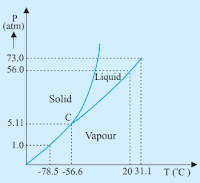
(a) The solid, liquid and vapour phase of carbon dioxide exist in equilibrium at the triple point, i.e., temprature = - 56.6° C and pressure = 5.11 atm.
(b) With the decrease in pressure, both the fusion and boiling point of carbon dioxide will decrease.
(c) For carbon dioxide, the critical temperature is 31.1° C and critical pressure is 73.0 atm. If the temprature of carbon dioxide is more than 31.1° C, it can not be liquified, however large pressure we may apply.
(d) Carbon dioxide will be (a) a vapour, at =70° C under 1atm. (b) a solid, at -6° C under 10 atm (c) a liquid, at 15° C under 56 atm.
17
11.17. Answer the following questions based on the P–T phase diagram of CO2:
(a) CO2 at 1 atm pressure and temperature – 60 °C is compressed isothermally. Does it go through a liquid phase?
(b) What happens when CO2 at 4 atm pressure is cooled from room temperature at constant pressure?
(c) Describe qualitatively the changes in a given mass of solid CO2 at 10 atm pressure and temperature –65 °C as it is heated up to room temperature at constant pressure.
(d) CO2 is heated to a temperature 70° C and compressed isothermally. What changes in its properties do you expect to observe?
Answer

(a) Since the temprature -60° C lies to the left of 56.6° C on the curve i.e. lies in the region vapour and solid phase, so carbon dioxide will condense directly into the solid without becoming liquid.
(b) Since the pressure 4 atm is less than 5.11 atm the carbon dioxide will condense directly into solid without becoming liquid.
(c) When a solid CO2 at 10 atm pressure and -65° C temprature is heated, it is first converted into liquid. A further increase in temprature brings it into the vapour phase. At P = 10 atm, if a horizontal line is drawn parallel to the T-axis, then the points of intersection of this line with the fusion and vaporization curve will give the fusion and boiling points of CO2 at 10 atm.
(d) Since 70° C is higher than the critical temprature of CO2, so the CO2 gas can not be converted into liquid state on being compressed isothermally at 70° C. It will remain in the vapour state. However, the gas will depart more and more from its perfect gas behaviour with the increase in pressure.
18
Answer
Initial temperature of the body of the child, T1 = 101°F
Final temperature of the body of the child, T2 = 98°F
Change in temperature, ΔT = [ (101 - 98) × (5/9) ] o C
Time taken to reduce the temperature, t = 20 min
Mass of the child, m = 30 kg = 30 × 103 g
Specific heat of the human body = Specific heat of water = c
= 1000 cal/kg/ °C
Latent heat of evaporation of water, L = 580 cal g–1
The heat lost by the child is given as:
∆θ = mc∆T
= 30 × 1000 × (101 - 98) × (5/9)
= 50000 cal
Let m1 be the mass of the water evaporated from the child’s body in 20 min.
Loss of heat through water is given by:
∆θ = m1L
∴ m1 = ∆θ / L
= (50000 / 580) = 86.2 g
∴ Average rate of extra evaporation caused by the drug = m1 / t
= 86.2 / 200
= 4.3 g/min.
19
Answer
Side of the given cubical ice box, s = 30 cm = 0.3 m
Thickness of the ice box, l = 5.0 cm = 0.05 m
Mass of ice kept in the ice box, m = 4 kg
Time gap, t = 6 h = 6 × 60 × 60 s
Outside temperature, T = 45°C
Coefficient of thermal conductivity of thermacole, K = 0.01 J s–1 m–1 K–1
Heat of fusion of water, L = 335 × 103 J kg–1
Let m’ be the total amount of ice that melts in 6 h.
The amount of heat lost by the food:
θ = KA(T - 0)t / l
Where,
A = Surface area of the box = 6s2 = 6 × (0.3)2 = 0.54 m3
θ = 0.01 × 0.54 × 45 × 6 × 60 × 60 / 0.05 = 104976 J
But θ = m'L
∴ m' = θ/L
= 104976/(335 × 103) = 0.313 kg
Mass of ice left = 4 – 0.313 = 3.687 kg
Hence, the amount of ice remaining after 6 h is 3.687 kg.
20
Answer
Base area of the boiler, A = 0.15 m2
Thickness of the boiler, l = 1.0 cm = 0.01 m
Boiling rate of water, R = 6.0 kg/min
Mass, m = 6 kg
Time, t = 1 min = 60 s
Thermal conductivity of brass, K = 109 J s –1 m–1 K–1
Heat of vaporisation, L = 2256 × 103 J kg–1
The amount of heat flowing into water through the brass base of the boiler is given by:
θ = KA(T1 - T2) t / l ....(i)
where,
T1 = Temperature of the flame in contact with the boiler
T2 = Boiling point of water = 100°C
Heat required for boiling the water:
θ = mL … (ii)
Equating equations (i) and (ii), we get:
∴ mL = KA(T1 - T2) t / l
T1 - T2 = mLl / KAt
= 6 × 2256 × 103 × 0.01 / (109 × 0.15 × 60)
= 137.98 o C
Therefore, the temperature of the part of the flame in contact with the boiler is 237.98°C.
21
11.21. Explain why:
(a) a body with large reflectivity is a poor emitter
(b) a brass tumbler feels much colder than a wooden tray on a chilly day
(c) an optical pyrometer (for measuring high temperatures) calibrated for an ideal black body radiation gives too low a value for the temperature of a red hot iron piece in the open, but gives a correct value for the temperature when the same piece is in the furnace
(d) the earth without its atmosphere would be inhospitably cold
(e) heating systems based on circulation of steam are more efficient in warming a building than those based on circulation of hot water
Answer
(a) A body with a large reflectivity is a poor absorber of light radiations. A poor absorber will in turn be a poor emitter of radiations. Hence, a body with a large reflectivity is a poor emitter.
(b) Brass is a good conductor of heat. When one touches a brass tumbler, heat is conducted from the body to the brass tumbler easily. Hence, the temperature of the body reduces to a lower value and one feels cooler.
Wood is a poor conductor of heat. When one touches a wooden tray, very little heat is conducted from the body to the wooden tray. Hence, there is only a negligible drop in the temperature of the body and one does not feel cool.
Thus, a brass tumbler feels colder than a wooden tray on a chilly day.
(c) An optical pyrometer calibrated for an ideal black body radiation gives too low a value for temperature of a red hot iron piece kept in the open.
Black body radiation equation is given by:
E = σ (T4 - T04)
Where,
E = Energy radiation
T = Temperature of optical pyrometer
To = Temperature of open space
σ = Constant
Hence, an increase in the temperature of open space reduces the radiation energy.
When the same piece of iron is placed in a furnace, the radiation energy, E = σ T4
(d) Without its atmosphere, earth would be inhospitably cold. In the absence of atmospheric gases, no extra heat will be trapped. All the heat would be radiated back from earth’s surface.
(e) A heating system based on the circulation of steam is more efficient in warming a building than that based on the circulation of hot water. This is because steam contains surplus heat in the form of latent heat (540 cal/g).
22
Answer
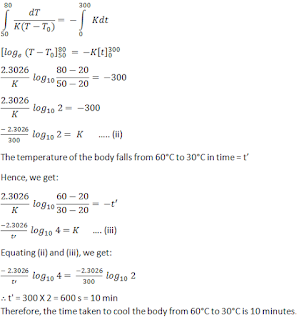
According to Newton’s law of cooling, we have:
(-dT/T) = K(T - T0)
dT / K(T - T0) = -Kdt ....(i)
Where,
Temperature of the body = T
Temperature of the surroundings = T0 = 20°C
K is a constant
Temperature of the body falls from 80°C to 50°C in time, t = 5 min = 300 s
Integrating equation (i), we get: