NCERT Solutions for Chapter 5 The Fundamental Unit of Life Class 9 Science
Book Solutions1
Answer
An English Botanist, Robert Hooke discovered cells. In 1665, he used self-designed microscope to observe cells in a cork slice.2
Answer
Cells are called the structural and functional unit of life because all the living organisms are made up of cells and also all the functions taking place inside the body of organisms are performed by cells.1
Answer
The substances like CO2 and water move in and out of a cell by diffusion from the region of high concentration to low concentration.
When the concentration of CO2 and water is higher in external environment than that inside the cell, CO2 and water moves inside the cell. When the concentration outside the cell becomes low and it is high inside the cell, they moves out.
2
Answer
Plasma membrane called a selectively permeable membrane because it regulates the movement of substances in and out of the cell. This means that the plasma membrane allows the entry of only some substances and prevents the movement of some other materials.
1
Fill in the gaps in the following table illustrating differences between prokaryotic and eukaryotic cells.
|
|
Prokaryotic cell |
|
Eukaryotic cell |
|
1. |
Size: generally small (1-10 μm) 1 μm = 106 m |
1. |
Size : generally large (5-100 μm) |
|
2. |
Nuclear region: ……… and is known as ……… |
2. |
Nuclear region : well-defined and surrounded by a nuclear membrane |
|
3. |
Chromosome : single |
3. |
More than on chromosome |
|
4. |
Membrane – bound cell organelles are absent |
4. |
……………………………………………………. |
Answer
|
|
Prokaryotic cell |
|
Eukaryotic cell |
|
1. |
Size: generally small (1-10 μm) 1 μm = 106 m |
1. |
Size : generally large (5-100 μm) |
|
2. |
Nuclear region: poorly defined because of the absence of a nuclear membrane, and is known as nucleoid |
2. |
Nuclear region : well-defined and surrounded by a nuclear membrane |
|
3. |
Chromosome : single |
3. |
More than on chromosome |
|
4. |
Membrane – bound cell organelles are absent |
4. |
Membrane – bound cell organelles such as mitochondria , plastids , etc., are present |
1
Answer
Mitochondria and plastids2
Answer
If the organisation of a cell is destroyed due to some physical or chemical influence then cell will not be able to perform the basic functions like respiration, nutrition, excretion etc. This may stop all the life activities and may result in its death.3
Answer
Lysosomes are called suicide bags because in case of disturbance of their cellular metabolism they digest their own cell by releasing own enzymes.4
Answer
The proteins are synthesized in the Ribosome inside the cell.1
Answer
| Animal cell | Plant cell |
| They do not have a cell wall. | They have a cell wall made up of cellulose. |
| They do not have chloroplast. | They contain chloroplast. |
| They have centrosome. | They do not have centrosome. |
| Vacuoles are smaller in size. | Vacuoles are larger in size. |
| Lysosomes are larger in number. | Lysosomes are absent or very few in number |
| Prominent Golgi bodies are present. | Subunits of Golgi bodies known as dictyosomes are present. |
2
Answer
| Prokaryotic cell | Eukaryotic cell |
| Most prokaryotes are unicellular. | Most eukaryotes are multicellular. |
| Size of the cell is generally small (0.5- 5 µm). | Size of the cell is generally large (50- 100 µm). |
| Nuclear region is poorly defined due to the absence of a nuclear membrane or the cell lacks true nucleus.a | Nuclear region is well-defined and is surrounded by a nuclear membrane, or true nucleus bound by a nuclear membrane is present in the cell. |
| It contains a single chromosome. | It contains more than one chromosome. |
|
Nucleolus is absent.
|
Nucleolus is present. |
| Membrane-bound cell organelles such as plastids, mitochondria, endoplasmic reticulum, Golgi apparatus, etc. are absent. | Cell organelles such as mitochondria, plastids, endoplasmic reticulum, Golgi apparatus, lysosomes, etc. are present. |
| Cell division occurs through binary fission | Cell division occurs by mitosis. |
| Prokaryotic cells are found in bacteria and blue-green algae. | Eukaryotic cells are found in fungi, plants, and animal cells. |
3
Answer
If the plasma membrane ruptures or breakdown then the cell will not be able to exchange material from its surrounding by diffusion or osmosis. Thereafter the protoplasmic material will be disappeared and the cell will die.4
Answer
5
Answer
Mitochondria are known as the powerhouse of cells because energy required for various chemical activities needed for life is released by mitochondria in the form of ATP (Adenosine triphosphate) molecules.6
Answer
Lipids are synthesized in Smooth endoplasmic reticulum (SER) and the proteins are synthesized in rough endoplasmic reticulum (RER).7
Answer
Amoeba takes in food using temporary finger-like extensions of the cell surface which fuse over the food particle forming a food-vacuole as shown in figure. Inside the food vacuole, complex substances are broken down into simpler ones which then diffuse into the cytoplasm. The remaining undigested material is moved to the surface of the cell and thrown out.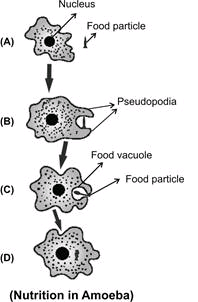
8
Answer
Osmosis is the process in which water molecules moves from the region of high concentration to a region of low concentration through a semi permeable membrane.9
Carry out the following osmosis experiment:
(a) Keep cup A empty
(b) Put one teaspoon sugar in cup B
(c) Put one teaspoon salt in cup C
(d) Put one teaspoon sugar in the boiled potato cup D.
(ii) Why is potato A necessary for this experiment?
(iii) Explain why water does not gather in the hollowed out portions of A and D.
Answer
(i) Water gathers in the hollowed portions of set-up B and C because water enters the potato as a result of osmosis. Since the medium surrounding the cell has a higher water concentration than the cell, the water moves inside by osmosis. Hence, water gathers in the hollowed portions of the potato cup.(ii) Potato A in the experiment acts as a control set-up. No water gathers in the hollowed portions of potato A.
(iii) Water does not gather in the hollowed portions of potato A because potato cup A is empty. It is a control set-up in the experiment.
Water is not able to enter potato D because the potato used here is boiled. Boiling denatures the proteins present in the cell membrane and thus, disrupts the cell membrane. For osmosis, a semi-permeable membrane is required, which is disrupted in this case. Therefore, osmosis will not occur. Hence, water does not enter the boiled potato cup.
10
Answer
Mitosis is required for growth and repair of body and meiosis is involved in the formation of gametes.