The d-and f-Block Elements
Book Solutions1
Write the electronic configuration of:
(i) Cr3+ (ii) Pm3+ (iii) Cu+ (iv)Ce4+ (v) Co2+ (vi) Lu2+ (vii) Mn2+ (viii) Th4+
Answer
(i) Cr3+: 1s2 2s2 2p6 3s2 3p6 3d3
Or, [Ar]18 3d3
(ii) Pm3+: 1s2 2s2 2p6 3s2 3p6 3d10 4s2 4p6 4d10 5s2 5p6 4f4
Or, [Xe]54 3d3
(iii) Cu+: 1s2 2s2 2p6 3s2 3p6 3d10
Or, [Ar]18 3d10
(iv) Ce4+: 1s2 2s2 2p6 3s2 3p6 3d10 4s2 4p6 4d10 5s2 5p6
Or, [Xe]54
(v) Co2+: 1s2 2s2 2p6 3s2 3p6 3d7
Or, [Ar]18 3d7
(vi) Lu2+: 1s2 2s2 2p6 3s2 3p6 3d10 4s2 4p6 4d10 5s2 5p6 4f14 5d1
Or, [Xe]54 2f14 3d3
(vii) Mn2+: 1s2 2s2 2p6 3s2 3p6 3d5
Or, [Ar]18 3d5
(viii) Th4+: 1s2 2s2 2p6 3s2 3p6 3d10 4s2 4p6 4d10 4f14 5s2 5p6 5d10 6s2 6s6
Or, [Rn]86
2
Answer
Electronic configuration of Mn2+ is [Ar]18 3d5.
Electronic configuration of Fe2+ is [Ar]18 3d6.
It is known that half-filled and fully-filled orbitals are more stable. Therefore, Mn in (+2) state has a stable d5 configuration. This is the reason Mn2+ shows resistance to oxidation to Mn3+. Also, Fe2+ has 3d6 configuration and by losing one electron, its configuration changes to a more stable 3d5 configuration. Therefore, Fe2+ easily gets oxidized to Fe3+ oxidation state.
3
Answer
The oxidation states displayed by the first half of the first row of transition metals are given in the table below.
4
Answer
The oxidation states with the maximum number (+2 to +7) are exhibited by the elements of Mn oxidation states that are in the first-half of the transition series. T With the increase in atomic number, the stability of +2 oxidation state increases. Once more electrons are filled in the d-orbital, this happens to a great extent. The +2 oxidation state is not shown by the Sc. Its electronic configuration is 4s2 3d1. It loses all the three electrons to form Sc3+, +3 oxidation state of Sc is very stable as by losing all three electrons, it attains stable noble gas configuration, [Ar], Ti (+ 4) and V(+5) are very stable for the same reason. For Mn, +2 oxidation state is very stable as after losing two electrons, its d-orbital is exactly half-filled, [Ar] 3d55
Answer

6
Answer
(i) Chromate, CrO42−
Oxidation state of Cr is +6.
(ii) Permanganate,
Oxidation state of Mn is +7.
(iii) Vanadate, VO3−
Oxidation state of V is + 5.
7
Answer
On moving along the lanthanoid series, the atomic number gradually increases by one. With the increase in atomic number, the number of protons and electrons present in the atom also increases by one. The effective nuclear charge increases as electrons are being added to the same shell. Owing to the proton addition being pronounced more above the interelectronic repulsions resulting from electron addition, nuclear attraction increase happens. Also, with the increase in atomic number, the number of electrons in the 4f orbital also increases. The 4f electrons have poor shielding effect. Therefore, the effective nuclear charge experienced by the outer electrons increases. Consequently, the attraction of the nucleus for the outermost electrons increases. This results in a steady decrease in the size of lanthanoids with the increase in the atomic number. This is termed as lanthanoid contraction.
Consequences of lanthanoid contraction
(i) It is due to lanthanide contraction that there is variation in the basic strength of lanthanide hydroxides. (Basic strength decreases from La(OH)3 to Lu(OH)3.
(ii) There is similarity in the properties of second and third transition series.
(iii) Separation of lanthanoids is possible due to lanthanide contraction
8
Answer
Transition elements are those elements in which the atoms or ions (in stable oxidation state) contain partially filled d-orbital. These elements are found in the d-block and show a transition of properties between s-block and p-block. Hence, these are called transition elements.
Elements such as Cd, Hg and Zn cannot be called as transition elements because they have completely filled d-sub shell.
9
Answer
Transition metals have a partially filled d−orbital. Therefore, the electronic configuration of transition elements is (n − 1)d1-10 ns0-2.
The non-transition elements either do not have a d−orbital or have a fully filled d−orbital. Therefore, the electronic configuration of non-transition elements is ns1-2 or ns2 np1-6.
10
Answer
In the lanthanide series, +3 oxidation state is most common i.e., Ln(III) compounds are predominant. However, +2 and +4 oxidation states can also be found in the solution or in solid compounds.11
Explain the following while giving reasons:
(i) Transition metals and their many compounds act as good catalyst.
(ii) The transition metals generally form coloured compounds.
(iii) The enthalpies of atomisation of the transition metals are high.
(iv) Transition metals and many of their compounds show paramagnetic behaviour.
Answer
(i) The catalytic activity of the transition elements can be explained by two basic facts.
(a) Transition metals provide a suitable surface for the reactions to occur.
(b) Owing to their ability to show variable oxidation states and form complexes, transition metals form unstable intermediate compounds. Thus, they provide a new path with lower activation energy, Ea, for the reaction.
(ii) Most of the complexes of transition metals are coloured. This is because of the absorption of radiation from visible light region to promote an electron from one of the d−orbitals to another. In the presence of ligands, the d-orbitals split up into two sets of orbitals having different energies. Therefore, the transition of electrons can take place from one set toanother. The energy required for these transitions is quite small and falls in the visible region of radiation. The ions of transition metals absorb the radiation of a particular wavelength and the rest is reflected, imparting colour to the solution.
(iii) Transition elements have high effective nuclear charge and a large number of valence electrons. Therefore, they form very strong metallic bonds. As a result, the enthalpy of atomization of transition metals is high.
(iv) Transition metals show paramagnetic behaviour. Paramagnetism arises due to the presence of unpaired electrons with each electron having a magnetic moment associated with its spin angular momentum and orbital angular momentum. However, in the first transition series, the orbital angular momentum is quenched. Therefore, the resulting paramagnetism is only because of the unpaired electron.
12
Answer
Transition metals are large in size and they also contain lots of interstitial sites. These interstitial sites can be used to trap atoms of other elements (that have small atomic size), such as H, C, N. The compounds resulting are called interstitial compounds.13
Answer
In the case of transition elements, the oxidation state can vary from +1 to the highest oxidation state by removing all its valence electrons. Also, in transition elements, the oxidation states differ by 1 (Fe2+ and Fe3+; Cu+ and Cu2+). In non-transition elements, the oxidation states differ by 2, for example, +2 and +4 or +3 and +5, etc.14
Answer
15
Describe the oxidizing action of potassium dichromate and write the ionic equations for its reaction with:
(i) H2S (ii) iodide and (iii) iron(II) solution
Answer
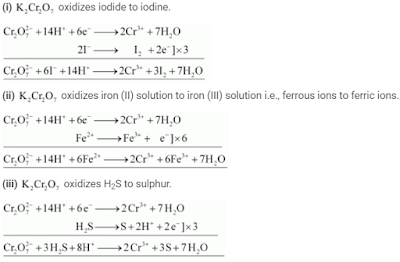
k2Cr2O7 acts as a very strong oxidising agent in the acidic medium.
k2Cr2O7 + 4H2SO4 → K2SO4 + Cr2(SO4)3 + 4H2O + 3[O],
k2Cr2O7 takes up electrons to get reduced and acts as an oxidizing agent. The reaction of k2Cr2O7 with H2S, iron (II) solution and other iodide are given below.
16
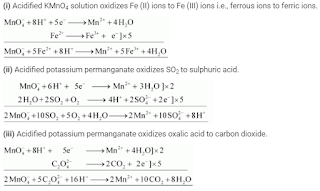
Explain how potassium permanganate is prepared. Also find the reactivity of the potassium permanganate solution with
(i) oxalic acid
(ii) iron(II) ions and
(iii) SO2
Write down the chemical equations for the reactions.
Answer
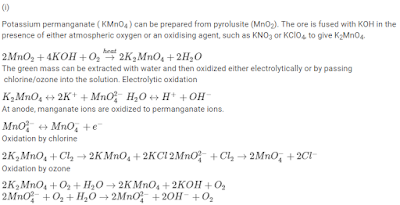
Potassium permanganate can be prepared from pyrolusite (MnO2). The ore is fused with KOH in the presence of either atmospheric oxygen or an oxidising agent, such as KNO3 or KClO4, to give K2MnO4.
2MnO2 + 4KOH + O2 → 2K2MnO4 + 2H2O
The green mass can be extracted with water and then oxidized either electrolytically or by passing chlorine/ozone into the solution. Electrolytic oxidation
K2MnO4 ↔ 2k+ + MnO42−
H2O ↔ H+ + OH−
At anode, manganate ions are oxidized to permanganate ions.
MnO42−↔ MnO4− + e−
Oxidation by chlorine
2K2MnO4 + Cl2 → 2MnO4 + 2KCl
2MnO42− + Cl2 → 2MnO4− + 2Cl−
Oxidation by ozone
2KMnO4 + O3 + H2O → 2KMnO4 + 2KOH + O2
2MnO42− + O3 + H2O → 2MnO42− + 2OH− + O2
17
For M3+/M2+ and M2+/M systems, the EΘ values for some metals are as follows:
Fe2+/Fe −0.4V
Fe3+/Fe2+ +0.8 V
Cr2+/Cr+ −0.9V
Cr3+/Cr2+ −0.4 V
Mn2+/Mn+ −1.2V
Mn3+ /Mn2+ +1.5 V
Comment upon:
(i) The ease with which iron can be oxidised as compared to a
similar process for either chromium or manganese metal.
(ii) The stability of Fe3+ in
acid solution as compared to that of Cr3+ or
Mn3+.
Answer
(i) The reduction potentials for the given pairs increase in the following order. Mn2+ / Mn < Cr2+ / Cr < Fe2+ /Fe So, the oxidation of Fe to Fe2+ is not as easy as the oxidation of Cr to Cr2+ and the oxidation of Mn to Mn2+. Thus, these metals can be arranged in the increasing order of their ability to get oxidised as: Fe < Cr < Mn.
(ii) The E0value for Fe3+/Fe2+ is higher than that for Cr3+/Cr2+ and lower than that for Mn3+/Mn2+. So, the reduction of Fe3+ to Fe2+ is easier than the reduction of Mn3+ to Mn2+, but not as easy as the reduction of Cr3+ to Cr2+. Hence, Fe3+ is more stable than Mn3+, but less stable than Cr3+. These metal ions can be arranged in the increasing order of their stability as: Mn3+ < Fe3+ < Cr3+
18
Answer
Ions with electrons in d-orbital will be the only ones that will be coloured and the ions with empty d-orbital will be colourless.
Element | Atomic Number | Ionic State | Electronic configuration in ionic State |
Ti | 22 | Ti3+ | [Ar] 3d1 |
V | 23 | V3+ | [Ar] 3d2 |
Cu | 29 | Cu+ | [Ar] 3d10 |
Sc | 21 | Sc3+ | [Ar] |
Mn | 25 | Mn2+ | [Ar] 3d5 |
Fe | 26 | Fe3+ | [Ar] 3d5 |
Co | 27 | Co2+ | [Ar] 3d7 |
All other ions, except Sc3+, will be coloured in aqueous solution because of d−d transitions. Not Sc3+ as it has an empty d-orbital.
19
Answer

From the table above:
Mn shows maximum number of oxidation states, changing between +2 to +7.
The number of oxidation states increases as we move on from Sc to Mn.
On moving from Mn to Zn, the number of oxidation states decreases due to a decrease in the number of available unpaired electrons.
The relative stability of the +2 oxidation state increases on moving from top to bottom. This is because on moving to bottom from the top, it becomes more and more difficult to remove the third electron from the d-orbital.
20
Note the similarity or dissimilarity between the chemistry of lanthanoids with that of the actinoids with special reference to:
(i) Chemical reactivity
(ii) Atomic and ionic sizes
(iii) Oxidation state
(iv) Electronic configuration
Answer
(i) Chemical reactivity:
In the lanthanide series, the earlier members of the series are more reactive. They have reactivity that is comparable to Ca. With an increase in the atomic number, the lanthanides start behaving similar to Al. Actinoids, on the other hand, are highly reactive metals, especially when they are finely divided. When they are added to boiling water, they give a mixture of oxide and hydride. Actinoids combine with most of the non-metals at moderate temperatures. Alkalies have no action on these actinoids. In case of acids, they are slightly affected by nitric acid (because of the formation of a protective oxide layer).
(ii) Atomic and lonic sizes:
Similar to lanthanoids, actinoids also exhibit actinoid contraction (overall decrease in atomic and ionic radii). The contraction is greater due to the poor shielding effect of 5f orbitals.
(iii) Oxidation states:
The principal oxidation state of lanthanoids is (+3). However, sometimes we also encounter oxidation states of + 2 and + 4. This is because of extra stability of fully-filled and half-filled orbitals. Actinoids exhibit a greater range of oxidation states. This is because the 5f, 6d, and 7s levels are of comparable energies. Again, (+3) is the principal oxidation state for actinoids. Actinoids such as lanthanoids have more compounds in +3 state than in +4 state.
(iv) Electronic configuration:
The general electronic configuration for lanthanoids is [Xe]54 4f0-14 5d0-1 6s2 and that for actinoids is [Rn]86 5f1-146d0-1 7s2. Unlike 4f orbitals, 5f orbitals are not deeply buried and participate in bonding to a greater extent.
21
How would you account for the following?
(a) The d1 configuration is very unstable in ions.
(b) Of the d4 species, Cr2+ is strongly reducing while manganese(III) is strongly oxidising.
(c) Cobalt(II) is stable in aqueous solution but in the presence of complexing reagents it is easily oxidised.
Answer
(i) The ions in d1configuration tend to lose one more
electron to get into stable d0 configuration. Also, the
hydration or lattice energy is more than sufficient to remove the only electron
present in the d-orbital of these ions. Therefore, they act as reducing agents.
(ii) Cr2+ is
strongly reducing in nature. It has a d4 configuration. While acting
as a reducing agent, it gets oxidized to Cr3+ (electronic configuration, d3).
This d3 configuration
can be written as configuration, which is a more stable configuration. In the
case of Mn3+ (d4), it
acts as an oxidizing agent and gets reduced to Mn2+ (d5).
This has an exactly half-filled d-orbital and is highly stable.
(iii) Co(II) is stable in aqueous solutions. However, in the
presence of strong field complexing reagents, it is oxidized to Co (III).
Although the 3rd ionization energy for Co is high, but the higher amount of
crystal field stabilization energy (CFSE) released in the presence of strong
field ligands overcomes this ionization energy.
22
Answer
It is found that sometimes a relatively less stable oxidation state undergoes an oxidation−reduction reaction in which it is simultaneously oxidised and reduced. This is called disproportionation.
For example,
(a)
Cr(V) is oxidized to Cr(VI) and reduced to Cr(III).
(b)
Mn (VI) is oxidized to Mn (VII) and reduced to Mn (IV).
23
Answer
In the first series of transition metals, Cu exhibits +1 oxidation state very frequently. We know Cu has an electronic configuration of [Ar] 3d10, that is, the completely filled d-orbital makes it highly stable.24
Answer
25
Give examples and suggest reasons for the following features of the transition metal chemistry:
(a) The highest oxidation state is exhibited in oxoanions of a metal.
(b)The lowest oxide of transition metal is basic, the highest is amphoteric/acidic.
(c) A transition metal exhibits highest oxidation state in oxides and fluorides.
Answer
(a) Oxygen is a strong oxidising agent due to its high electronegativity and small size. So, oxo-anions of a metal have the highest oxidation state. For example, in , the oxidation state of Mn is +7.
(b) In the case of a lower oxide of a transition metal, the metal atom has a low oxidation state. This means that some of the valence electrons of the metal atom are not involved in bonding. As a result, it can donate electrons and behave as a base. On the other hand, in the case of a higher oxide of a transition metal, the metal atom has a high oxidation state. This means that the valence electrons are involved in bonding and so, they are unavailable. There is also a high effective nuclear charge. As a result, it can accept electrons and behave as an acid.
For example, MnIIO and Mn2VIIO7 is basic and acidic.(c) Oxygen and fluorine act as strong oxidising agents because of their high electronegativities and small sizes. Hence, they bring out the highest oxidation states from the transition metals. In other words, a transition metal exhibits higher oxidation states in oxides and fluorides.
For example, in OsF6 and V2O5, the oxidation states of Os and V are +6 and +5 respectively.
26
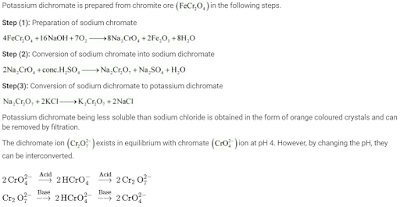
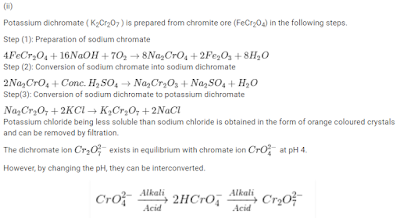
Explain the procedure involved in the manufacture of :
(i) KMnO4 from pyrolusite ore.
(ii) K2Cr2O7 from chromite ore.
Answer
27
Answer
An alloy is a solid solution of two or more elements in a metallic matrix. It can be a partial solid solution or a complete solid solution. Alloys generally are created as they have varied properties compared to their constituent elements. An important alloy of lanthanoids is Mischmetal. It contains lanthanoids (94−95%), iron (5%), and traces of Al, Ca, Si, C, S.
Uses
(a) It is used in tracer bullets and shells.
(b) Mischmetal is used in cigarettes and gas lighters.
(c) It is used in flame throwing tanks.
28
Answer
Inner transition metals : elements in which the last electron enters the f-orbital.
The elements in which the 4f and the 5f orbitals are progressively filled are called f-block elements.
From the given atomic numbers, the inner transition elements are the ones with atomic numbers 59, 95, and 102.
29
Answer
Lanthanoids project 3 oxidation states (+2, +3, +4). From these, +3 state is the most common. Lanthanoids display a limited number of oxidation states because the energy difference between 4f, 5d, and 6s orbital’s is quite large. While, the energy difference between 5f, 6d, and 7s orbital’s is very less. Hence, actinoids display a large number of oxidation states.
For example, neptunium displays +3, +4, +5, and +7 while uranium and plutonium display +3, +4, +5, and +6 oxidation states. The most common oxidation state in case of actinoids is also +3.
30
Answer
In the actinoid series, the last element is lawrencium, Lr. The atomic number of the element is 103 and its electronic configuration is [Rn] 5f14 6d1 7s2 . The most common oxidation state displayed by it is +3; because after losing 3 electrons it attains stable f14 configuration.31
Answer

32
Answer
| +2 | +4 |
| Nd(60) | Ce (58) |
| Sm(62) | Pr (59) |
| Eu (63) | Nd (60) |
| Tm(69) | Tb (65) |
| Yb (70) | Dy (66) |
In the parenthesis are the atomic numbers of the elements are given.
Tb after forming Tb4+ attains a stable electronic configuration of [Xe] 4f7.
Yb after forming Yb2+ attains a stable electronic configuration of [Xe] 4f14.
Eu after forming Eu2+ attains a stable electronic configuration of [Xe] 4f7.
Ce after forming Ce4+ attains a stable electronic configuration of [Xe].
33
Compare the chemistry of lanthanoids with that of actinoids with reference to:
(i)Chemical reactivity.
(ii) Electronic configuration
(iii)Oxidation states
Answer
Chemical reactivity
In the lanthanide series, the earlier members of the series are more reactive. They have reactivity that is comparable to Ca. With an increase in the atomic number, the lanthanides start behaving similar to Al. Actinoids, on the other hand, are highly reactive metals, especially when they are finely divided. When they are added to boiling water, they give a mixture of oxide and hydride. Actinoids combine with most of the non-metals at moderate temperatures. Alkalies have no action on these actinoids. In case of acids, they are slightly affected by nitric acid (because of the formation of a protective oxide layer).
Electronic configuration
The general electronic configuration for lanthanoids is [Xe]54 4f0-14 5d0-1 6s2 and that for actinoids is [Rn]86 5f1-146d0-1 7s2. Unlike 4f orbitals, 5f orbitals are not deeply buried and participate in bonding to a greater extent.
Oxidation states
The principal oxidation state of lanthanoids is (+3). However, sometimes we also encounter oxidation states of + 2 and + 4. This is because of extra stability of fully-filled and half-filled orbitals. Actinoids exhibit a greater range of oxidation states. This is because the 5f, 6d, and 7s levels are of comparable energies. Again, (+3) is the principal oxidation state for actinoids. Actinoids such as lanthanoids have more compounds in +3 state than in +4 state.
34
Answer
Atomic number | Electronic configuration |
61 | [Xe]544f55d06s2 |
91 | [Rn]565f26d17s2 |
101 | [Rn]565f135d07s2 |
109 | [Rn]565f146d77s2 |
35
Compare the general characteristics of the first series of the transition metals with those of the second and third series metals in the respective vertical columns. Give special emphasis on the following points:
(i) atomic sizes.
(ii) ionisation enthalpies
(iii) oxidation states
(iv) electronic configurations
Answer
(i) Atomic size generally decreases from left to right across a period. Now, among the three transition series, atomic sizes of the elements in the second transition series are greater than those of the elements corresponding to the same vertical column in the first transition series. However, the atomic sizes of the elements in the third transition series are virtually the same as those of the corresponding members in the second transition series. This is due to lanthanoid contraction.
(ii) In each of the three transition series, the first ionisation enthalpy increases from left to right. However, there are some exceptions. The first ionisation enthalpies of the third transition series are higher than those of the first and second transition series. This occurs due to the poor shielding effect of 4f electrons in the third transition series. Certain elements in the second transition series have higher first ionisation enthalpies than elements corresponding to the same vertical column in the first transition series. There are also elements in the 2nd transition series whose first ionisation enthalpies are lower than those of the elements corresponding to the same vertical column in the 1st transition series.
(iii) In each of the three transition series the number of oxidation states shown by the elements is the maximum in the middle and the minimum at the extreme ends. However, +2 and +3 oxidation states are quite stable for all elements present in the first transition series. All metals present in the first transition series form stable compounds in the +2 and +3 oxidation states. The stability of the +2 and +3 oxidation states decreases in the second and the third transition series, wherein higher oxidation states are more important.
Some stable complexes are :
The issue is that no such complexes are known for the second and third transition series such as Mo, W, Rh, In. They form complexes in which their oxidation states are high.
For example: WCl6, ReF7, RuO4, etc.
(iv) In the 1st, 2nd and 3rd transition series,
the 3d, 4d and 5d orbitals are respectively filled. We know that elements in the same vertical column generally have similar electronic configurations.
In the first transition series,
two elements show unusual electronic configurations:
Cu (29) = 3d104s1
Cr (24) = 3d54s1
Similarly, there are exceptions in the second transition series. These are:
Ag(47) = 4d105s1
Pd(46) = 4d10 5s0
Rh(45) = 4d85s1
Ru (44) = 4d75s1
Tc (43) = 4d65s1
Mo (42) = 4d55s1
There are some exceptions in the third transition series as well. These are:
Au (79 ) = 5d10 6s1
Pt (78) = 5d9 6s1
W (74) = 5d4 6s2
As a result of these exceptions, it happens many times that the electronic configurations of the elements present in the same group are dissimilar.
36
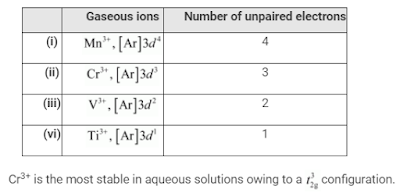
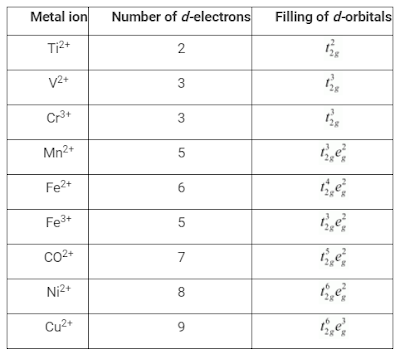
Write down the number of 3d electrons in each of the following ions:
Ti2+, V2+, Cr3+, Mn2+, Fe2+, Fe3+, CO2+, Ni2+ and Cu2+.
Indicate how would you expect the five 3d orbitals to be occupied for these hydrated ions (octahedral).
Answer
37
Answer
By many ways, the properties of elements of heavier transition elements differs from those of first transition series.
(a) The elements of the first transition series form low-spin or high-spin complexes depending upon the strength of the ligand field. However, the heavier transition elements form only low-spin complexes, irrespective of the strength of the ligand field.
(b) The enthalpies of atomisation of the elements in the first transition series are lower than those
of the corresponding elements in the second and third transition series.
(c) The meltingand boiling points of the first transition series are lower than those of the heavier transition elements. This is because of the occurrence of stronger metallic bonding (M−M bonding).
(d) For heavier elements , the higher oxidation states are more common whereas for first transition series elements the +2 and +3 oxidation states are more common.
(e) The atomic sizes of the elements of the first transition series are smaller than those of the heavier elements (elements of 2nd and 3rd transition series). However, the atomic sizes of the elements in the third transition series are virtually the same as those of the corresponding members in the second transition series. This is due to lanthanoid contraction.
38
From the below complex species, what could be inferred from the magnetic moment values?
Example Magnetic Moment (BM)
K2[MnCl4] = 5.9
K4[Mn(CN)6] = 2.2
[Fe(H2O)6]2+ = 5.3
Answer
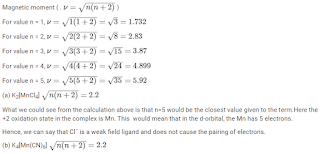
For in transition metals, the magnetic moment is calculated from the spin-only formula.
Therefore,
We can see from the above calculation that the given value is closest to n = 1 . Also, in this complex, Mn is in the +2 oxidation state. This means that Mn has 5 electrons in the d-orbital.
Hence, we can say that CN− is a strong field ligand that causes the pairing of electrons.
(c) [Fe(H2O)6]2+
Thus the calculation given above proves that the closest value to n= 4 . In addition to this, the +2 oxidation state in this complex is none other than Fe. The d-orbital for Fe would have 6 electrons. Hence, we can say that H2O is a weak field ligand and does not cause the pairing of electrons.