Summary for Wisdom Paves The Way Class 8 English Poorvi
Book Solutions1
Answer
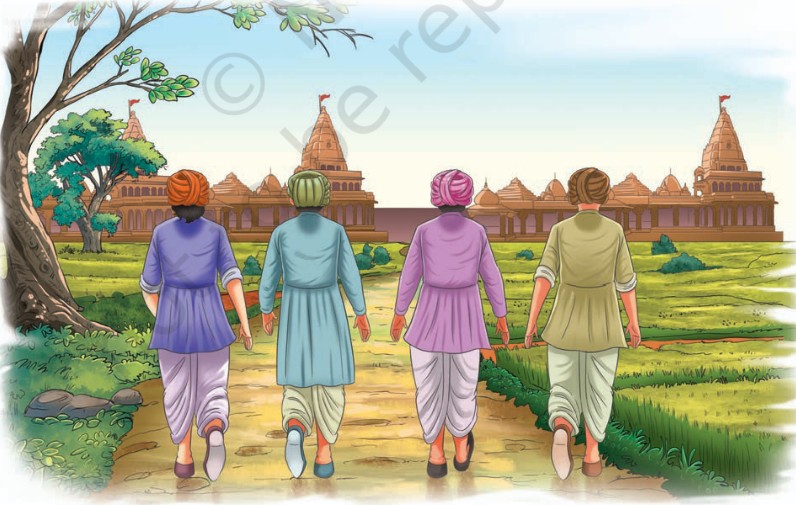
- Four young men—Ram Datt, Shiv Datt, Har Datt, and Dev Datt—are traveling along a dusty road toward Ujjain, appearing tired but resolute.
- They have been away from their village for ten days, yet finding work still eludes them.
- They hope the King of Ujjain will recognize their talents and employ them, and they discuss remaining united in this hope.
- Har Datt notes that gaining an audience with the King is not simple, and they plan to devise a strategy once they reach the city gates.
- While walking, Ram Datt notices something on the ground; the group observes fresh camel tracks, scrutinizing them carefully.
- Each of the four men notices something peculiar about the camel, and they decide to rest beneath a large tree to share their findings.
- A merchant approaches hastily, looking distressed, and asks for help in finding his camel, which has gone astray.
- The young men ask questions and astonishingly describe the camel as having a lame leg, blind right eye, short tail, and stomach pain, surprising the merchant.
- They admit they do not know the camel’s location, angering the merchant, who accuses them of deception and threatens to take the matter to the King.
- The four men agree to go with the merchant, who leads them toward the city gates and then to the palace, where the merchant speaks urgently to a sentry.
2
Answer
Four young men—Ram Datt, Shiv Datt, Har Datt, and Dev Datt—are walking on a dusty road towards Ujjain. They are tired because they have been traveling for ten days, searching for work. Even though they are weary, they still hope to find employment in the King’s court. Ram Datt believes that if they meet the King, he will recognize their abilities and give them jobs. The others agree but also know it will not be easy to reach the King. On the way, they notice fresh camel footprints on the ground. 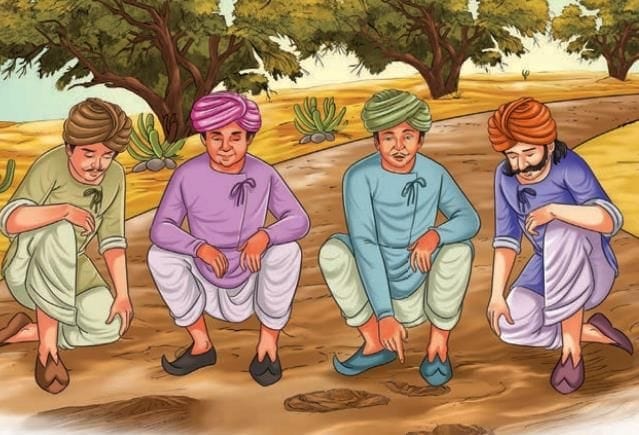
Each of them observes the marks carefully and quietly understands something about the camel. Soon, a merchant comes running towards them, very upset, because his camel has been lost. The young men surprise him by correctly describing the camel—it is lame in one leg, blind in the right eye, has a short tail, and is suffering from stomach pain.
The merchant is shocked and cannot believe their words. He thinks they must have stolen the camel since they know everything about it, even though they say they have never seen it. Angry and suspicious, he decides to take them to the King to be judged. The four friends agree to go, calm and confident in their innocence.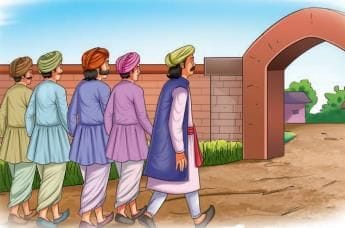
3
Answer
The scene shifts to the royal court of the King of Ujjain, a grand hall adorned with rich draperies, tall columns, and a golden canopy. The merchant approaches the King with a complaint, accusing the four young men of stealing his camel. The Sentry brings the four travellers before the King. They bow respectfully, remaining calm despite the accusations.
The King asks the merchant to state his complaint clearly. The merchant claims that the young men know every detail of his camel, yet insist they have never seen it, which makes them suspicious in his eyes.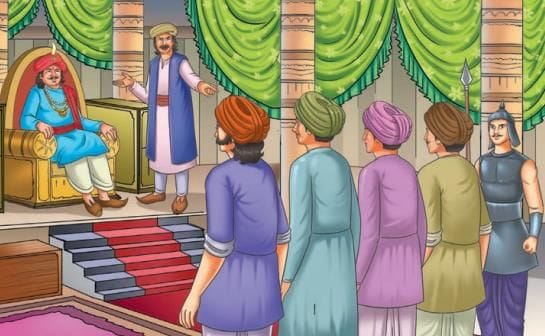
The King then questions the young men individually:
- Ram Datt explains that the camel is lame in one leg, deduced from the tracks, where only three hoof marks were deep, and the fourth faint.
- Shiv Datt observes that the camel is blind in the right eye, as it ate leaves only from the left side of the road.
- Har Datt concludes the camel has a short tail, noting blood droplets from mosquito bites, which a long tail would have brushed away.
- Dev Datt notices the camel has stomach pain, inferred from its careful movements and the way it lifts its hind legs cautiously.

The King is astonished by their sharp observation, reasoning, and insight. He declares that the young men are wise and honest, not thieves, and reprimands the merchant for his baseless accusations. The merchant, feeling chastened and embarrassed, bows and leaves the court.
The King then offers the four young men positions as his advisers, praising their intelligence and wisdom. Ram Datt, Shiv Datt, Har Datt, and Dev Datt accept the honour humbly, pledging to serve the King faithfully. The court applauds, celebrating the young men’s success and remarkable insight, marking a triumphant end to their journey.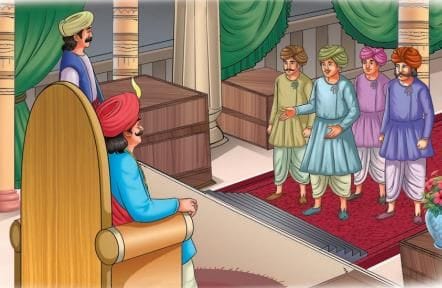
4
Answer
- The theme of wisdom and observation is central to the story. It shows how careful observation can lead to understanding and insight, which is more important than mere luck.
- The story emphasizes the importance of honesty and integrity. The young men, despite being wrongfully accused, remain truthful and calm, which ultimately leads to their success.
- The value of teamwork and collaboration is also a key theme. The four friends work together and support each other, demonstrating the strength of friendship and unity.
5
Answer
- The story teaches us that wisdom comes from careful observation and thinking critically about what we see. It highlights that sometimes, what appears to be obvious may not be the whole truth.
- It also conveys the message that integrity and honesty are essential virtues. Even when faced with challenges or accusations, staying true to oneself is crucial.
- Lastly, the story reminds us that working together with friends can lead to great achievements. Supporting one another can help overcome obstacles and reach our goals.
6
Answer
- Grievance: A complaint or a feeling of having been treated unfairly.
- Accuse: To say that someone has done something wrong or illegal.
- Resolve: To decide firmly on a course of action.
- Deduce: To reach a conclusion based on reasoning and evidence.
- Intimidated: Feeling frightened or nervous about something or someone.
- Observation: The act of watching carefully to learn something.
- Insight: The ability to understand something clearly and deeply.
- Chastened: Made to feel sorry or embarrassed, often after doing something wrong.
- Regal: Suitable for a king; royal or majestic.
- Counsel: Advice or guidance, especially in legal or serious matters.
- Impress: To make someone feel admiration or respect.
- Integrity: The quality of being honest and having strong moral principles.
- Distressed: Very upset or worried about something.
- Burdened: Weighed down by a heavy load or problem.
- Accomplished: Highly skilled or successful in a particular area.