NCERT Solutions for Chapter 4 Simple Equations Class 7 Maths
Book Solutions1
Complete the last column of the table:
|
S. No. |
Equation |
Value |
Say, whether the Equation is satisfied. (Yes / No) |
|
1 |
x+3=0 |
x=3 |
|
|
2 |
x+3=0 |
x=0 |
|
|
3 |
x+3=0 |
x=−3 |
|
|
4 |
x−7=1 |
x=7 |
|
|
5 |
x−7=1 |
x=8 |
|
|
6 |
5x=25 |
x=0 |
|
|
7 |
5x=25 |
x=5 |
|
|
8 |
5x=25 |
x=−5 |
|
|
9 |
m/3=2 |
m=−6 |
|
|
10 |
m/3=2 |
m=0 |
|
|
11 |
m/3=2 |
m=6 |
|
Answer
|
S. No. |
Equation |
Value |
Say, whether the Equation is satisfied. (Yes / No) |
|
1 |
x+3=0 |
x=3 |
No |
|
2 |
x+3=0 |
x=0 |
No |
|
3 |
x+3=0 |
x=−3 |
Yes |
|
4 |
x−7=1 |
x=7 |
No |
|
5 |
x−7=1 |
x=8 |
Yes |
|
6 |
5x=25 |
x=0 |
No |
|
7 |
5x=25 |
x=5 |
Yes |
|
8 |
5x=25 |
x=−5 |
No |
|
9 |
m/3=2 |
m=−6 |
No |
|
10 |
m/3=2 |
m=0 |
No |
|
11 |
m/3=2 |
m=6 |
Yes |
Exercise 4.1
Page Number 81
2
Check whether the value given in the brackets is a solution to the given equation or not:
(a) n+5=19(n=1)
(b) 7n+5=19(n=−2)
(c) 7n+5=19(n=2)
(d) 4p−3=13(p=1)
(e) 4p−3=13(p=−4)
(f) 4p−3=13(p=0)
Answer
(a) n+5=19(n=1)
Putting n=1 in L.H.S.,
1 + 5 = 6
∵ L.H.S. ≠ R.H.S.,
∴ n=1 is not the solution of given equation.
(b) 7n+5=19(n=−2)
Putting n=−2 in L.H.S.,
7(−2)+5=−14+5=−9
∵ L.H.S. ≠ R.H.S.,
∴ n=−2 is not the solution of given equation.
(c) 7n+5=19(n=2)
Putting n=2 in L.H.S.,
7(2)+5=14+5=19
∵ L.H.S. = R.H.S.,
∴ n=2is the solution of given equation.
(d) 4p−3=13(p=1)
Putting p=1 in L.H.S.,
4(1)−3=4−3=1
∵ L.H.S. ≠ R.H.S.,
∴ p=1 is not the solution of given equation.
(e) 4p−3=13(p=−4)
Putting p=−4 in L.H.S.,
4(−4)−3=−16−3=−19
∵ L.H.S. ≠ R.H.S.,
∴ p=−4 is not the solution of given equation.
(f) 4p−3=13(p=0)
Putting p=0 in L.H.S.,
4(0)−3=0−3=−3
∵ L.H.S. ≠ R.H.S.,
∴ p=0 is not the solution of given equation.
Exercise 4.1
Page Number 81
3
Solve the following equations by trial and error method:
(i) 5p+2=17
(ii) 3m−14=4
Answer
(i) 5p+2=17
Putting p=−3 in L.H.S. 5(−3)+2 = −15+2=−13
∵−13≠17 Therefore, p=−3 is not the solution.
Putting p=−2 in L.H.S. 5(−2)+2=−10+2=−8
∵−8≠17 Therefore, p=−2 is not the solution.
Putting p=−1 in L.H.S. 5(−1)+2=−5+2=−3
∵−3≠17 Therefore, p=−1 is not the solution.
Putting p=0 in L.H.S. 5(0)+2=0+2=2
∵ 2≠17 Therefore, p=0 is not the solution.
Putting p=1 in L.H.S. 5(1)+2=5+2=7
∵7≠17 Therefore, p=1 is not the solution.
Putting p=2 in L.H.S. 5(2)+2=10+2=12
∵12≠17 Therefore, p=2 is not the solution.
Putting p=3 in L.H.S. 5(3)+2=15+2=17
∵17=17Therefore, p=3 is the solution.
(ii) 3m−14=4
Putting m=−2 in L.H.S. 3(−2)−14=−6−14=−20
∵−20≠4 Therefore, m=−2 is not the solution.
Putting m=−1 in L.H.S. 3(−1)−14=−3−14=−17
∵−17≠4 Therefore, m=−1 is not the solution.
Putting m=0 in L.H.S. 3(0)−14=0−14=−14
∵−14≠4 Therefore, m=0 is not the solution.
Putting m=1 in L.H.S. 3(1)−14=3−14=−11
∵−11≠4 Therefore, m=1 is not the solution.
Putting m=2 in L.H.S. 3(2)−14=6−14=−8
∵−8≠4 Therefore, m=2is not the solution.
Putting m=3 in L.H.S. 3(3)−14=9−14=−5
∵−5≠4 Therefore, m=3 is not the solution.
Putting m=4 in L.H.S. 3(4)−14=12−14=−2
∵−2≠4 Therefore, m=4 is not the solution.
Putting m=5 in L.H.S. 3(5)−14=15−14=1
∵1≠4 Therefore, m=5 is not the solution.
Putting m=6 in L.H.S. 3(6)−14=18−14=4
∵4=4 Therefore, m=6m=6 is the solution.
Exercise 4.1
Page Number 81
4
Write equations for the following statements:
(i) The sum of numbers x and 4 is 9.
(ii) 2 subtracted from y is 8.
(iii) Ten times aa is 70.
(iv) The number b divided by 5 gives 6.
(v) Three-fourth of tt is 15.
(vi) Seven times mm plus 7 gets you 7.
(vii) One-fourth of a number x minus 4 gives 4.
(viii) If you take away 6 from 6 times y, you get 60.
(ix) If you add 3 to one-third of z, you get 30.
Answer
(i) x+4=9
(ii) y−2=8
(iii) 10a=70
(iv) b/5=6
(v) 3/4.t=15
(vi) 7m+7=77
(vii) x/4−4=4
(viii) 6y−6=60
(ix) z/3+3=30
Exercise 4.1
Page Number 81
5
Write the following equations in statement form:
(i) p+4=15
(ii) m−7=3
(iii) 2m=7
(iv) m/5=3
(v) 3m/5=6
(vi) 3p+4=25
(vii) 4p−2=18
(viii) p/2+2=8
Answer
(i) The sum of numbers p and 4 is 15.
(ii) 7 subtracted from m is 3.
(iii) Two times m is 7.
(iv) The number m is divided by 5 gives 3.
(v) Three-fifth of the number m is 6.
(vi) Three times p plus 4 gets 25.
(vii) If you take away 2 from 4 times p, you get 18.
(viii) If you added 2 to half is p, you get 8.
Exercise 4.1
Page Number 81
6
Set up an equation in the following cases:
(i) Irfan says that he has 7 marbles more than five times the marbles Parmit has. Irfan has 37 marbles. (Tale mm to be the number of Parmit’s marbles.)
(ii) Laxmi’s father is 49 years old. He is 4 years older than three times Laxmi’s age. (Take Laxmi’s age to be y years.)
(iii) The teacher tells the class that the highest marks obtained by a student in her class are twice the lowest marks plus 7. The highest score is 87. (Take the lowest score to be l. )
(iv) In an isosceles triangle, the vertex angle is twice either base angle. (Let the base angle be b in degrees. Remember that the sum of angles of a triangle is 180∘.)
Answer
(i) Let m be the number of Parmit’s marbles.
∴ 5m+7=37
(ii) Let the age of Laxmi be y years.
∴ 3y+4=49
(iii) Let the lowest score be l.
∴ 2l+7=87
(iv) Let the base angle of the isosceles triangle be b, so vertex angle = 2b
∴ 2b+b+b=180∘
⇒ 4b=180∘ [Angle sum property of a Δ]
Exercise 4.1
Page Number 83
1
Give first the step you will use to separate the variable and then solve the equations:
(a) x−1=0
(b) x+1=0
(c) x−1=5
(d) x+6=2
(e) y−4=−7
(f) y−4=4
(g) y+4=4
(h) y+4=−4
Answer
(a) x−1=0
⇒ x−1+1=0+1 [Adding 1 both sides]
⇒ x=1
(b) x+1=0
⇒ x+1−1=0−1 [Subtracting 1 both sides]
⇒ x=−1
(c) x−1=5
⇒ x−1+1=5+1 [Adding 1 both sides]
⇒ x=6
(d) x+6=2
⇒ x+6−6=2−6 [Subtracting 6 both sides]
⇒ x=−4
(e) y−4=−7
⇒ y−4+4=−7+4 [Adding 4 both sides]
⇒ y=−3
(f) y−4=4
⇒ y−4+4=4+4 [Adding 4 both sides]
⇒ y=8
(g) y+4=4
⇒ y+4−4=4−4 [Subtracting 4 both sides]
⇒ y=0
(h) y+4=−4
⇒ y+4−4=−4−4 [Subtracting 4 both sides]
⇒ y=−8
Exercise 4.2
Page Number 86
2
Give first the step you will use to separate the variable and then solve the equations
(a) 3l=42
(b) b/2=6
(c) p/7=4
(d) 4x=25
(e) 8y=36
(f) z/3=54
(g) a/5=7/15
(h) 20t=−10
Answer
(a) 3l=42
⇒ 3l/3=42/3 [Dividing both sides by 3]
⇒ l=14
(b) b/2=6
⇒ b/2×2=6×2 [Multiplying both sides by 2]
⇒ b=12
(c) p/7=4
⇒ p/7×7=4×7[Multiplying both sides by 7]
⇒ p=28
(d) 4x=25
⇒ 4x4=25/4 [Dividing both sides by 4]
⇒ x=25/4
(e) 8y=36
⇒ 8y/8=36/8 [Dividing both sides by 8]
⇒ y=9/2
(f) z/3=54
⇒ z/3×3=5/4×3 [Multiplying both sides by 3]
⇒ z=15/4
(g) a/5=7/15
⇒ a/5×5=7/15×5 [Multiplying both sides by 5]
⇒ a=73
(h) 20t=−10
⇒ 20t/20=−10/20 [Dividing both sides by 20]
⇒ t=−1/2
Exercise 4.2
Page Number 86
3
Give first the step you will use to separate the variable and then solve the equations
(a) 3n−2=46
(b) 5m+7=17
(c) 20p/3=40
(d) 3p/10=6
Answer
(a) 3n−2=46
Step I: 3n−2+2=46+2=48
[Adding 2 both sides]
Step II: 3n/3=48/3
⇒n=16 [Dividing both sides by 3]
(b) 5m+7=17
Step I: 5m+7−7=17−7=17−7
⇒ 5m=10 [Subtracting 7 both sides]
Step II: 5m/5=10/5
⇒m=2 [Dividing both sides by 5]
(c) 20p/3=40
Step I: 20p/3×3=40×3
⇒ 20p=120 [Multiplying both sides by 3]
Step II: 20p/20=120/20
⇒ p=6 [Dividing both sides by 20]
(d) 3p/10=6
Step I: 3p/10×10=6×10
⇒ 3p=60 [Multiplying both sides by 10]
Step II: 3p/3=60/3
⇒ p=20 [Dividing both sides by 3]
Exercise 4.2
Page Number 86
4
Solve the following equation:
(a) 10p=100
(b) 10p+10=100
(c) p/4=5
(d) −p/3=5
(e) 3p/4=6
(f) 3s=−9
(g) 3s+12=0
(h) 3s=0
(i) 2q=6
(j) 2q−6=0
(k) 2q+6=0
(l) 2q+6=12
Answer
(a) 10p=100
⇒ 10p/10=100/10 [Dividing both sides by 10]
⇒ p=10
(b) 10p+10=100
⇒ 10p+10−10=100−10 [Subtracting both sides 10]
⇒ 10p=90 ⇒ 10p/10=90/10 [Dividing both sides by 10]
⇒ p=9
(c) p/4=5
⇒ p/4×4=5×4 [Multiplying both sides by 4]
⇒ p=20
(d) −p/3=5
⇒ −p/3×(−3)=5×(−3) [Multiplying both sides by – 3]
⇒ p=−15
(e) 3p/4=6
⇒ 3p/4×4=6×4 [Multiplying both sides by 4]
⇒ 3p=24⇒ 3p/3=24/3 [Dividing both sides by 3]
⇒ p=8
(f) 3s=−9
⇒ 3s/3=−9/3 [Dividing both sides by 3]
⇒ s=−3
(g) 3s+12=0
⇒ 3s+12−12=0−12 [Subtracting both sides 10]
⇒ 3s=−12 ⇒ 3s/3=−12/3 [Dividing both sides by 3]
⇒ s=−4
(h) 3s=0
⇒ 3s/3=0/3 [Dividing both sides by 3]
⇒ s=0
(i) 2q=6
⇒ 2q/2=6/2 [Dividing both sides by 2]
⇒ q=3
(j) 2q−6=0
⇒ 2q−6+6=0+6 [Adding both sides 6]
⇒ 2q=6 ⇒ 2q/2=6/2 [Dividing both sides by 2]
⇒ q=3
(k) 2q+6=0
⇒ 2q+6−6=0−6 [Subtracting both sides 6]
⇒ 2q=−6⇒ 2q/2=−6/2 [Dividing both sides by 2]
⇒ q=−3
(l) 2q+6=12
⇒ 2q+6−6=12−6 [Subtracting both sides 6]
⇒ 2q=6⇒ 2q/2=6/2 [Dividing both sides by 2]
⇒ q=3
Exercise 4.2
Page Number 86
1
Solve the following equations:
(a) 2y+5/2=37/2
(b) 5t+28=10
(c) a/5+3=2
(d) q/4+7=5
(e) 5/2x=10
(f) 5/2x=25/4
(g) 7m+19/2=13
(h) 6z+10=−2
(i) 3l/2=2/3
(j) 2b/3−5=3
Answer
(a) 2y+5/2=37/2
⇒ 2y=37/2−5/2 ⇒ 2y=37−5/2
⇒ 2y=32/2⇒ 2y=16/2
⇒ y=8
(b) 5t+28=10
⇒ 5t=10−28 ⇒ 5t=−18
⇒ t=−18/5
(c) a/5+3=2
⇒ a/5=2−3⇒ a/5=−1
⇒ a=−1×5
⇒ a=−5
(d) q/4+7=5
⇒ q/4=5−7⇒ q/4=−2
⇒ q=−2×4
⇒ q=−8
(e) 5/2x=10
⇒ 5x=10×2
⇒ 5x=20
⇒ x=20/5
⇒ x=4
(f) 5/2x=25/4
⇒ 5x=25/4×2
⇒ 5x=25/2
⇒ x=25/(2×5)
⇒ x=5/2
(g) 7m+19/2=13
⇒ 7m=13−19/2
⇒ 7m=26−19/2
⇒ 7m=7/2⇒ m=7/(2×7)⇒ m=12
(h) 6z+10=−2
⇒ 6z=−2−10
⇒ 6z=−12
⇒ z=−12/6
⇒ z=−2
(i) 3l/2=2/3
⇒ 3l=2/3×2⇒ 3l=4/3
⇒ l=4/3×3
⇒l=49
(j) 2b/3−5=3
⇒ 2b/3=3+5
⇒ 2b/3=8
⇒ 2b=8×3
⇒ 2b=24
⇒ b=24/2
⇒ b=1/2
Exercise 4.3
Page Number 89
2
Solve the following equations:
(a) 2(x+4)=12
(b) 3(n−5)=21
(c) 3(n−5)=−21
(d) 3−2(2−y)=7
(e) −4(2−x)=9
(f) 4(2−x)=9
(g) 4+5(p−1)=34
(h) 34−5(p−1)=4
Answer
(a) 2(x+4)=12
⇒ x+4=12/2
⇒ x+4=6
⇒ x=6−4
⇒ x=2
(b) n=7+5
⇒ n=12
(c) n=−7+5
⇒ n=−2
(d) 2−y=4−2
⇒ 2−y=−2
⇒ −y=−2−2
⇒ −y=−4
⇒ y=4
(e) 4x=9+8
⇒ 4x=17
⇒ x=174
(f) −4x=9−8
⇒ −4x=1
⇒ x=−14
(g) p−1=30/5
⇒ p−1=6
⇒ p=6+1
⇒ p=7
(h) p−1=−30/−5
⇒ p−1=6
⇒ p=6+1
⇒ p=7
Exercise 4.3
Page Number 89
3
Solve the following equations:
(a) 4=5(p−2)
(b) −4=5(p−2)
(c) −16=−5(2−p)
(d) 10=4+3(t+2)
(e) 28=4+3(t+5)
(f) 0=16+4(m−6)
Answer
(a) 2(x+4)=12
⇒ x+4=12/2
⇒ x+4=6
⇒ x=6−4
⇒ x=2
(b) 3(n−5)=21
⇒ n−5=21/3
⇒ n−5=7
⇒ n=7+5
⇒ n=12
(c) 3(n−5)=−21
⇒ n−5=−21/3
⇒ n−5=−7
⇒ n=−7+5
⇒ n=−2
(d) 3−2(2−y)=7
⇒ −2(2−y)=7−3
⇒ −2(2−y)=4
⇒ 2−y=4/−2
⇒ 2−y=−2
⇒ −y=−2−2
⇒ −y=−4
⇒ y=4
(e) −4(2−x)=9
⇒ −4×2−x×(−4)=9
⇒ −8+4x=9
⇒ 4x=9+8
⇒ 4x=17
⇒ x=17/4
(f) 4(2−x)=9
⇒ 4×2−x×(4)=9
⇒ 8−4x=9
⇒ −4x=9−8
⇒ −4x=1
⇒ x=−1/4
(g) 4+5(p−1)=34
⇒ 5(p−1)=34−4
⇒ 5(p−1)=30
⇒ p−1=30/5
⇒ p−1=6
⇒ p=6+1
⇒ p=7p=7
(h) 34−5(p−1)=4
⇒ −5(p−1)=4−34
⇒ −5(p−1)=−30
⇒ p−1=−30/−5
⇒ p−1=6
⇒ p=6+1
⇒ p=7p=7
Exercise 4.3
Page Number 89
4
(a) Construct 3 equations starting with x=2.
(b) Construct 3 equations starting with x=−2
Answer
(a) 3 equations starting with x=2.
(i) x=2
Multiplying both sides by 10, 10x=20
Adding 2 both sides 10x+2 =20+2 = 10x + 2 = 22
(ii) x=2
Multiplying both sides by 5 5x=10
Subtracting 3 from both sides 5x−3=10−3 = 5x−3=7
(iii) x=2
Dividing both sides by 5 x 5=2/5
(b) 3 equations starting with x=−2.
(i) x=−2
Multiplying both sides by 3 3x=−6
(ii) x=−2
Multiplying both sides by 3 3x=−6
Adding 7 to both sides 3x+7=−6+7 = 3x+7=1
(iii) x=−2
Multiplying both sides by 3 3x=−6
Adding 10 to both sides 3x+10=−6+10= 3x+10=4
Exercise 4.3
Page Number 89
1
Set up equations and solve them to find the unknown numbers in the following cases:
1. Add 4 to eight times a number; you get 60.
2 One-fifth of a number minus 4 gives 3.
3. If I take three-fourth of a number and add 3 to it, I get 21.
4. When I subtracted 11 from twice a number, the result was 15.
5. Munna subtracts thrice the number of notebooks he has from 50, he finds the result to be 8.
6. Ibenhal thinks of a number. If she adds 19 to it divides the sum by 5, she will get 8.
7. Answer thinks of a number. If he takes away 7 from 5/2 of the number, the result is 11/2.
Answer
(a) Let the number be x.
According to the question, 8x+4=60
⇒ 8x=60−4
⇒ 8x=56
⇒ x=56/8
⇒ x=7
(b) Let the number be y.
According to the question, y/5−4=3
⇒ y/5=3+4
⇒ y/5=7
⇒ y=7×5
⇒ y=35
(c) Let the number be z.
According to the question, 3/4.z+3=21
⇒ 3/4.z=21−3
⇒ 3/4.z=18
⇒ 3z=18×4
⇒ 3z=72
⇒ z=72/3
⇒ z=24
(d) Let the number be x
According to the question, 2x−11=15
⇒ 2x=15+11
⇒ 2x=26
⇒ x=26/2
⇒ x=13
(e) Let the number be m.
According to the question, 50−3m=8
⇒ −3m=8−50
⇒ −3m=−42
⇒ m=−42/−3
⇒ m=14
(f) Let the number be n.
According to the question, (n+190/5=8
⇒ n+19=8×5
⇒ n+19=40
⇒ n=40−19
⇒ n=21
(g) Let the number be x.
According to the question, 5/2x−7=11/2
⇒ 5/2x=11/2+7
⇒ 5/2x=(11+14)/2
⇒ 5/2x=25/2
⇒ 5x=(25×2)/2
⇒ 5x=25
⇒ x=25/5
⇒ x=5
Exercise 4.4
Page Number 91
2
Solve the following:
1. The teacher tells the class that the highest marks obtained by a student in her class are twice the lowest marks plus 7. The highest score is 87. What is the lowest score?
2. In an isosceles triangle, the base angles are equal. The vertex angle is 40∘. What are the base angles of the triangle? (Remember, the sum of three angles of a triangle is 180∘.)
3. Sachin scored twice as many runs as Rahul. Together, their runs fell two short of a double century. How many runs did each one score?
Answer
(a) Let the lowest marks be y.
According to the question, 2y+7=87
⇒ 2y=87−7
⇒ 2y=80
⇒ y=80/2
⇒ y=40
Thus, the lowest score is 40.
(b) Let the base angle of the triangle be b.
Given, a=40∘,b=c
Since, a+b+c=180∘ [Angle sum property of a triangle]
⇒ 40∘+b+b=180∘
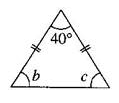
⇒ 40∘+2b=180∘
⇒ 2b=180∘−40∘
⇒ 2b=140∘
⇒ b=140∘/2
⇒ b=70∘
Thus, the base angles of the isosceles triangle are 70∘ each.
(c) Let the score of Rahul be xx runs and Sachin’s score is 2x.
According to the question, x+2x=198
⇒ 3x=198
⇒ x=198/3
⇒ x=66
Thus, Rahul’s score = 66 runs
And Sachin’s score = 2 x 66 = 132 runs.
Exercise 4.4
Page Number 91
3
Solve the following:
1. Irfan says that he has 7 marbles more than five times the marbles Parmit has. Irfan has 37 marbles. How many marbles does Parmit have?
2. Laxmi’s father is 49 years old. He is 4 years older than three times Laxmi’s age. What is Laxmi’s age?
3. People of Sundergram planted a total of 102 trees in the village garden. Some of the trees were fruit trees. The number of non-fruit trees were two more than three times the number of fruit trees. What was the number of fruit trees planted?
Answer
(i) Let the number of marbles Parmit has be m.m.
According to the question, 5m+7=37
⇒ 5m=37−7
⇒ 5m=30
⇒ m=30/5
⇒ m=6
Thus, Parmit has 6 marbles.
(ii) Let the age of Laxmi be yy years.
Then her father’s age = (3y+4) years
According to question, 3y+4=49
⇒ 3y=49−4
⇒ 3y=45
⇒ y=45/3
⇒ y=15
Thus, the age of Laxmi is 15 years.
(iii) Let the number of fruit trees be t.
Then the number of non-fruits tree = 3t+2
According to the question, t+3t+2=102
⇒ 4t+2=102
⇒ 4t=102−2
⇒ 4t=100
⇒ t=100/4
⇒ t=25
Thus, the number of fruit trees are 25.
Exercise 4.4
Page Number 91
4
Solve the following riddle:
I am a number, Tell my identity!
Take me seven times over, And add a fifty!
To reach a triple century, You still need forty!
Answer
Let the number be n.
According to the question, 7n+50+40=300
⇒ 7n+90=300
⇒ 7n=300−90
⇒ 7n=210
⇒ n=210/7
⇒ n=30
Thus, the required number is 30.
Exercise 4.4
Page Number 91