NCERT Solutions for Chapter 1 Rational Numbers Class 8 Maths
Book Solutions1
Using appropriate properties to find:
(i) 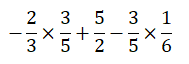
(ii) 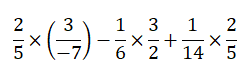
Answer
(i)
=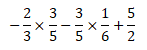 [Using Associative property]
=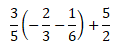 [Using distributive property]
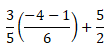
=
=
=
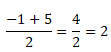
=
=
[Using Associative property]=
[Using distributive property]=
=
=
=
(ii) 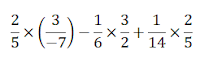
=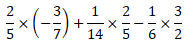 [Using Associative property]
=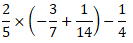 [Using distributive property]
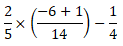
=
=
= -1/7 - 1/4
= (-4-7)/28
= -11/28
=
[Using Associative property]=
[Using distributive property]=
=
= -1/7 - 1/4
= (-4-7)/28
= -11/28
Exercise 1.1
Page Number 14
2
Write the additive inverse of each of the following:
(i) 2/8
(ii) -5/9
(iii) -6/-5
(iv) 2/-9
(v) 19/-6
(ii) -5/9
(iii) -6/-5
(iv) 2/-9
(v) 19/-6
Answer
We know that additive inverse of a rational number a/b is (-a/b), such that a/b + (-a/b) = 0
(i) Additive inverse of 2/8 IS -2/8.
(ii) Additive inverse of -5/9 IS 5/9
(iii) Additive inverse of -6/-5 IS -6/5
(iv) Additive inverse of 2/-9 IS 2/9
(v) Additive inverse of 19/-6 IS 19/6
Exercise 1.1
Page Number 14
3
Verify that -(x)=x for:
(i) x= 11/15
(ii) x= - 13/17
Answer
(i) Putting x= 11/15 in -(-x) =x
-(-11/15) = 11/15
⇒ 11/15 = 11/15
L.H.S. = R.H.S.
Hence, verified.
(ii) Putting x= -13/17 in -(-x) =x,
-{-(-13/17)} = -13/17 ⇒ -13/17 = -13/17
L.H.S. = R.H.S.
Hence, verified.
Exercise 1.1
Page Number 14
4
Find the multiplicative inverse of the following:
(i) - 13
(ii) -13/19
(iii) 1/5
(ii) -13/19
(iii) 1/5
(iv) (-5/8) × (-3/7)
(v) -1 ×(-2/5)
(vi) -1
(v) -1 ×(-2/5)
(vi) -1
Answer
We know that multiplicative inverse of a rational number a is (1/a), such that a × 1/a = 1
(i) Multiplicative inverse of -13 is -1/13
(ii) Multiplicative inverse of -13/19 is -19/13
(iii) Multiplicative inverse of 1/5 is 5
(iv) Multiplicative inverse of (-5/8) ×(-3/7) = 15/56 is 56/15
(v) Multiplicative inverse of -1 × -2/5 = 2/5 is 5/2
(vi) Multiplicative inverse of -1 is 1/-1 = -1
Exercise 1.1
Page Number 14
5
Name the property under multiplication used in each of the following:
(i) -4/5 × 1 = 1 × -4/5 = -4/5
(ii) (-13/17) × (-2/7) = (-2/7) × (-13/17)
(iii) (-19/29) × (29/-19) = 1
Answer
(i) 1 is the multiplicative identity.
(ii) commutativity property.
(iii) Multiplicative Inverse property.
Exercise 1.1
Page Number 14
6
Multiply 6/13 by the reciprocal of -7/16
Answer
The reciprocal of -7/16 is -16/7
According to the question,
(6/13)× (-16/7)
= -96/91
(6/13)× (-16/7)
= -96/91
Exercise 1.1
Page Number 14
7
Tell what property allows you to compute
1/3 × (6×4/3) as (1/3 × 6) × 4/3
Answer
By using associative property of multiplication,
we will compute as:
a ×(b×c) = (a×b)× c
a ×(b×c) = (a×b)× c
Exercise 1.1
Page Number 14
8
Is 8/9 the multiplicative inverse of -1.1/8? Why or why not?
Answer
Since multiplicative inverse of a rational number a is (1/a), if a× 1/a = 1
Therefore, (8/9) × (-1.1/8) = 8/9 × -9/8 = -1
But its product must be positive 1.
Therefore, 8/9 is not the multiplicative inverse of (-1.1/8)
Exercise 1.1
Page Number 14
9
Is 0.3 the multiplicative inverse of 3.1/3? Why or why not?
Answer
Since multiplicative inverse of a rational number a is (1/a), if a×1/a = 1
Therefore,
0.3 × 3.1/3
= 3/10 ×10/3
= 1
0.3 × 3.1/3
= 3/10 ×10/3
= 1
Therefore, Yes 0.3 is the multiplicative inverse of 3.1/3
Exercise 1.1
Page Number 14
10
Write:
(i) The rational number that does not have a reciprocal.
(ii) The rational numbers that are equal to their reciprocals.
(iii) The rational number that is equal to its negative.
Answer
(i) 0
(ii) 1 and
(iii) 0
Exercise 1.1
Page Number 15
11
Fill in the blanks:
(i) Zero has ____________ reciprocal.
(ii) The numbers ___________ and __________ are their own reciprocals.
(iii) The reciprocal of -5 is _____________.
(iv) Reciprocal of 1/x where x≠0 is _____________.
(v) The product of two rational numbers is always a ____________.
(vi) The reciprocal of a positive rational number is _______________
Answer
(i) No
(ii) 1, -1
(iii) -1/5
(iv) x
(v) Rational Number
(vi) Positive
Exercise 1.1
Page Number 15
1
Represent these numbers on the number line:
(i) 7/4
(ii) -5/6
Answer
(i) 7/4 = 1.3/4
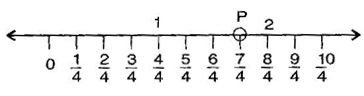
Here, P 1.3/4 = 7/4
(ii) -5/6
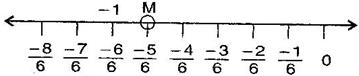
Here, M = -5/6
Here, P 1.3/4 = 7/4
(ii) -5/6
Here, M = -5/6
Exercise 1.2
Page Number 20
2
Represent -2/11 , -5/11, -9/11 on the number line.
Answer
Here, B = -2/11 C = -5/11 and D = -9/11

Exercise 1.2
Page Number 20
3
Write five rational numbers which are smaller than 2.
Answer
1/3 , 1/4, 1/2, -1/2, -1/5 and so on.
Exercise 1.2
Page Number 20
4
Find ten rational numbers between -2/5 and 1/2.
Answer
-2/5 and 1/2
Here, L.C.M. of 5 and 2 is 10.
∴ (-2/5)×(2/2) = -4/10 and (1/2) ×(5/5) = 5/10
Again, (-4/10) × (2/2) = -8/20 and 5/10 ×2/2 = 10/20
∴ Ten rational number between -2/5 and 1/2 are -7/20, -6/20, -5/20, -4/20, -3/20, -2/10, -1/20, 0, 1/20, 2/20
Here, L.C.M. of 5 and 2 is 10.
∴ (-2/5)×(2/2) = -4/10 and (1/2) ×(5/5) = 5/10
Again, (-4/10) × (2/2) = -8/20 and 5/10 ×2/2 = 10/20
∴ Ten rational number between -2/5 and 1/2 are -7/20, -6/20, -5/20, -4/20, -3/20, -2/10, -1/20, 0, 1/20, 2/20
Exercise 1.2
Page Number 20
5
Find five rational numbers between:
(i) 2/3 and 4/5
(ii) -3/2 and 5/3
(iii) 1/4 and 1/2
Answer
(i) 2/3 and 4/5
L.C.M. of 3 and 5 is 15.
(2/3) × (5/5) = 10/15 and (4/5)×(3/3) = 12/15
Again (10/15) × (4×4) = 40/60 and (12/15)×(4/4) = 48/60
∴ Five rational numbers between 2/3 and 4/5 are 41/60, 42/60, 43/60, 44/60, 45/60
L.C.M. of 3 and 5 is 15.
(2/3) × (5/5) = 10/15 and (4/5)×(3/3) = 12/15
Again (10/15) × (4×4) = 40/60 and (12/15)×(4/4) = 48/60
∴ Five rational numbers between 2/3 and 4/5 are 41/60, 42/60, 43/60, 44/60, 45/60
(ii) -3/2 and 5/3
L.C.M. of 2 and 3 is 6
∴ (-3/2) ×(3/3) = -9/6 and (5/3) × (2/2) = 10/6
Five rational numbers between -3/2 and 5/3 are -8/6, -7/6, 0, 1/6, 2/6
L.C.M. of 2 and 3 is 6
∴ (-3/2) ×(3/3) = -9/6 and (5/3) × (2/2) = 10/6
Five rational numbers between -3/2 and 5/3 are -8/6, -7/6, 0, 1/6, 2/6
(iii) 1/4 and 1/2
L.C.M. of 4 and 2 is 4.
(1/4) × (1/1) = 1/4 and (1/2) × (2/2) = 2/4
Again (1/4) ×(8/8) = 8/32 and (2/4) × (8/8) = 16/32
Five rational numbers between 1/4 and 1/2 are 9/32, 10/32, 11/32, 12/32, 12/32.
L.C.M. of 4 and 2 is 4.
(1/4) × (1/1) = 1/4 and (1/2) × (2/2) = 2/4
Again (1/4) ×(8/8) = 8/32 and (2/4) × (8/8) = 16/32
Five rational numbers between 1/4 and 1/2 are 9/32, 10/32, 11/32, 12/32, 12/32.
Exercise 1.2
Page Number 20
6
Write 5 rational numbers greater than -2.
Answer
Five rational numbers greater than -2 are:
-3/2, -1, -1/2, 0, 1/2
[Other rational numbers may also be possible]
-3/2, -1, -1/2, 0, 1/2
[Other rational numbers may also be possible]
Exercise 1.2
Page Number 20
7
Find ten rational numbers between 3/5 and 3/4.
Answer
3/5 and 3/4
L.C.M. of 5 and 4 is 20.
(3/5) × (4/4) = 12/20 and (3/4) × (5/5) = 15/20
Again (12/20) × (8/8) = 96/160 and (15/20) × (8/8) = 120/160
Ten rational numbers between 3/5 and 3/4 are:
97/160, 98/160, 99/160, 100/160, 101/160, 102/160, 103/160, 104/160, 105/160, 106/160
L.C.M. of 5 and 4 is 20.
(3/5) × (4/4) = 12/20 and (3/4) × (5/5) = 15/20
Again (12/20) × (8/8) = 96/160 and (15/20) × (8/8) = 120/160
Ten rational numbers between 3/5 and 3/4 are:
97/160, 98/160, 99/160, 100/160, 101/160, 102/160, 103/160, 104/160, 105/160, 106/160
Exercise 1.2
Page Number 20