NCERT Solutions for Chapter 4 Practical Geometry Class 8 Maths
Book Solutions1
Construct the following quadrilaterals:
(i) Quadrilateral ABCD
AB = 4.5 cm, BC = 5.5 cm, CD = 4 cm, AD = 6 cm, AC = 7 cm
(ii) Quadrilateral JUMP
JU = 3.5 cm, UM = 4 cm, MP = 5 cm, PJ = 4.5 cm, PU = 6.5 cm
(iii) Parallelogram MORE
OR = 6 cm, RE = 4.5 cm, EO = 7.5 cm
(iv) Rhombus BEST
BE = 4.5 cm, ET = 6 cm
Answer
(i) Given: AB = 4.5 cm, BC = 5.5 cm, CD = 4 cm, AD = 6 cm, AC = 7 cm
To construct: A quadrilateral ABCD
Steps of construction:
(a) Draw AB = 4.5 cm.
(b) Draw an arc taking radius 5.5 cm from point B.
(c) Taking radius 7 cm, draw an another arc from point A which intersects the first arc at point C.
(d) Join BC and AC.
(e) Draw an arc of radius 6 cm from point A and draw another arc of radius 4 cm from point C which intersects at D.
(f) Join AD and CD.
It is required quadrilateral ABCD.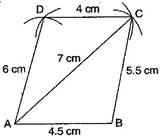
(ii) Given: JU = 3.5 cm, UM = 4 cm, MP = 5 cm, PJ = 4.5 cm, PU = 6.5 cm
To construct: A quadrilateral JUMP
Steps of construction:
(a) Draw JU = 3.5 cm.
(b) Draw an arc of radius 4.5 cm taking centre J and then draw another arc of radius 6.5 cm taking U as centre. Both arcs intersect at P.
(c) Join PJ and PU.
(d) Draw arc of radius 5 cm and 4 cm taking P and U as centres respectively, which intersect at M.
(e) Join MP and MU.
It is required quadrilateral JUMP.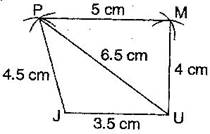
(iii) Given: OR = 6 cm, RE = 4.5 cm, EO = 7.5 cm
To construct: A parallelogram MORE
Steps of construction:
(a) Draw OR = 6 cm.
(b) Draw arcs of radius 7.5 cm and radius 4.5 cm taking O and R as centres respectively, which intersect at E.
(c) Join OE and RE.
(d) Draw an arc of 6 cm radius taking E as centre.
(e) Draw another arc of 4.5 cm radius taking O as centre, which intersects at M.
(f) Join OM and EM.
It is required parallelogram MORE.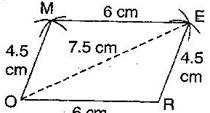
(iv) Given: BE = 4.5 cm, ET = 6 cm
To construct: A rhombus BEST
Steps of construction:
(a) Draw TE = 6 cm and bisect it into two equal parts.
(b) Draw up and down perpendiculars to TE.
(c) Draw two arcs of 4.5 cm taking E and T as centres, which intersect at S.
(d) Again draw two arcs of 4.5 cm taking E and T as centres, which intersects at B.
(e) Join TS, ES, BT and EB.
It is the required rhombus BEST.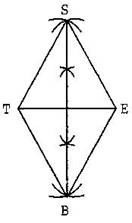
1
Construct the following quadrilaterals:
(i) Quadrilateral LIFT
LI = 4 cm, IF = 3 cm, TL = 2.5 cm, LF = 4.5 cm, IT = 4 cm
(ii) Quadrilateral GOLD
OL = 7.5 cm, GL = 6 cm, GD = 6 cm, LD = 5 cm, OD = 10 cm
(iii) Rhombus BEND
BN = 5.6 cm, DE = 6.5 cm
Answer
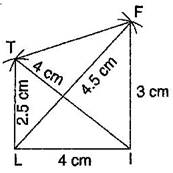
(i) Given: LI = 4 cm, IF = 3 cm, TL = 2.5 cm, LF = 4.5 cm, IT = 4 cm
To construct: A quadrilateral LIFT
Steps of construction:
(a) Draw a line segment LI = 4 cm.
(b) Taking radius 4.5 cm, draw an arc taking L as centre.
(c) Draw an arc of 3 cm taking I as centre which intersects the first arc at F.
(d) Join FI and FL.
(e) Draw another arc of radius 2.5 cm taking L as centre and 4 cm taking I as centre which intersect at T.
(f) Join TF, Tl and TI.
It is the required quadrilateral LIFT.
(ii) Given: OL = 7.5 cm, GL = 6 cm, GD = 6 cm, LD = 5 cm, OD = 10 cm
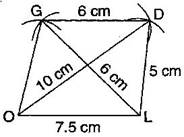
To construct: A quadrilateral GOLD
Steps of construction:
(a) Draw a line segment OL = 7.5 cm.
(b) Draw an arc of radius 5 cm taking L as centre and another arc of radius 10 cm taking O as centre which intersect the first arc at point D.
(c) Join LD and OD.
(d) Draw an arc of radius 6 cm from D and draw another arc of radius 6 cm taking L as centre, which intersects at G.
(e) Join GD and GO.
It is the required quadrilateral GOLD.
(iii) Given: BN = 5.6 cm, DE = 6.5 cm
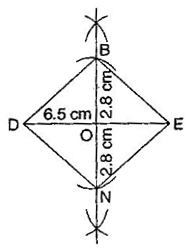
To construct: A rhombus BEND
Steps of construction:
(a) Draw DE = 6.5 cm.
(b) Draw perpendicular bisector of line segment DE.
(c) Draw two arcs of radius 2.8 cm from intersection point O, which intersects the perpendicular bisector at B and N.
(d) Join BE, BD as well as ND and NE.
It is the required rhombus BEND.
1
Construct the following quadrilaterals:
(i) Quadrilateral MORE
MO = 6 cm, OR = 4.5 cm, ∠M = 60°, ∠O = 105°, ∠R = 105°
(ii) Quadrilateral PLAN
PL = 4 cm, LA = 6.5 cm, ∠P = 90°, ∠A = 110°, ∠N = 85°
(iii) Parallelogram HEAR
HE = 5 cm, EA = 6 cm, ∠R = 85°
(iv) Rectangle OKAY
OK = 7 cm, KA = 5 cm
Answer
(i) Given: MO = 6 cm, OR = 4.5 cm,
∠M = 60°, ∠O = 105°, ∠R = 105°
To construct: A quadrilateral MORE
Steps of construction:
(a) Draw a line segment MO = 6 cm.
(b) Construct ∠R = 105° and taking radius 4.5 cm, draw an arc taking O as centre, which intersects at R.
(c) Also construct an angle 105° at R and produce the side RE.
(d) Construct another angle of 60° at point M and produce the side ME. Both sides ME and RE intersect at E.
It is the required quadrilateral MORE.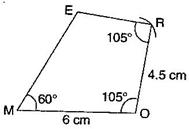
(ii) Given: PL = 4 cm, LA = 6.5 cm,
∠P = 90°, ∠A = 110°, ∠N = 85°
To construct: A quadrilateral PLAN
To find: ∠L = 360° - (90° + 85° + 110°) = 360° - 285° = 75°
Steps of construction:
(a) Draw a line segment PL = 4 cm.
(b) Construct angle of 90° at P and produce the side PN.
(c) Construct angle of 75° at L and with L as centre, draw an arc of radius 6 cm, which intersects at A.
|(d) Construct ∠A = 110° at A and produce the side AN which intersects PN at N.
It is the required quadrilateral PLAN.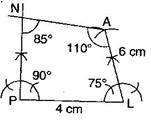
(iii) Given: HE = 5 cm, EA = 6 cm, ∠R = 85°
To construct: A parallelogram HEAR
To find: ∠H = 180° - 85° = 95°
[ Sum of adjacent angle of ||gm is 180°]
Steps of construction:
(a) Draw a line segment HE = 5 cm.
(b) Construct ∠H = 95° and draw an arc of radius 6 cm with centre H. It intersects AR at R.
(c) Join RH.
(d) Draw ∠R = ∠E = 85° and draw an arc of radius 6 cm with E as a centre which intersects RA at A.
(e) Join RA.
It is the required parallelogram HEAR.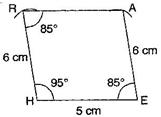
(iv) Given: OK = 7 cm, KA = 5 cm
To construct: A rectangle OKAY
Steps of construction:
(a) Draw a line segment OK = 7 cm.
(b) Construct angle 90° at both points O and K and produce these sides.
(c) Draw two arcs of radius 5 cm from points O and K respectively. These arcs intersect at Y and A.
(d) Join YA.
It is the required rectangle OKAY.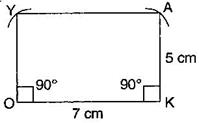
1
Construct the following quadrilaterals:
(i) Quadrilateral DEAR
DE = 4 cm, EA = 5 cm, AR = 4.5 cm, ∠E = 60°, ∠A = 90°
(ii) Quadrilateral TRUE
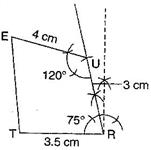
TR = 3.5 cm, RU = 3 cm, UE = 4 cm, ∠R = 75°, ∠U = 120°
Answer
(i) Given: DE = 4 cm, EA = 5 cm, AR = 4.5 cm, ∠E = 60°, ∠A = 90°
To construct: A quadrilateral DEAR
Steps of construction:
(a) Draw a line segment DE = 4 cm.
(b) At point E, construct an angle of 60°.
(c) Taking radius 5 cm, draw an arc from point E which intersects at A.
(d) Construct ∠A = 90°, draw an arc of radius 4.5 cm with centre A which intersect at R.
(e) Join RD.
It is the required quadrilateral DEAR.
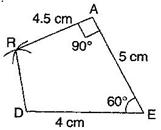
(ii) Given: TR = 3.5 cm, RU = 3 cm, UE = 4 cm, ∠R = 75°, ∠U = 120°
To construct: A quadrilateral TRUE
Steps of construction:
(a) Draw a line segment TR = 3.5 cm.
(b) Construct an angle 75° at R and draw an arc of radius 3 cm with R as centre, which intersects at U.
(c) Construct an angle of 120° at U and produce the side UE.
(d) Draw an arc of radius 4 cm with U as centre.
(e) Join UE and TE.
It is the required quadrilateral TRUE.
1
Draw the following:
The square READ with RE = 5.1 cm.
Answer
Given: RE = 5.1 cm
To construct: the square READ.
Steps of construction: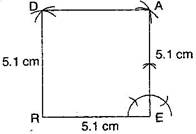
(i) Draw a line segment RE = 5.1 cm.
(ii) At point E, construct an angle of 90o and draw an arc of radius 5.1 cm, mark the intesection of line and arc as point A.
(iii) From point R, draw an arc of radius 5.1 cm and from point A, draw another arc of radius 5.1 cm, mark the intersection of the two arcs as point D.
(iv) Join AD and RD.
It is the required square READ.
2
Answer
Given: Diagonals of a rhombus
AC = 5.2 cm and BD = 6.4 cm.
To construct: A rhombus ABCD.
Steps of construction: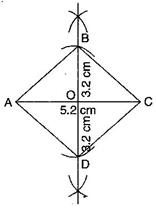
(i) Draw AC = 5.2 cm and draw a perpendicular bisector on AC.
(ii) From the midpoint O, draw two arcs of radius 3.2 cm cutting the perpendicular bisector on both sides.
(iii) Mark the points of intersection of arcs and perpendicular bisector as B and D.
(iv) Join AB, BC, CD and DA.
It is required rhombus ABCD.
3
Answer
Given: MN = 5 cm and MP = 4 cm.
To construct: A rectangle MNOP
Steps of construction: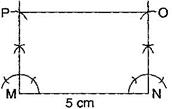
(a) Draw a segment MN = 5 cm.
(b) At points M and N, draw perpendiculars of lengths 4 cm and produce them.
(c) Taking centres M and N, draw two arcs of 4 cm each, which intersect P and Q respectively.
(d) Join side PO.
It is required rectangle MNOP.
4
Answer
OK = 5.5 cm and KA = 4.2 cm.
To construct: A parallelogram OKAY.
Steps of construction: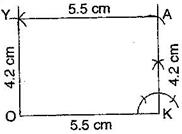
(a) Draw a line segment OK = 5.5 cm.
(b) Draw an angle of 90o at K and draw an arc of radius KA = 4.2 cm, which intersects at point A.
(c) Draw another arc of radius AY = 5.5 cm and at point O, draw another arc of radius 4.2 cm which intersect at Y.
(d) Join AY and OY.
It is the required parallelogram OKAY.