NCERT Solutions for Chapter 10 Practical Geometry Class 7 Maths
Book Solutions1
Draw a line, say AB, take a point C outside it. Through C, draw a line parallel to AB using ruler and compasses only.
Answer
To construct: A line, parallel to given line by using ruler and compass.
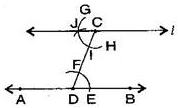
Steps of construction:
(a) Draw a line-segment AB and take a point C outside AB.
(b) Take any point D on AB and join C to D.
(c) With D as centre and take convenient radius, draw an arc cutting AB at E and CD at F.
(d) With C as centre and same radius as in step 3, draw an arc GH cutting CD at I.
(e) With the same arc EF, draw the equal arc cutting GH at J.
(f) Join JC to draw a line l.
This the required line AB∥l.
Steps of construction:
(a) Draw a line-segment AB and take a point C outside AB.
(b) Take any point D on AB and join C to D.
(c) With D as centre and take convenient radius, draw an arc cutting AB at E and CD at F.
(d) With C as centre and same radius as in step 3, draw an arc GH cutting CD at I.
(e) With the same arc EF, draw the equal arc cutting GH at J.
(f) Join JC to draw a line l.
This the required line AB∥l.
Exercise 10.1
Page Number 196
2
Draw a line l. Draw a perpendicular to ll at any point on l. On this perpendicular choose a point X, 4 cm away from l. Through X, draw a line mm parallel to l.
Answer
To construct: A line parallel to given line when perpendicular line is also given.
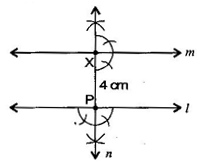
Steps of construction:
(a) Draw a line ll and take a point P on it.
(b) At point P, draw a perpendicular line n.
(c) Take PX = 4 cm on line n.
(d) At point X, again draw a perpendicular line m.
It is the required construction.
Steps of construction:
(a) Draw a line ll and take a point P on it.
(b) At point P, draw a perpendicular line n.
(c) Take PX = 4 cm on line n.
(d) At point X, again draw a perpendicular line m.
It is the required construction.
Exercise 10.1
Page Number 196
3
Let l be a line and P be a point not on l. Through P, draw a line mm parallel to l. Now join P to any point Q on l. Choose any other point R on m. Through R, draw a line parallel to PQ. Let this meet l at S. What shape do the two sets of parallel lines enclose?
Answer
To construct: A pair of parallel lines intersecting other part of parallel lines.

Steps of construction:
(a) Draw a line l and take a point P outside of l.
(b) Take point Q on line l and join PQ.
(c) Make equal angle at point P such that ∠Q = ∠P.
(d) Extend line at P to get line m.
(e) Similarly, take a point R online m, at point R, draw angles such that ∠P = ∠R.
(f) Extended line at R which intersects at S online l. Draw line RS.
Thus, we get parallelogram PQRS.
Steps of construction:
(a) Draw a line l and take a point P outside of l.
(b) Take point Q on line l and join PQ.
(c) Make equal angle at point P such that ∠Q = ∠P.
(d) Extend line at P to get line m.
(e) Similarly, take a point R online m, at point R, draw angles such that ∠P = ∠R.
(f) Extended line at R which intersects at S online l. Draw line RS.
Thus, we get parallelogram PQRS.
Exercise 10.1
Page Number 196
1
Construct ΔXYZ in which XY = 4.5 cm, YZ = 5 cm and ZX = 6 cm.
Answer
To construct: ΔXYZ, where XY = 4.5 cm, YZ = 5 cm and ZX = 6 cm.
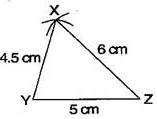
Steps of construction:
(a) Draw a line segment YZ = 5 cm.
(b) Taking Z as centre and radius 6 cm, draw an arc.
(c) Similarly, taking Y as centre and radius 4.5 cm, draw another arc which intersects first arc at point X.
(d) Join XY and XZ.
It is the required ΔXYZ.
Steps of construction:
(a) Draw a line segment YZ = 5 cm.
(b) Taking Z as centre and radius 6 cm, draw an arc.
(c) Similarly, taking Y as centre and radius 4.5 cm, draw another arc which intersects first arc at point X.
(d) Join XY and XZ.
It is the required ΔXYZ.
Exercise 10.2
Page Number 199
2
Construct an equilateral triangle of side 5.5 cm.
Answer
To construct: A ΔABC where AB = BC = CA = 5.5 cm

Steps of construction:
(a) Draw a line segment BC = 5.5 cm
(b) Taking points B and C as centers and radius 5.5 cm, draw arcs which intersect at point A.
(c) Join AB and AC.
It is the required ΔABC.
Steps of construction:
(a) Draw a line segment BC = 5.5 cm
(b) Taking points B and C as centers and radius 5.5 cm, draw arcs which intersect at point A.
(c) Join AB and AC.
It is the required ΔABC.
Exercise 10.2
Page Number 199
3
Draw ΔPQR with PQ = 4 cm, QR = 3.5 cm and PR = 4 cm. What type of triangle is this?
Answer
To construction: ΔPQR, in which PQ = 4 cm, QR = 3.5 cm and PR = 4 cm.
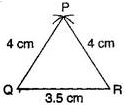
Steps of construction:
(a) Draw a line segment QR = 3.5 cm.
(b) Taking Q as centre and radius 4 cm, draw an arc.
(c) Similarly, taking R as centre and radius 4 cm, draw an another arc which intersects first arc at P.
(d) Join PQ and PR.
It is the required isosceles ΔPQR.
Steps of construction:
(a) Draw a line segment QR = 3.5 cm.
(b) Taking Q as centre and radius 4 cm, draw an arc.
(c) Similarly, taking R as centre and radius 4 cm, draw an another arc which intersects first arc at P.
(d) Join PQ and PR.
It is the required isosceles ΔPQR.
Exercise 10.2
Page Number 199
4
Construct ΔABC such that AB = 2.5 cm, BC = 6 cm and AC = 6.5 cm. Measure ∠B.
Answer
To construct :ΔABC in which AB = 2.5 cm, BC = 6 cm and AC = 6.5 cm.

Steps of construction:
(a) Draw a line segment BC = 6 cm.
(b) Taking B as centre and radius 2.5 cm, draw an arc.
(c) Similarly, taking C as centre and radius 6.5 cm, draw another arc which intersects first arc at point A.
(d) Join AB and AC.
(e) Measure angle B with the help of protractor.
It is the required ΔABC where ∠B = 80∘
Steps of construction:
(a) Draw a line segment BC = 6 cm.
(b) Taking B as centre and radius 2.5 cm, draw an arc.
(c) Similarly, taking C as centre and radius 6.5 cm, draw another arc which intersects first arc at point A.
(d) Join AB and AC.
(e) Measure angle B with the help of protractor.
It is the required ΔABC where ∠B = 80∘
Exercise 10.2
Page Number 199
1
Construct ΔDEF such that DE = 5 cm, DF = 3 cm and m∠EDF = 90∘
Answer
To construct: ΔDEF where DE = 5 cm, DF = 3 cm and m∠EDF = 90∘

Steps of construction:
(a) Draw a line segment DF = 3 cm.
(b) At point D, draw an angle of 90∘90∘ with the help of compass i.e., ∠XDF = 90∘
(c) Taking D as centre, draw an arc of radius 5 cm, which cuts DX at the point E.
(d) Join EF.
It is the required right angled triangle DEF.
Steps of construction:
(a) Draw a line segment DF = 3 cm.
(b) At point D, draw an angle of 90∘90∘ with the help of compass i.e., ∠XDF = 90∘
(c) Taking D as centre, draw an arc of radius 5 cm, which cuts DX at the point E.
(d) Join EF.
It is the required right angled triangle DEF.
Exercise 10.3
Page Number 200
2
Construct an isosceles triangle in which the lengths of each of its equal sides is 6.5 cm and the angle between them is 110∘
Answer
To construct: An isosceles triangle PQR where PQ = RQ = 6.5 cm and ∠Q = 110∘
Steps of construction:
(a) Draw a line segment QR = 6.5 cm.
(b) At point Q, draw an angle of 110∘
(d) Taking Q as centre, draw an arc with radius 1cm, which cuts QY at point P. 110∘
(e) Join PR
It is the required isosceles triangle PQR
Steps of construction:
(a) Draw a line segment QR = 6.5 cm.
(b) At point Q, draw an angle of 110∘
(d) Taking Q as centre, draw an arc with radius 1cm, which cuts QY at point P. 110∘
(e) Join PR
It is the required isosceles triangle PQR
Exercise 10.3
Page Number 200
3
Construct ΔABC with BC = 7.5 cm, AC = 5 cm and m∠C = 60∘
Answer
To construct: ΔABC where BC = 7.5 cm, AC = 5 cm and m∠C = 60∘

Steps of construction:
(a) Draw a line segment BC = 7.5 cm.
(b) At point C, draw an angle of 60∘
(c) Taking C as centre and radius 5 cm, draw an arc, which cuts XC at the point A.
(d) Join AB
It is the required triangle ABC.
Steps of construction:
(a) Draw a line segment BC = 7.5 cm.
(b) At point C, draw an angle of 60∘
(c) Taking C as centre and radius 5 cm, draw an arc, which cuts XC at the point A.
(d) Join AB
It is the required triangle ABC.
Exercise 10.3
Page Number 200
1
Construct ΔABC, given m∠A = 60o, m∠B = 30o and AB = 5.8 cm.
Answer
To construct: ΔABC where m∠A = 60o, m∠B = 30o and AB = 5.8 cm.
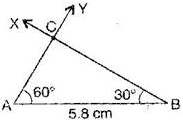
Steps of construction:
(a) Draw a line segment AB = 5.8 cm.
(b) At point A, draw an angle ∠YAB = 60o with the help of compass.
(c) At point B, draw ∠XBA = 30o with the help of compass.
(d) AY and BX intersect at the point C.
It is the required triangle ABC.
Steps of construction:
(a) Draw a line segment AB = 5.8 cm.
(b) At point A, draw an angle ∠YAB = 60o with the help of compass.
(c) At point B, draw ∠XBA = 30o with the help of compass.
(d) AY and BX intersect at the point C.
It is the required triangle ABC.
Exercise 10.4
Page Number 202
2
Construct ΔPQR if PQ = 5 cm, m∠PQR = 105o and m∠QRP = 40o
Answer
Given: m∠PQR = 105o∘ and m∠QRP = 40o
We know that sum of angles of a triangle is 180o
∴ m∠PQR + m∠QRP + m∠QPR = 180o
⇒ 105o+40o+m∠QPR = 180o
We know that sum of angles of a triangle is 180o
∴ m∠PQR + m∠QRP + m∠QPR = 180o
⇒ 105o+40o+m∠QPR = 180o
⇒ 145o + m∠QPR = 180o
⇒ m∠QPR = 180o – 145o
⇒ m∠QPR = 35o
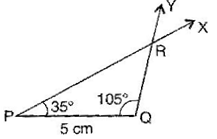
To construct: ΔPQR wherem∠P = 35o, m∠Q = 105o and PQ = 5 cm.
Steps of construction:
(a) Draw a line segment PQ = 5 cm.
(b) At point P, draw ∠XPQ = 35o with the help of protractor.
(c) At point Q, draw ∠YQP = 105o with the help of protractor.
(d) XP and YQ intersect at point R.
It is the required triangle PQR.
⇒ m∠QPR = 180o – 145o
⇒ m∠QPR = 35o
To construct: ΔPQR wherem∠P = 35o, m∠Q = 105o and PQ = 5 cm.
Steps of construction:
(a) Draw a line segment PQ = 5 cm.
(b) At point P, draw ∠XPQ = 35o with the help of protractor.
(c) At point Q, draw ∠YQP = 105o with the help of protractor.
(d) XP and YQ intersect at point R.
It is the required triangle PQR.
Exercise 10.4
Page Number 202
3
Examine whether you can construct ΔDEF such that EF = 7.2 cm, m∠E = 110o and m∠F = 80o. Justify your answer.
Answer
Triangel DEF cannot be constructed since Angle E + Angle F = 110o + 80o = 190o and the sum of all the angles of triangle is 180o
Exercise 10.4
Page Number 202
1
Construct the right angled ΔPQR, where m∠Q = 90∘, QR = 8 cm and PR = 10 cm.
Answer
To construct: A right angled triangle PQR where m∠Q = 90∘, QR = 8 cm and PQ = 10 cm.
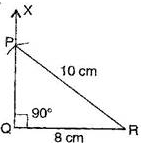
Steps of construction:
(a) Draw a line segment QR = 8 cm.
(b) At point Q, draw QX ⊥ QR.
(c) Taking R as centre, draw an arc of radius 10 cm.
(d) This arc cuts QX at point P.
(e) Join PQ.
It is the required right angled triangle PQR.
Steps of construction:
(a) Draw a line segment QR = 8 cm.
(b) At point Q, draw QX ⊥ QR.
(c) Taking R as centre, draw an arc of radius 10 cm.
(d) This arc cuts QX at point P.
(e) Join PQ.
It is the required right angled triangle PQR.
Exercise 10.5
Page Number 203
2
Construct a right angled triangle whose hypotenuse is 6 cm long and one the legs is 4 cm long.
Answer
To construct: A right angled triangle DEF where DF = 6 cm and EF = 4 cm
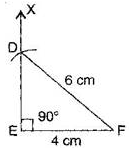
Steps of construction:
(a) Draw a line segment EF = 4 cm.
(b) At point E, draw EX ⊥ EF.
(c) Taking F as centre and radius 6 cm, draw an arc. (Hypotenuse)
(d) This arc cuts the EX at point D.
(e) Join DF.
It is the required right angled triangle DEF.
Steps of construction:
(a) Draw a line segment EF = 4 cm.
(b) At point E, draw EX ⊥ EF.
(c) Taking F as centre and radius 6 cm, draw an arc. (Hypotenuse)
(d) This arc cuts the EX at point D.
(e) Join DF.
It is the required right angled triangle DEF.
Exercise 10.5
Page Number 203
3
Construct an isosceles right angled triangle ABC, where m∠ACB = 90∘ and AC = 6 cm.
Answer
To construct: An isosceles right angled triangle ABC where m∠C = 90∘, AC = BC = 6 cm.
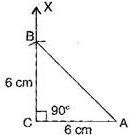
Steps of construction:
(a) Draw a line segment AC = 6 cm.
(b) At point C, draw XC ⊥ CA.
(c) Taking C as centre and radius 6 cm, draw an arc.
(d) This arc cuts CX at point B.
(e) Join BA.
It is the required isosceles right angled triangle ABC.
Steps of construction:
(a) Draw a line segment AC = 6 cm.
(b) At point C, draw XC ⊥ CA.
(c) Taking C as centre and radius 6 cm, draw an arc.
(d) This arc cuts CX at point B.
(e) Join BA.
It is the required isosceles right angled triangle ABC.
Exercise 10.5
Page Number 203
1
Below are given the measures of certain sides and angles of triangles. Identify those which cannot be constructed and, say why you cannot construct them. Construct rest of the triangle.
Triangle Given measurements
1. ΔABC m∠A = 85∘ ; m∠B = 115∘ ; AB = 5 cm
Answer
In ΔABC, m∠A = 85∘,m∠B = 115∘, AB = 5 cm Construction of ΔABC is not possible because m∠A = 85∘+m∠B = 200∘ and we know that the sum of angles of a triangle should be 180∘
Miscellaneous
Page Number 205
2
ΔPQR m∠Q = 30∘ ; m∠R = 60∘ ; QR = 4.7 cm
Answer
To construct: ΔPQR where m∠Q = 30∘,m∠R = 60∘ and QR = 4.7 cm.
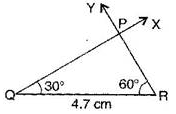
Steps of construction:
(a)Draw a line segment QR = 4.7 cm.
(b) At point Q, draw ∠XQR = 30∘ with the help of compass.
(c) At point R, draw ∠YRQ = 60∘ with the help of compass.
(d) QX and RY intersect at point P.
It is the required triangle PQR.
Steps of construction:
(a)Draw a line segment QR = 4.7 cm.
(b) At point Q, draw ∠XQR = 30∘ with the help of compass.
(c) At point R, draw ∠YRQ = 60∘ with the help of compass.
(d) QX and RY intersect at point P.
It is the required triangle PQR.
Miscellaneous
Page Number 205
3
ΔABC m∠A = 70∘ ; m∠B = 50∘ ; AC = 3 cm
Answer
We know that the sum of angles of a triangle is 180∘
∴ m∠A + m∠B + m∠C = 180∘
⇒ 70∘+50∘+m∠C = 180∘
⇒ 120∘ + m∠C = 180∘
⇒ m∠C = 180∘ – 120∘
⇒ m∠C = 60∘
To construct: ΔABC where m∠A = 70∘, m∠C = 60∘ and AC = 3 cm.

Steps of construction:
(a) Draw a line segment AC = 3 cm.
(b) At point C, draw ∠YCA = 60∘
(c) At point A, draw ∠XAC = 70∘
(d) Rays XA and YC intersect at point B
It is the required triangle ABC.
∴ m∠A + m∠B + m∠C = 180∘
⇒ 70∘+50∘+m∠C = 180∘
⇒ 120∘ + m∠C = 180∘
⇒ m∠C = 180∘ – 120∘
⇒ m∠C = 60∘
To construct: ΔABC where m∠A = 70∘, m∠C = 60∘ and AC = 3 cm.
Steps of construction:
(a) Draw a line segment AC = 3 cm.
(b) At point C, draw ∠YCA = 60∘
(c) At point A, draw ∠XAC = 70∘
(d) Rays XA and YC intersect at point B
It is the required triangle ABC.
Miscellaneous
Page Number 205
4
ΔLMN m∠L = 60∘ ; m∠N = 120∘ ; LM = 5 cm
Answer
In ΔLMN , m∠L = 60∘,m∠N = 120∘, LM = 5 cm
This ΔLMN is not possible to construct because m∠L + m∠N = 60∘+120∘=180∘ which forms a linear pair.
This ΔLMN is not possible to construct because m∠L + m∠N = 60∘+120∘=180∘ which forms a linear pair.
Miscellaneous
Page Number 205
5
ΔABC BC = 2 cm; AB = 4 cm; AC = 2 cm
Answer
ΔABC, BC = 2 cm, AB = 4 cm and AC = 2 cm
This ΔABC is not possible to construct because the condition is Sum of lengths of two sides of a triangle should be greater than the third side.
AB < BC + AC ⇒ 4 < 2 + 2 ⇒ 4 = 4,
This ΔABC is not possible to construct because the condition is Sum of lengths of two sides of a triangle should be greater than the third side.
AB < BC + AC ⇒ 4 < 2 + 2 ⇒ 4 = 4,
Miscellaneous
Page Number 205
6
ΔPQR PQ = 3.5 cm; QR = 4 cm; PR = 3.5 cm
Answer
To construct: ΔPQR where PQ = 3.5 cm, QR = 4 cm and PR = 3.5 cm
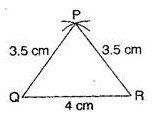
Steps of construction:
(a) Draw a line segment QR = 4 cm.
(b) Taking Q as centre and radius 3.5 cm, draw an arc.
(c) Similarly, taking R as centre and radius 3.5 cm, draw an another arc which intersects the first arc at point P.
It is the required triangle PQR.
Steps of construction:
(a) Draw a line segment QR = 4 cm.
(b) Taking Q as centre and radius 3.5 cm, draw an arc.
(c) Similarly, taking R as centre and radius 3.5 cm, draw an another arc which intersects the first arc at point P.
It is the required triangle PQR.
Miscellaneous
Page Number 205
7
ΔXYZ XY = 3 cm; YZ = 4 cm; XZ = 5 cm
Answer
To construct: A triangle whose sides are XY = 3 cm, YZ = 4 cm and XZ = 5 cm.

Steps of construction:
(a) Draw a line segment ZY = 4 cm.
(b) Taking Z as centre and radius 5 cm, draw an arc.
(c) Taking Y as centre and radius 3 cm, draw another arc.
(d) Both arcs intersect at point X.
It is the required triangle XYZ.
Steps of construction:
(a) Draw a line segment ZY = 4 cm.
(b) Taking Z as centre and radius 5 cm, draw an arc.
(c) Taking Y as centre and radius 3 cm, draw another arc.
(d) Both arcs intersect at point X.
It is the required triangle XYZ.
Miscellaneous
Page Number 205
8
ΔDEF DE = 4.5 cm; EF = 5.5 cm; DF = 4 cm
Answer
To construct: A triangle DEF whose sides are DE = 4.5 cm, EF = 5.5 cm and DF = 4 cm.
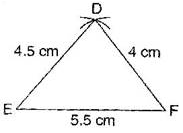
Steps of construction:
(a) Draw a line segment EF = 5.5 cm.
(b) Taking E as centre and radius 4.5 cm, draw an arc.
(c) Taking F as centre and radius 4 cm, draw an another arc which intersects the first arc at point D.
It is the required triangle DEF.
Steps of construction:
(a) Draw a line segment EF = 5.5 cm.
(b) Taking E as centre and radius 4.5 cm, draw an arc.
(c) Taking F as centre and radius 4 cm, draw an another arc which intersects the first arc at point D.
It is the required triangle DEF.
Miscellaneous
Page Number 205