NCERT Solutions for Ch 8 Working with Fractions Class 7 Maths
Book Solutions1
Answer
Number of glasses of milk drunk in a day = 1/2
There are 7 days in a week.
So, number of glasses of milk drunk in 1 week =
7 × (1/2) = 7/2 = 3½
Therefore, Tenzin drinks 3½ glasses of milk in a week.
Also, there are 31 days in January.
So, number of glasses of milk drunk in January =
31 × (1/2) = 31/2 = 15½
Therefore, Tenzin drinks 15½ glasses of milk in January.
2
Answer
Water canal made by team of workers in 8 days = 1 km
So, water canal made by team of workers in 1 day = 1/8 km
The length of the water canal made by the team of workers in 5 days = 5 × (1/8) km = 5/8 km
Hence, the team can make 5/8 km of the water canal in one week.
3
Answer
The amount of oil each family gets in a week = 5 ÷ 3 = 5/3 litres.The amount of oil one family gets in 4 week = 4 × 5/3 = 20/3 = 6⅔ litres.
4
Answer
There are 3 days from Monday to Thursday.
Since the Moon sets 5/6 hours later than the previous day,
the number of hours the Moon will set later on Thursday than Monday = 3 × (5/6) hours
= 15/6 hours
= 5/2 hours
We know that 1 hour = 60 minutes
5/2 hours = (5/2) × 60 minutes = 300/2 minutes = 150 minutes
Now, 150 minutes = 120 minutes + 30 minutes = 2 hours 30 minutes
Hence, on Thursday the Moon will set 2 hours 30 minutes after 10 pm.
5
(a) 7 × 3/5
(b) 4 × 1/3
(c) 9/7 × 6
(d) 13/11 × 6
Answer
(a) 7 × 3/5 = 21/5 = 4⅕.
(b) 4 × 1/3 = 4/3 = 1⅓.
(c) 9/7 × 6 = 54/7 = 
(d) 13/11 × 6 = 78/11 = 7¹/₁₁.
6
(a) 1/3 × 1/5
(b) 1/4 × 1/3
(c) 1/5 × 1/2
(d) 1/6 × 1/5
Answer
(a) Unit square divided into 3 rows and 5 columns = 15 parts.
1 part shaded = 1/15. Thus, 1/3 × 1/5 = 1/15.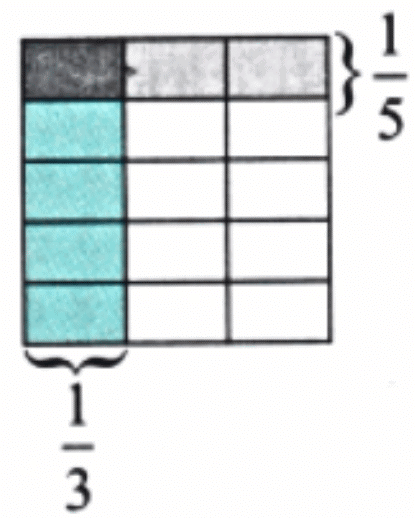
(b) Unit square divided into 4 rows and 3 columns = 12 parts.
1 part shaded = 1/12. Thus, 1/4 × 1/3 = 1/12.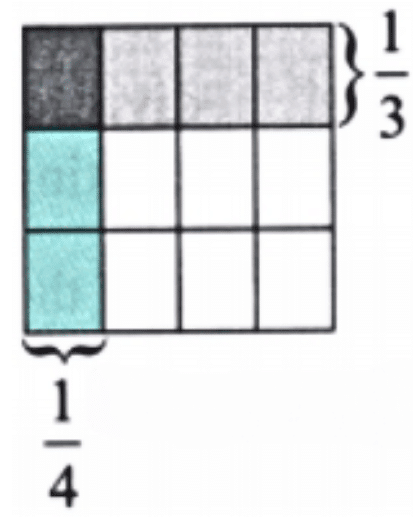
(c) Unit square divided into 5 rows and 2 columns = 10 parts.
1 part shaded = 1/10. Thus, 1/5 × 1/2 = 1/10.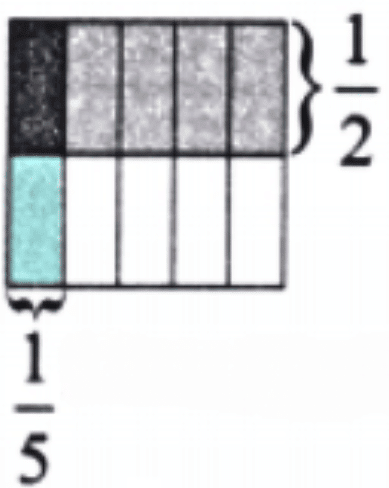
(d) Unit square divided into 6 rows and 5 columns = 30 parts.
1 part shaded = 1/30. Thus, 1/6 × 1/5 = 1/30.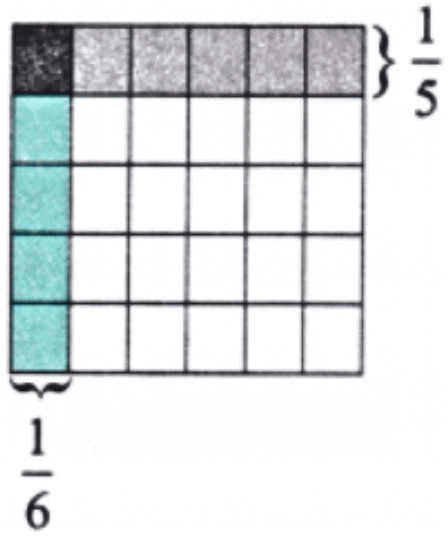
7
(a) 2/3 × 4/5
(b) 1/4 × 2/3
(c) 3/5 × 1/2
(d) 4/6 × 3/5
Answer
(a) Divide unit square into 3 rows and 5 columns = 15 parts.
2/3 = 10 parts, divide by 5 to get 2 parts per 1/5.
4/5 = 4 columns, so 4 × 2 = 8 parts shaded.
Thus, 2/3 × 4/5 = 8/15.
(b) Divide unit square into 4 rows and 3 columns = 12 parts.
1/4 = 3 parts, divide by 3 to get 1 part per 1/3.
2/3 = 2 columns, so 2 × 1 = 2 parts shaded.
Thus, 1/4 × 2/3 = 2/12 = 1/6.
(c) Divide unit square into 5 rows and 2 columns = 10 parts.
3/5 = 6 parts, divide by 2 to get 3 parts per 1/2.
1/2 = 1 column, so 1 × 3 = 3 parts shaded.
Thus, 3/5 × 1/2 = 3/10.
(d) Divide unit square into 6 rows and 5 columns = 30 parts.
4/6 = 20 parts, divide by 5 to get 4 parts per 1/5.
3/5 = 3 columns, so 3 × 4 = 12 parts shaded.
Thus, 4/6 × 3/5 = 12/30 = 2/5.
8
(a) 1/3 hour ____________
(b) 2/3 hour ____________
(c) 3/4 hour ____________
(d) 7/10 hour ____________
(e) For the tank to be full, how long should the tap be running?
Answer
Rate = 7/10 tank per hour.
(a) 1/3 hour: 1/3 × 7/10 = 7/30 tank.
(b) 2/3 hour:2/3 × 7/10 = 14/30 = 7/15 tank.
(c) 3/4 hour:3/4 × 7/10 = 21/40 tank.
(d) 7/10 hour: 7/10 × 7/10 = 49/100 tank.
(e) For full tank (1): 1 ÷ 7/10 = 10/7 hours =  hours.
9
(a) What part of the original land did Krishna get?
(b) What part of the original land did Bora get?
(c) What part of the original land did Somu keep for herself?
Answer
After the government acquired 1/6 of the land,
The land remaining with Somu is 1 - 1/6 = 5/6 parts.
(a) Krishna received half of the remaining land.
Since the remaining land is 5/6 of the original land,
Krishna received 1/2 × 5/6 = 5/12 of the original land.
Thus, Krishna got 5/12 of the original land.
(b) Bora received 1/3 of the remaining land.
That is 1/3 × 5/6 = (1×5)/(3×6) = 5/18
Thus, Bora got 5/18 of the original land.
(c) Total share of Bora, Krishna, and the government form the original land =
Now, part of land left with Somu = 
Thus, Somu kept 5/36 of the original land for herself.
10
Answer
3¾ = 15/4 ft, 9⅗ = 48/5 ft.Area = 15/4 × 48/5 = (15 × 48)/(4 × 5) = 720/20 = 36 sq. ft.
11
Answer

Four saplings have 3 gaps.
Distance = 3 × ¾ = 9/4 = 2¼ m.
12
Answer
12/15 × 500 = 4/5 × 500 = 400 grams.
3/20 × 4 kg = 3/20 × 4000 g = 600 grams.
∴ 600 g is heavier than 400 g
∴ (3)/(20) of 4 kg is heavier than (12)/(15) of 500 grams.
13
Q: What can you conclude about the relationship between the numbers multiplied and the product?
Fill in the blanks:
- When one of the numbers being multiplied is between 0 and 1, the product is ____________ (greater/less) than the other number.
- When one of the numbers being multiplied is greater than 1, the product is _____________ (greater/less) than the other number.
Answer
• When one of the numbers being multiplied is between 0 and 1, the product is less than the other number.
Example:
0 < 1/2 < 1, and 1/2 × 100 = 50 < 100
• When one of the numbers being multiplied is greater than 1, the product is greater than the other number.
Example:1 1/2 > 1 and 1 1/2 × 1/4 = 3/2 × 1/4 = 3/8
Now, 1/4 = 2/8 ⇒ 1/4 < 3/8
14
Is there a similar relationship between the divisor and the quotient?
Use your understanding of such relationships in multiplication to answer the questions above.
Answer
When the divisor is between 0 and 1, the quotient is greater than the dividend.
When the divisor is greater than 1, the quotient is less than the dividend.
When the divisor is 1, the quotient is equal to the dividend.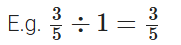
There is no similar relationship between the divisor and the quotient.
15
Example 5: This problem was posed by Chaturveda Prithudakasvami (c. 860 CE) in his commentary on Brahmagupta’s book Brahmasphutasiddhanta.
Four fountains fill a cistern. The first fountain can fill the cistern in a day. The second can fill it in half a day. The third can fill it in a quarter of a day. The fourth can fill the cistern in one-fifth of a day. If they all flow together, in how much time will they fill the cistern?
Let us solve this problem step by step.
In a day, the number of times-
• The first fountain will fill the cistern in 1 ÷ 1 = 1
• The second fountain will fil the cistern is  _________
• The third fountain will fil the cistern is  ________
• The fourth fountain will fil the cistern is  _________
• The number of times the four fountains together will fill the cistern in a day is ___ + ____ + ___ + ____ = 12.
Answer
In a day, the number of times-
• The first fountain will fill the cistern in 1 ÷ 1 = 1
• The second fountain will fill the cistern is 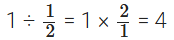
• The third fountain will fill the cistern is 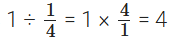
• The fourth fountain will fill the cistern, is third fountain will fill the cistern is 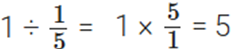
• The number of times the four fountains together will fill the cistern in a day is 1 + 2 + 4 + 5 = 12.
16
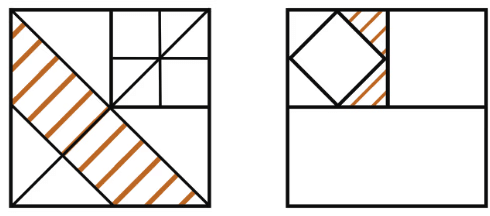
Answer
Consider the following images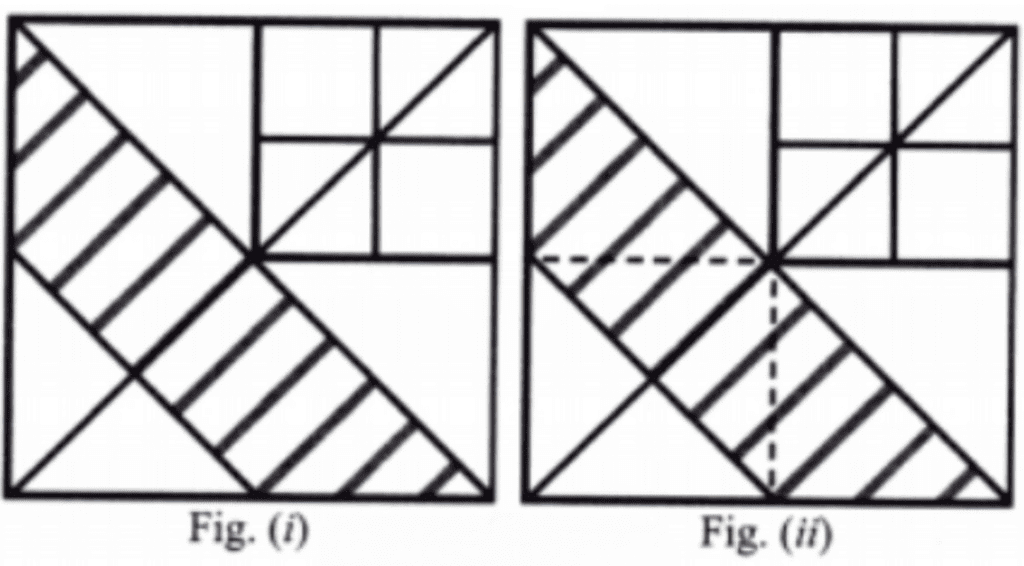
We can see in image (i) that the top right square occupies 1/4 of the area of the whole square.
Now, draw similar squares in the other three corners of the whole square as shown in Figure II.
From fig (ii), it is clear that the shaded region is (1/2 + 1/2 + 1/2) of the top right square, that is 3/2 of the top right square. But the top right square occupies 1/4 of the area of the whole square.
Therefore, the shaded region occupies 3/2 × 1/4 of the area of the whole square, that is 3/2 × 1/4 = 3/8 of the area of whole square.
Now, consider the second given images (Fig. IV)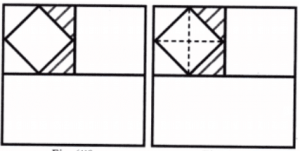
From figure (iii), it is clear that the top left square shown by the bold line occupies 1/4 of the area of the whole square.
Now, from figure (iv) it is clear that the top left square is divided into 8 identical triangles, out of which two are the shaded triangles.
So, the shaded region occupies 2/8 of the top left square. But, the top left square occupies 1/4 of the area of the whole.
Therefore the shaded region occupies 2/8 × 1/4 of the area of the whole square.
That is, 2/8 × 1/4 = 1/16
Thus, the shaded region occupies 1/16 of the area of the whole square.
17
Q: If we assume 1 gold dinar = 12 silver drammas, 1 silver dramma = 4 copper panas, 1 copper pana = 6 mashakas, and 1 pana = 30 cowrie shells,
1 copper pana = 1/48 gold dinar 
1 cowrie shell =____ copper panas
1 cowrie shell =____ gold dinar.
Answer
1 copper pana = 1/48 gold dinar (1/12 × 1/4)
1 cowrie shell = 1/30 copper panas
1 cowrie shell = 1/48 × 1/30 gold dinar = 1/1440 gold dinar
18
Answer
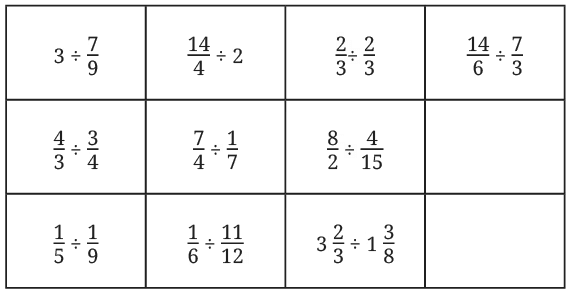
• 3 ÷ 7/9 = 3 × 9/7 = 27/7 = 3⁶/₇.
• 14/4 ÷ 2 = 14/4 × 1/2 = 14/8 = 7/4 = 1¾.
• 2/3 ÷ 2/3 = 2/3 × 3/2 = 6/6 = 1.
• 14/6 ÷ 7/3 = 14/6 × 3/7 = (14 × 3)/(6 × 7) = 42/42 = 1.
• 4/3 ÷ 3/4 = 4/3 × 4/3 = 16/9 = 1⁷/₉.
• 7/4 ÷ 1/7 = 7/4 × 7/1 = 49/4 = 12¼.
• 8/2 ÷ 4/15 = 8/2 × 15/4 = (8 × 15)/(2 × 4) = 120/8 = 15.
• 1/5 ÷ 1/9 = 1/5 × 9/1 = 9/5 = 1⅘.
• 1/6 ÷ 11/12 = 1/6 × 12/11 = 12/66 = 2/11.
• 3⅔ ÷ 1⅜ = 11/3 ÷ 11/8 = 11/3 × 8/11 = 88/33 = 
19
Q2: For each of the questions below, choose the expression that describes the solution. Then simplify it.
(a) Maria bought 8 m of lace to decorate the bags she made for school. She used ¼ m for each bag and finished the lace. How many bags did she decorate?
(i) 8 × 1/4
(ii) 1/8 × 1/4
(iii) 8 ÷ 1/4
(iv) 1/4 ÷ 8
(b) ½ meter of ribbon is used to make 8 badges. What is the length of the ribbon used for each badge?
(i) 8 × 1/2
(ii) 1/2 × 1/8
(iii) 8 ÷ 1/2
(iv) 1/2 ÷ 8
(c) A baker needs ⅙ kg of flour to make one loaf of bread. He has 5 kg of flour. How many loaves of bread can he make?
(i) 5 × 1/6
(ii)1/6 ÷ 5
(iii) 5 ÷ 1/6
(iv) 5 × 6
Answer
(a) To find the total number of bags Maria decorates, we need to divide the total length of lace by the length of the lace required to decorate one bag, i.e., 8 ÷ ¼ = 8 × 4 = 32 bags.
So, Option (iii) is the correct answer.
(b) To find the length of the ribbon required for one badge, we need to divide the total length of the ribbon by the total number of badges made, i.e., ½ ÷ 8 = ½ × 1/8 = 1/16 m.
So, Option (iv) is the correct answer.
(c) To find the total number of loaves of bread that can be made, we need to divide the total weight of flour by the weight of the flour that is required to make the loaf of bread, i.e., 5 ÷ ⅙ = 5 × 6 = 30 loaves.
So, Option (iii) is the correct answer.
20
Answer
Flour for 12 rotis = 1/4 kg.Flour per roti = ¼ ÷ 12 = 1/48 kg.
For 6 rotis = 6 × 1/48 = 6/48 = 1/8 kg.
21
Answer
Calculate:
- 1 ÷ ⅙ = 6.
- 1 ÷ 1/10 = 10.
- 1 ÷ 1/13 = 13.
- 1 ÷ 1/9= 9.
- 1 ÷ ½ = 2.
Sum = 6 + 10 + 13 + 9 + 2 = 40.
The friend should say 40.
22
Answer
Pages read:
- Yesterday: ⅕ × 400 = 80.
- Today: 3/10 × 400 = 120.
∴ Total number of pages read by Mira = 80 + 120 = 200.
Thus, the number of papers she needs to read to finish the novel = 400 − 200 = 200 pages.
23
Answer
2¾ = 11/4 litres.Distance for 1 litre = 16 km.
Distance for 11/4 litres = 11/4 × 16 = 11 × 4 = 44 km.
The car will go 44 km.
24
Answer
Train time = 5⅙ = 31/6 hours.Plane time = 1/2 hour.
Time saved = 31/6 − ½ = 31/6 − 3/6 = 28/6 = 14/3 = 4⅔ hours.
25
Answer
Remaining cake = 1 − ⅘ = ⅕.
So, 1/5 of the cake is shared equally by Mariam’s three friends.
Each friend’s share = ⅕ ÷ 3 = ⅕ × ⅓ = 1/15 of the cake.
26
(a) >565/465
(b) <565/465
(c) >707/676
(d) <707/676
(e) >1
(f) <1
Answer
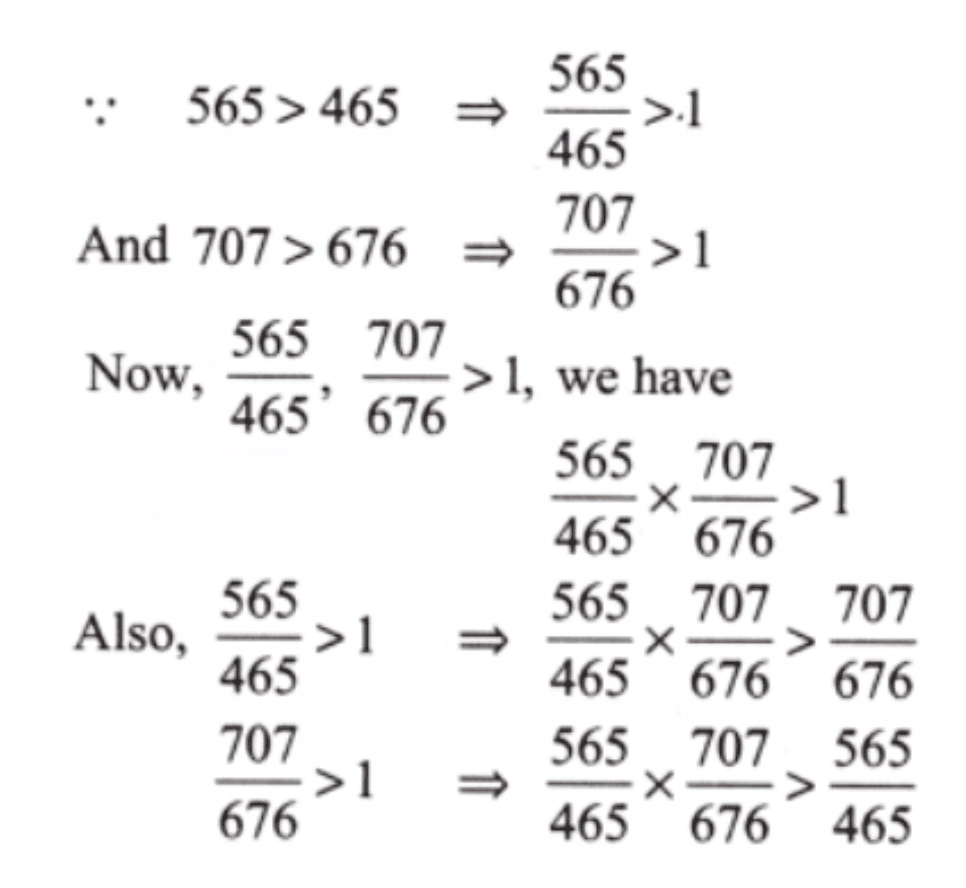
Hence, the correct options are (a), (c), and (e).
27
Answer
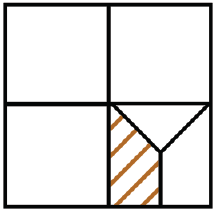
In the given figure, the big square is divided into 4 identical squares.
So, one small square occupies 1/4 of the area of the big square.
Now, consider the smaller square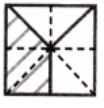
The square in the above figure is divided into 8 identical triangles, of which 3 are the shaded parts.
So, the shaded part is 3/8 of the small square.
But the small square is 1/4 of the big square.
The shaded part is 1/4 × 3/8 = 3/32 of the big square.
Hence, 3/32 of the whole square is shaded.
28
Answer
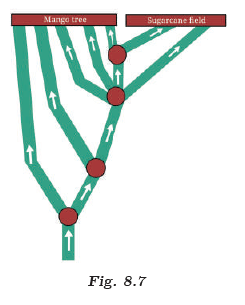
At first point ants split into two ways.
So, fraction of ants at each way is 1 ÷ 2 = 1/2.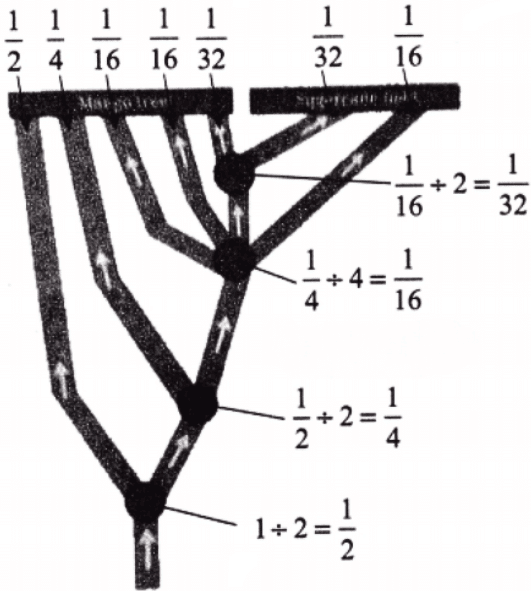
At the second point, ants split into two ways.
So fraction of ants at each way = 1/2 ÷ 2 = 1/2 × 1/2 = 1/4
At the third point, ants split into four ways.
So, fraction of ants at each way = 1/4 ÷ 4 = 1/4 × 1/4 = 1/16
At the fourth point, ants split into 2 ways.
So fraction of ants at each way = 1/16 ÷ 2 = 1/16 × 1/2 = 1/32
Hence, a fraction of ants at the mango tree is
1/2 + 1/4 + 1/16 + 1/16 + 1/32 = 29/32
Fraction of ants near sugarcane field is
1/32 + 1/16 = 3/32
29
(1 − ½) × (1 − ⅓)?
(1 − ½) × (1 − ⅓) × (1 − ¼) × (1 − ⅕) ?
(1 − ½) × (1 − ⅓) × (1 − ¼) × (1 − ⅕) × (1 − ⅙) × (1 − ⅐) × (1 − ⅛) × (1 − ⅑) × (1 − 1/10) × …?
Answer
Here, we observe that in this pattern of product denominator of each term cancels the numerator of the next term, and the final product is the numerator of the first term and the denominator of the last term.
30
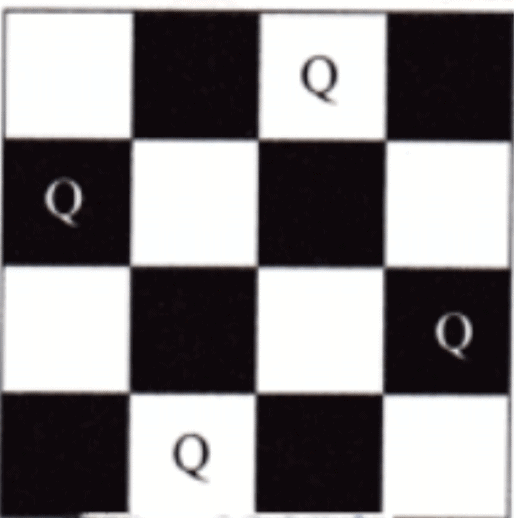
Here is a famous chess-based puzzle. From its current position, a Queen piece can move along the horizontal, vertical or diagonal. Place 4 Queens such that no 2 queens attack each other. For example, the arrangement below is not valid as the queens are in the line of attack of each other.
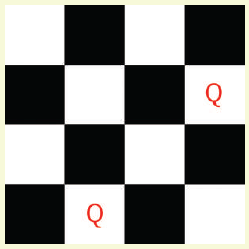
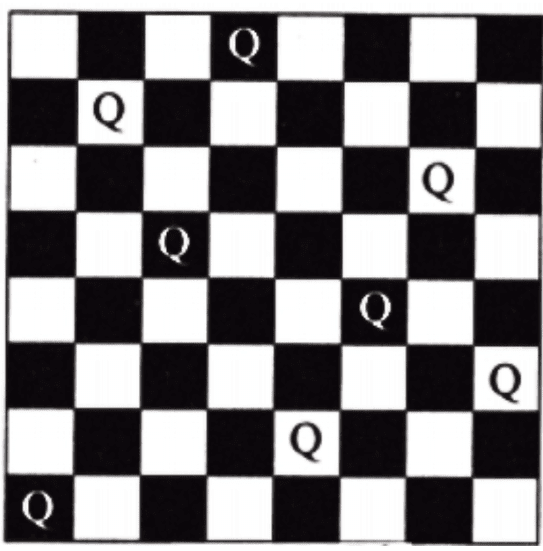
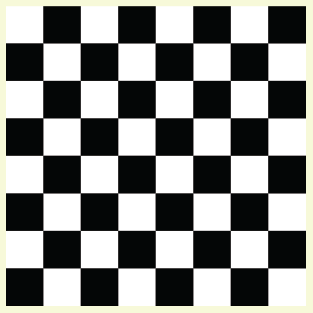
Now, place 8 queens on this 8 × 8 grid so that no 2 queens attack each other!
Answer
Four queens are placed on this 4 × 4 chequered grid such that no 2 queens attack each other.