NCERT Solutions for Ch8 Measurement of Time and Motion Class 7 Science Curiosity
Book Solutions1
Answer
Speed = Distance / TimeGiven:
• Distance = 150 meters
• Time = 10 seconds
Convert meters to kilometers and seconds to hours:
• 150 meters = 0.15 km
• 10 seconds = 10/3600 hours = 1/360 hours
Now calculate speed:
Speed = 0.15 km / (1/360 hour) = 0.15 x 360 = 54 km/h
2
Answer
Speed = Distance / TimeRunner 1:
• Distance = 400 meters
• Time = 50 seconds
• Speed = 400 / 50 = 8 m/s
Runner 2:
• Distance = 400 meters
• Time = 45 seconds
• Speed = 400 / 45 ≈ 8.89 m/s
Conclusion:
Runner 2 has a greater speed by:
8.89 m/s - 8 m/s = 0.89 m/s
3
Answer
Time = Distance / SpeedConvert 360 km to meters:
360 km = 360,000 meters
Now calculate the time:
Time = 360,000 meters / 25 m/s = 14,400 seconds
Convert seconds to hours:
14,400 / 3600 = 4 hours
4
(i) km/h
(ii) m/s
(iii) What distance will it travel in 4 hours if it maintains the same speed throughout the journey?
Answer
(i) Speed in km/h:
Speed = Distance / Time = 180 km / 3 hours = 60 km/h
(ii) Speed in m/s:
Convert 180 km to meters:
180 km = 180,000 meters
Now calculate speed in m/s:
Speed = 180,000 meters / (3 hours x 3600 seconds) = 16.67 m/s
(iii) Distance in 4 hours:
Distance = Speed x Time = 60 km/h x 4 hours = 240 km
5
Answer
Convert the speed of the train to m/s:72 km/h = 72 x 1000 meters / 3600 seconds = 20 m/s
Comparison:
The horse moves at 18 m/s.
The train moves at 20 m/s.
Conclusion:
The train is faster than the galloping horse by:
20 m/s - 18 m/s = 2 m/s
6
Answer
Uniform motion
When a car moves on a straight highway with no traffic, it maintains a constant speed. This is uniform motion, where the distance covered in equal time intervals is the same.
Non-uniform motion
In city traffic, the car's speed changes due to stops, slowdowns, and accelerations. This is non-uniform motion, where the distance covered in equal intervals of time is not constant.
7

Answer
Check for uniform motion: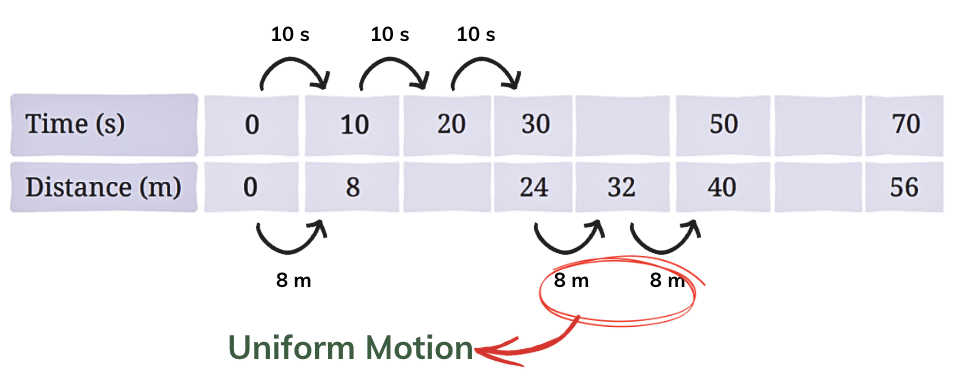
Keeping in mind , this is an uniform motion, the object must cover equal distances in equal time intervals.
Therefore,

8
Answer
Since the car covers different distances in each hour (60 km, 70 km, and 50 km), the motion is non-uniform.
To find the average speed:
Total distance = 60 km + 70 km + 50 km = 180 km
Total time = 3 hours
Average speed = Total distance / Total time = 180 km / 3 hours = 60 km/h
9
Answer
Non-uniform motion is more common in daily life. Examples:1. A car in city traffic: The car's speed changes due to stops and accelerations.
2. A bicycle in a park: The rider's speed changes while turning or stopping.
3. People walking: Walking speed varies due to obstacles or fatigue.
10

Answer
Check the distance traveled in each time interval: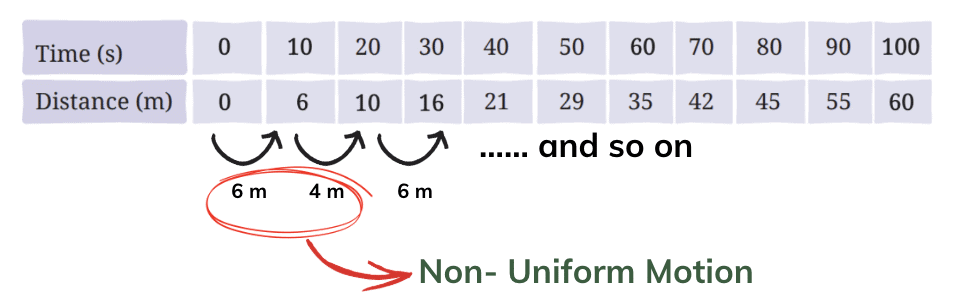
As the distances covered in each interval are not equal, the motion is non-uniform.
Average Speed = Total Distance / Total Time
Total distance = 60 m (final distance)
Total time = 100 s (final time)
Average Speed = 60 m / 100 s = 0.6 m/s
11
Answer
Given-
1. Total distance = 2 km = 2000 meters
2. First part of the journey: Distance = 500 meters, Speed = 10 m/s
3. Second part of the journey: Distance = 500 meters, Speed = 5 m/s
4. Total time for the journey = 200 seconds
Calculate the time taken for the first two parts of the journey
1. For the first 500 meters (speed = 10 m/s):
Time = Distance / Speed = 500 meters / 10 m/s = 50 seconds
2. For the next 500 meters (speed = 5 m/s):
Time = Distance / Speed = 500 meters / 5 m/s = 100 seconds
Calculate the remaining time for the last 1000 meters
The total time allowed is 200 seconds, and the time spent on the first two parts of the journey is:
Time spent = 50 seconds + 100 seconds = 150 seconds
Thus, the time remaining for the last 1000 meters is:
Remaining time = 200 seconds - 150 seconds = 50 seconds
Calculate the required speed for the remaining 1000 meters
Now, we need to cover the remaining 1000 meters in 50 seconds.
The required speed is:
Speed = Distance / Time = 1000 meters / 50 seconds = 20 m/s
Calculate the average speed for the entire journey
The average speed for the entire journey is given by:
Average speed = Total distance / Total time
Total distance = 2000 meters, and total time = 200 seconds, so:
Average speed = 2000 meters / 200 seconds = 10 m/s