NCERT Solutions for Ch 7 A Tale of Three Intersecting Lines Class 7 Maths
Book Solutions1
Answer
When the three vertices lie on a straight line, they become collinear. This means they no longer form a triangle because the three points do not enclose any area; they simply align along the same straight path.2
(a) 4, 4, 6;
(b) 3, 4, 5;
(c) 1, 5, 5;
(d) 4, 6, 8;
(e) 3.5, 3.5, 3.5
Answer
(a) Steps of Construction:
Step 1: Construct the base AB with one of the side lengths.
Let us choose AB = 6 cm.
Step 2: From A, construct a long arc of radius 4 cm.
Step 3: From B, construct an arc of radius 4 cm such that it intersects the first arc.
Step 4: The point where both the arcs meet is the required third vertex C.
Join AC and BC to get ∆ABC.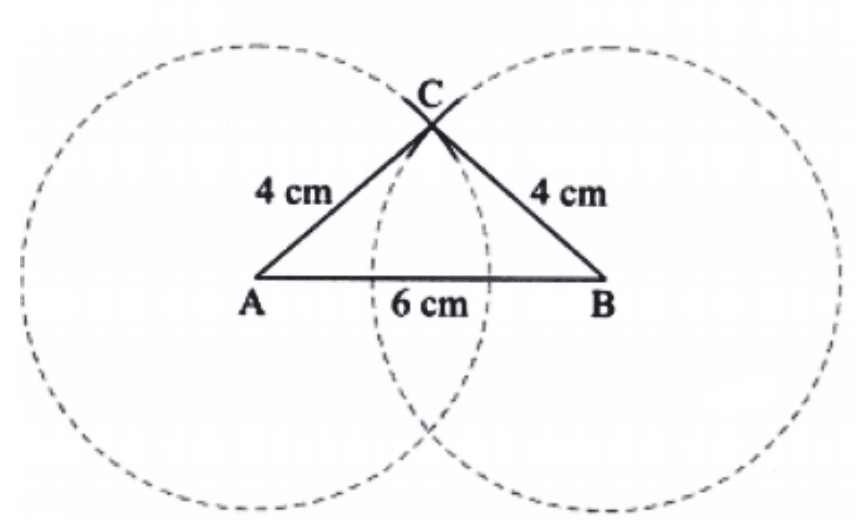
(b) Steps of Construction:
Step 1: Construct the base AB with one of the side lengths.
Let us choose AB = 3 cm.
Step 2: From A, construct a sufficiently long arc of radius 4 cm.
Step 3: From B, construct an arc of radius 5 cm such that it intersects the first arc.
Step 4: The point where both the arcs meet is the required third vertex C.
Join AC and BC to get ∆ABC.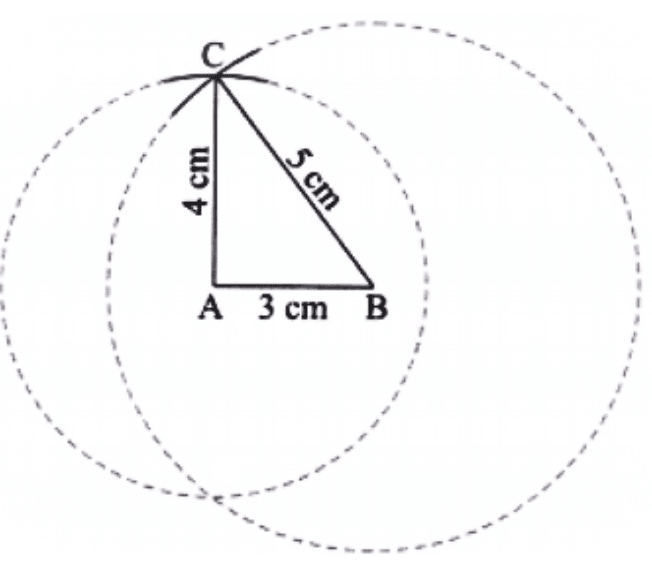
(c) Steps of Construction:
Do it yourself.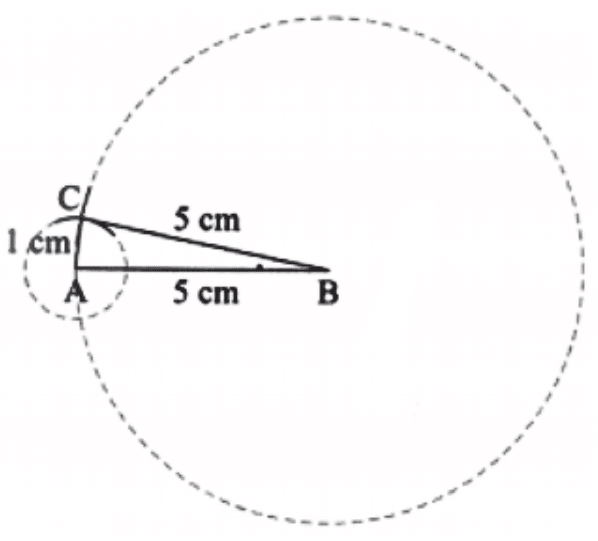
(d) Steps of Construction:
Do it yourself.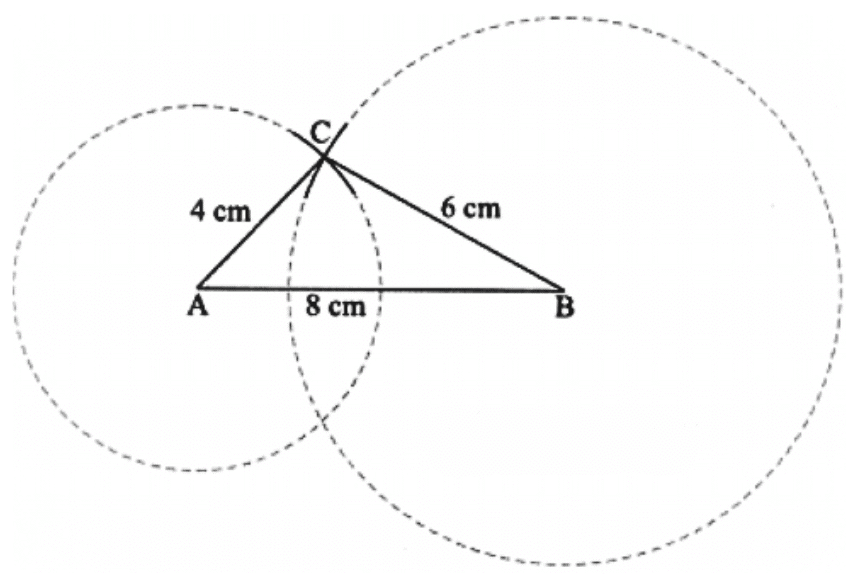
(e) Steps of Construction:
Step 1: Construct the base AB with a side length of 3.5 cm.
Step 2: From A, construct a long arc of radius 3.5 cm.
Step 3: Construct another arc of radius 3.5 cm from B.
Step 4: The point where both the arcs meet is the required third vertex C.
Join AC and BC to get ∆ABC.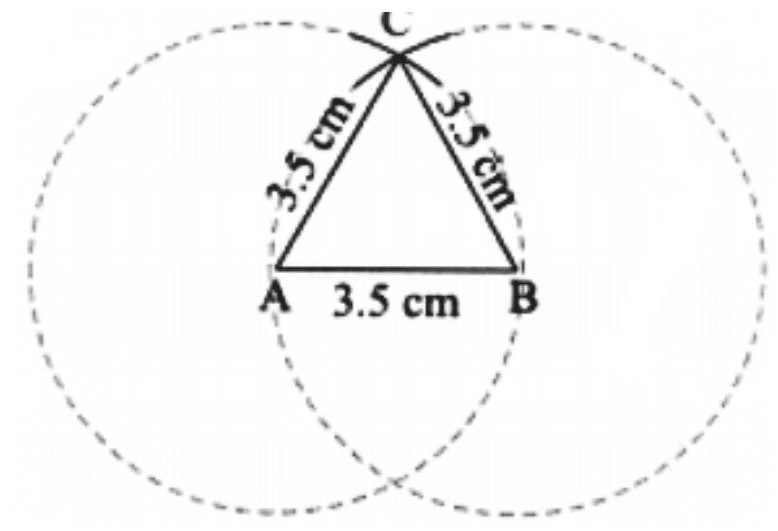
3
Answer
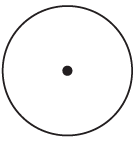
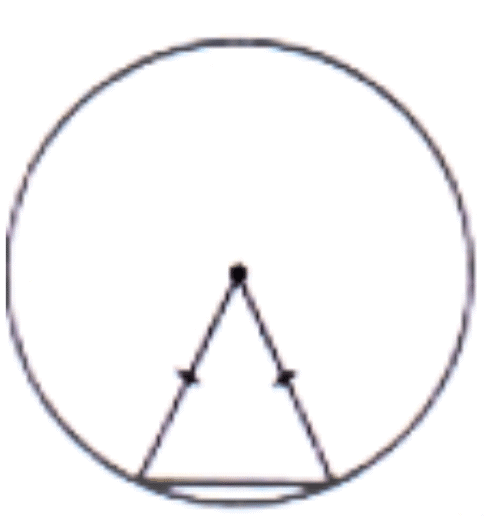
Select any two points on the circle and connect them to the centre of the circle.Also, join these points to each other. This will form an isosceles triangle as the two radii are equal in length.
4
Answer
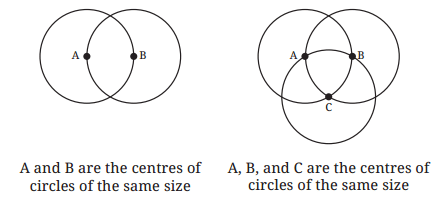
An isosceles triangle can be formed by connecting the intersecting points of two circles and the centres of either circle.
Here, isosceles triangles are AXY and BXY.
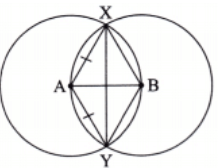
An equilateral triangle can be formed by connecting the centers of the 2 equal circles and one of their intersecting point.
Here, triangle AXB or triangle AYB is an equilateral triangle.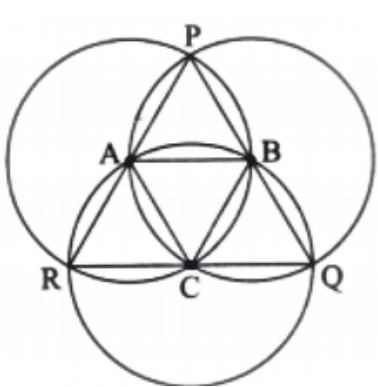
5
Answer
Since the arcs from the points A and B do not meet. So, we are not able to construct the triangle with sidelengths 3 cm, 4 cm, and 8 cm.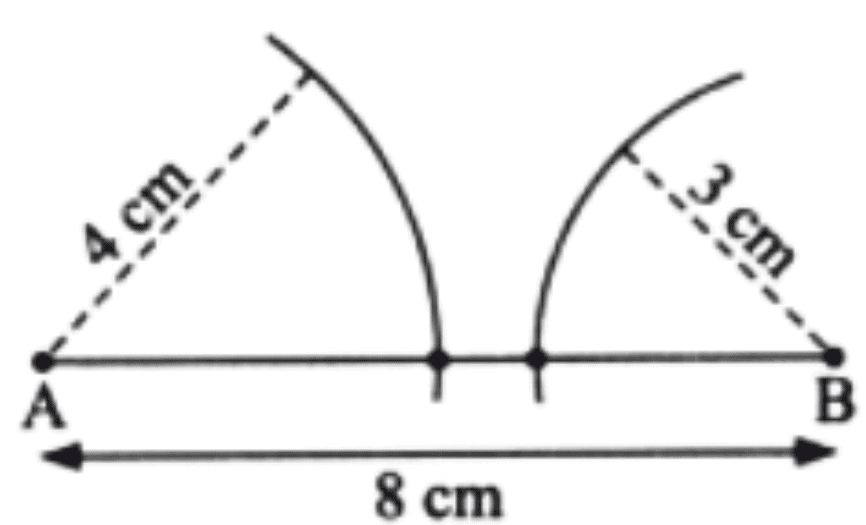
6
Answer
Check triangle inequality: 2 + 3 < 6. The arcs of 2 cm from A and 6 cm from B (base AB = 3 cm) do not intersect, so no triangle is possible.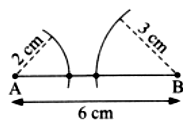
7
Answer
Examples:
- 1 cm, 2 cm, 4 cm (1 + 2 = 3 < 4).
- 5 cm, 5 cm, 11 cm (5 + 5 = 10 < 11).
- 2 cm, 3 cm, 7 cm (2 + 3 = 5 < 7).
Pattern: A triangle is impossible if the sum of the two smaller sides is less than or equal to the largest side.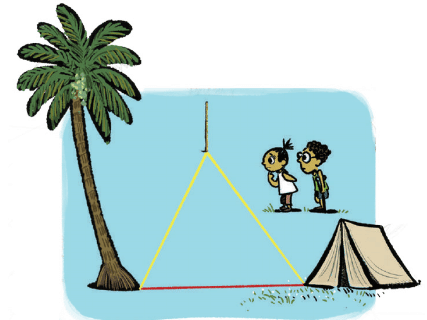
8
Answer
Check triangle inequality: 10 + 15 = 25 < 30. The direct path CA = 30 cm is longer than the roundabout path CB + BA = 25 cm, violating the triangle inequality, so no triangle exists.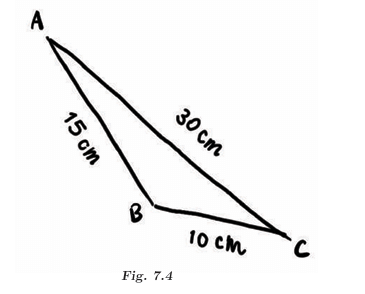
9
Answer
Here, let us choose the direct path length AB = 7 cm.And, the round about path length = BC + CA = 3 cm + 3 cm = 6 cm.
Since the direct path between two vertices is longer than the roundabout path via the third vertex. So, this triangle is not possible.
Also, by construction existence of a triangle having side lengths 3 cm, 3 cm, and 7 cm is not possible because if we draw arcs from point A and B then they do not meet.
10
Answer
No, for 10 cm, 15 cm, and 30 cm, rearranging doesn’t help. The largest side (30) will always be greater than the sum of the other two (10 + 15 = 25), so a triangle cannot exist.11
Answer
No, the lengths 10 cm, 15 cm, and 30 cm cannot be rearranged to form a triangle because 10 + 15 = 25 is less than 30 in any order.12
Answer
(a) Consider AB = 4 cm, BC = 3 cm and AC = 8 cm.
Now, direct path length = BC = 3 cm
And, roundabout path length = BA + AC
= 4 cm + 8 cm
= 12 cm
The direct path length is shorter than the roundabout path length.
Also, direct path length = AB = 4 cm
Roundabout path length = AC + BC
= 8 cm + 3 cm
= 11 cm
The direct path length is shorter than the roundabout path length.
Again, direct path length = AC = 8 cm
Then, roundabout path length = AB + BC
= 4 cm + 3 cm
= 7 cm
In this case, the direct path is longer than the roundabout path.
So, a triangle cannot exist.
(b) Consider AB = 3 cm, BC = 2 cm, AC = 6 cm
If we take the direct path = AC = 6 cm.
And, roundabout path length = AB + BC
= 3 cm + 2 cm
= 5 cm
Since the direct path is longer than the roundabout path. So, a triangle cannot exist.
13
Q2: Can we say anything about the existence of a triangle for each of the following sets of lengths?
(a) 10 km, 10 km, 25 km
(b) 5 mm, 10 mm, 20 mm
(c) 12 cm, 20 cm, 40 cm
You would have realised that using a rough figure and comparing the direct path lengths with their corresponding roundabout path lengths is the same as comparing each length with the sum of the other two lengths. There are three such comparisons to be made.
Answer
(a) When we take the direct path = 25 km.
Then the roundabout path = 10 km + 10 km = 20 km.
Since the direct path is longer than the roundabout path.
So, the existence of a triangle is not possible.
(b) When we take the direct path = 20 mm.
Then the roundabout path = 10 mm + 5 mm = 15 mm.
Since the direct path is longer than the roundabout path.
So, the existence of a triangle is not possible.
(c) When we take the direct path = 40 cm.
Then the roundabout path = 12 cm + 20 cm = 32 cm.
Since the direct path is longer than the roundabout path.
So, the existence of a triangle is not possible.
14
10 < 15 + 30
15 < 10 + 30
But this doesn’t happen for the third length: 30 > 10 + 15.
Answer
Yes, this will always happen. When you take any three lengths and arrange them in increasing order (a, b, c where a ≤ b ≤ c), the two smaller lengths (a and b) will always satisfy the comparisons:
- a < b + c (because a is the smallest, and b + c is larger).
- b < a + c (because b is less than c, so a + c is larger).
The third comparison (c < a + b) may or may not be true. Let’s check with examples:
For 3 cm, 4 cm, 5 cm:
- 3 < 4 + 5 (3 < 9, true).
- 4 < 3 + 5 (4 < 8, true).
- 5 < 3 + 4 (5 < 7, true).
All three are true.
For 2 cm, 3 cm, 6 cm:
- 2 < 3 + 6 (2 < 9, true).
- 3 < 2 + 6 (3 < 8, true).
- 6 < 2 + 3 (6 < 5, false).
Two comparisons are true.
So, in any set of three lengths, at least two comparisons will always hold because the two smaller lengths are naturally less than the sum of the other two.
15
Answer
Yes, in any set of three lengths, if you arrange them in increasing order (a, b, c), the two smaller lengths (a and b) will always have:
- a < b + c (true because a is the smallest).
- b < a + c (true because b is less than c).
So, at least two comparisons will hold. For example:
- 3, 4, 5: 3 < 4 + 5, 4 < 3 + 5, 5 < 3 + 4 (all true).
- 3, 4, 8: 3 < 4 + 8, 4 < 3 + 8, but 8 > 3 + 4 (only two hold).
16
[Hint: Consider the direct lengths in the increasing order.]
Answer
Yes, arrange the lengths in increasing order: a, b, c (a ≤ b ≤ c). The two smaller lengths (a and b) will always be less than the sum of the other two:
- a < b + c (a is the smallest).
- b < a + c (b is less than c).
So, a and b will immediately satisfy the triangle inequality without calculations.
17
Answer
Compare each length with the sum of the other two:
- a < b + c
- b < a + c
- c < a + b
If all three conditions are true, a triangle exists. This is called the triangle inequality.
18
(a) 2, 2, 5
(b) 3, 4, 6
(c) 2, 4, 8
(d) 5, 5, 8
(e) 10, 20, 25
(f) 10, 20, 35
(g) 24, 26, 28
We observe from the previous problems that whenever there is a set of lengths satisfying the triangle inequality (each length < sum of the other two lengths), there is a triangle with those three lengths as sidelengths.
Answer
A set of lengths can be the sidelengths of a triangle if each length < the sum of the other two lengths.
(a) 2 < 5 + 2 but 5 > 2 + 2
So, 2, 2, 5 cannot be the sidelengths of a triangle.
(b) 3 < 4 + 6, 4 < 3 + 6, 6 < 4 + 3
So, 3, 4, 6 can be the sidelengths of a triangle.
(c) 2 < 4 + 8, 4 < 2 + 8, but 8 > 4 + 2
So, 2, 4, 8 cannot be the sidelengths of a triangle.
(d) 5 < 5 + 8, 8 < 5 + 5
So, 5, 5, 8 can be the sidelengths of a triangle.
(e) 10 < 20 + 25, 20 < 25 + 10, 25 < 10 + 20
So, 10, 20, 25 can be the sidelengths of a triangle.
(f) 10 < 20 + 35, 20 < 10 + 35, but 35 > 10 + 20
So, 10, 20, 35 cannot be the sidelengths of a triangle.
(g) 24 < 26 + 28, 26 < 24 + 28, 28 < 24 + 26
So, 24, 26, 28 can be the sidelengths of a triangle.
19
Answer
Yes, if the lengths satisfy the triangle inequality (each length is less than the sum of the other two), a triangle always exists. We can be sure because when we construct the triangle by drawing the longest side as the base and arcs for the other two sides, the arcs will intersect (since the sum of the two smaller lengths is greater than the longest length), forming the triangle.20
(a) touch each other at a point,
(b) do not intersect.
Answer
(a) Circles touch: Sum of two smaller lengths = longest length.
Examples:
- 2, 2, 4 (2 + 2 = 4).
- 3, 3, 6 (3 + 3 = 6).
- 5, 5, 10 (5 + 5 = 10).
(b) Circles do not intersect: Sum of two smaller lengths < longest length.
Examples:
- 2, 3, 6 (2 + 3 < 6).
- 1, 2, 4 (1 + 2 < 4).
- 5, 5, 11 (5 + 5 < 11).
21
Answer
• Take the three lengths and arrange them in increasing order: a, b, c (a ≤ b ≤ c).
• Check if the sum of the two smaller lengths is greater than the longest length: a + b > c.
• If yes, a triangle exists. If no, a triangle does not exist.
22
(a) 1, 100, 100;
(b) 3, 6, 9;
(c) 1, 1, 5;
(d) 5, 10, 12.
Answer
We know that when each length is smaller than the sum of the other two, we say that the lengths satisfy the triangle inequality, and when a set of lengths satisfies the triangle inequality, then a triangle exists.
(a) Here 1 < 100 + 100, 100 < 100 + 1
So, for sidelengths 1, 100, 100, a triangle exists.
(b) 3 < 6 + 9, 6 < 3 + 9, but 9 = 6 + 3
So, for sidelengths 3, 6, 9, a triangle does not exist.
(c) 1 < 1 + 5, but 5 > 1 + 1
So, for sidelengths 1, 1, 5, a triangle does not exist.
(d) 5 < 10 + 12, 10 < 5 + 12, 12 < 10 + 5
So, for sidelengths 5, 10, and 12, a triangle exists.
23
Answer
Yes, an equilateral triangle with sides 50, 50, 50 exists because 50 + 50 = 100 > 50, satisfying the triangle inequality.In general, for any length a, an equilateral triangle with sides a, a, a exists because a + a = 2a > a, always satisfying the triangle inequality.
24
(a) 1, 100
(b) 5, 5
(c) 3, 7
Answer
(a) 5 possible values for the third length would be 99.5, 99.8, 100, 100.5, 100.9
Since, 100 < 1 + 99.5, 100 < 1 + 99.8, 100 < 1 + 100, 100 < 1 + 100.5, and 100 < 1 + 100.9
(b) 5 possible values for the third length would be 1, 3.5, 5, 7.5, 8.9
Since, 5 < 1 + 5, 5 < 5 + 3.5, 5 < 5 + 5, 5 < 5 + 7.5, and 5 < 5 + 8.9
(c) 5 possible values for the third length would be 4.5, 5, 6.9, 8, 9.8
Since, 7 < 3 + 4.5, 7 < 5 + 3, 7 < 3 + 6.9, 7 < 3 + 8, 7 < 3 + 9.8
25
For example, in case (a), all numbers strictly between 99 and 101 would be possible.
Answer
When two sides are given, then the third side must lie between the sum and the difference of the two lengths for the existence of a triangle.Therefore, (b) numbers will lie between 0 and 10, and (c) numbers will be between 4 and 10.
26
(a) 3 cm, 75°, 7 cm;
(b) 6 cm, 25°, 3 cm;
(c) 3 cm, 120°, 8 cm.
Answer
(a) Step 1: Construct a side AB of length 7 cm.
Step 2: Construct ∠A = 75° by drawing the other arm of the angle.
Step 3: Mark the point C on the other arm such that AC = 3 cm.
Step 4: Join BC to get the required triangle.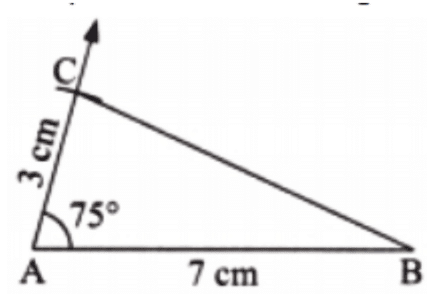
(b) Step 1: Construct a side AB of length 6 cm.
Step 2: Construct ∠A = 25° by drawing the other arm of the angle.
Step 3: Mark the point C on the other arm such that AC = 3 cm.
Step 4: Join BC to get the required triangle.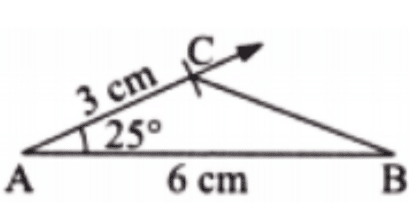
(c) Step 1: Construct a side AB of length 8 cm.
Step 2: Construct ∠A = 120° by drawing the other arm of the angle.
Step 3: Mark the point C on the other arm such that AC = 3 cm.
Step 4: Join BC to get the required triangle.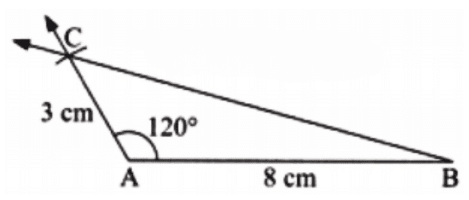
27
Answer
A triangle is always possible when given two sides and the included angle. During construction, draw the base (first side), make the given angle at one end, and draw a ray. Then, from the other end of the base, draw an arc of the second side’s length. The arc will always intersect the ray at a point (the third vertex), forming a triangle. This works for any angle and side lengths, so a triangle is always possible.28
(a) 75°, 5 cm, 75°
(b) 25°, 3 cm, 60°
(c) 120°, 6 cm, 30°
Answer
(a) Step 1: Draw base AB = 5 cm.
Step 2: At point A, use a protractor to draw a ray at 75°.
Step 3: At point B, draw a ray at 75°.
Step 4: The rays intersect at point C. Join AC and BC to form triangle ABC.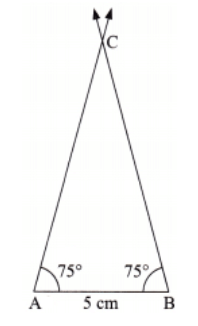
(b) Step 1: Draw base AB = 3 cm.
Step 2: At point A, use a protractor to draw a ray at 25°.
Step 3: At point B, draw a ray at 60°.
Step 4: The rays intersect at point C. Join AC and BC to form triangle ABC.
(c) Step 1: Draw base AB = 6 cm.
Step 2: At point A, use a protractor to draw a ray at 120°.
Step 3: At point B, draw a ray at 30°.
Step 4: The rays intersect at point C. Join AC and BC to form triangle ABC.
29
Answer
No, triangles do not always exist for every combination of two angles and their included side. If the sum of the two angles is 180° or more, the rays drawn from the ends of the base will not meet, so no triangle forms. For example:
- For 90°, 5 cm, 90°: Sum = 90° + 90° = 180°. The rays are parallel and don’t intersect, so no triangle exists.
- For 120°, 5 cm, 70°: Sum = 120° + 70° = 190° > 180°. The rays diverge and don’t intersect, so no triangle exists.
In the given cases:
(a) 75° + 75° = 150° < 180°, so a triangle exists.
(b) 25° + 60° = 85° < 180°, so a triangle exists.
(c) 120° + 30° = 150° < 180°, so a triangle exists.
A triangle exists only if the sum of the two angles is less than 180°.
30
Answer
No, triangles do not exist for every combination. If the sum of the two angles is 180° or more, the rays drawn from the ends of the base will not meet, so no triangle forms. For example, 90° and 90° (sum = 180°) makes the rays parallel, so they don’t intersect.31
Answer
Examples:
• 90°, 90°, 5 cm (sum = 180°, rays are parallel).
• 100°, 80°, 5 cm (sum = 180°, rays are parallel).
• 120°, 70°, 5 cm (sum = 190°, rays diverge).
In each case, the rays don’t meet, so no triangle forms.
32
(a) 30°
(b) 70°
(c) 54°
(d) 144°
Answer
(a) Possible: 60° (30° + 60° = 90° < 180°), 120° (30° + 120° = 150° < 180°).
Not possible: 150° (30° + 150° = 180°), 160° (30° + 160° = 190° > 180°).
(b) Possible: 50° (70° + 50° = 120° < 180°), 100° (70° + 100° = 170° < 180°).
Not possible: 110° (70° + 110° = 180°), 120° (70° + 120° = 190° > 180°).
(c) Possible: 60° (54° + 60° = 114° < 180°), 90° (54° + 90° = 144° < 180°).
Not possible: 126° (54° + 126° = 180°), 130° (54° + 130° = 184° > 180°).
(d) Possible: 10° (144° + 10° = 154° < 180°), 20° (144° + 20° = 164° < 180°).
Not possible: 36° (144° + 36° = 180°), 40° (144° + 40° = 184° > 180°).
33
(a) 35°, 150°
(b) 70°, 30°
(c) 90°, 85°
(d) 50°, 150°
Answer
(a) 35 + 150 = 185° > 180°. Not possible.(b) 70 + 30 = 100° < 180°. Possible.
(c) 90 + 85 = 175° < 180°. Possible.
(d) 50 + 150 = 200° > 180°. Not possible.
34
Answer
Yes, the rule is: A triangle is possible if the sum of the two angles is less than 180°. If the sum is 180° or more, no triangle is possible. The sum of the two angles can be used to frame this rule.35
Answer
For angles 60° and 70°:Third angle = 180° - (60° + 70°) = 180° - 130° = 50°.
Construct with base 5 cm, then with 7 cm. In both cases, the third angle remains 50°, so the base length does not change the third angle.
36
Answer
Do it Yourself!37
(a) 36°, 72°
(b) 150°, 15°
(c) 90°, 30°
(d) 75°, 45°
Answer
(a) Here ∠B = 36° and ∠C = 72°.
Since the line BC is parallel to XY.
So, ∠XAB = ∠B = 36° [Alternate angles] ….. (i)
and ∠YAC = ∠C = 72° [Alternate angles] …… (ii)
Also, ∠XAB + ∠BAC + ∠YAC = 180° [∵∠XAY is a straight angle]
⇒ 36° + ∠BAC + 72° = 180° [Using (i) and (ii)]
⇒ ∠BAC = 180°- 108° = 72°.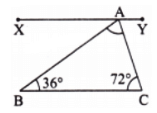
(b) Here ∠B = 150° and ∠C = 15°.
Since the line BC is parallel to XY.
So, ∠XAB = ∠B = 150° [Alternate angles] ….. (i)
and ∠YAC = ∠C = 15° [Alternate angles] …… (ii)
Also, ∠XAB + ∠BAC + ∠YAC = 180° [∠XAY is a straight angle]
⇒ 150° + ∠BAC + 15° = 180° [Using (i) and (ii)]
⇒ ∠BAC = 180° – 165° = 15°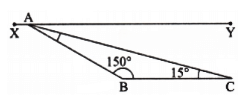
(c) Here ∠B = 90° and ∠C = 30°.
Since the line BC is parallel to XY.
So, ∠XAB = ∠B = 90° [Alternate angles] …… (i)
and ∠YAC = ∠C = 30° [Alternate angles] …… (ii)
Also, ∠XAB + ∠BAC + ∠YAC = 180° [∠XAY is a straight angle]
⇒ 90° + ∠BAC + 30° = 180° [Using (i) and (ii)]
⇒ ∠BAC = 180°- 120° = 60°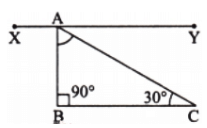
(d) Here ∠B = 75° and ∠C = 45°.
Since the line BC is parallel to XY.
So, ∠XAB = ∠B = 75° [Alternate angles] ….. (i)
and ∠YAC = ∠C = 45° [Alternate angles] ….. (ii)
Also, ∠XAB + ∠BAC + ∠YAC = 180° [∠XAY is a straight angle]
⇒ 75° + ∠BAC + 45° = 180° [Using (i) and (ii)]
⇒ ∠BAC = 180° – 120° = 60°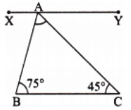
38
Answer
No, it is not possible to construct a triangle with all angles equal to 70°.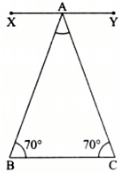
If we take two base angles as 70° that is, ∠B and ∠C = 70°, then we have to find ∠BAC.
Since XY is parallel to BC.
So, ∠XAB = ∠B = 70° ….. (i)
and ∠YAC = ∠C = 70° …… (ii)
Also, ∠XAB + ∠BAC + ∠YAC = 180°
⇒ 70° + ∠BAC + 70° = 180° [Using (i) and (ii)]
⇒ ∠BAC = 180° – 140° = 40°.
So, the third angle would be 40°.
If all the angles in a triangle have to be equal, then each angle must measure 60°. This type of triangle is called an equilateral triangle.
39
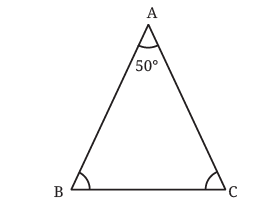
Answer
Given ∠A = 50° and ∠B = ∠C.
Draw a line XY that is parallel to BC.
Now, ∠XAB = ∠B and ∠YAC = ∠C [Alternate angles] …… (i)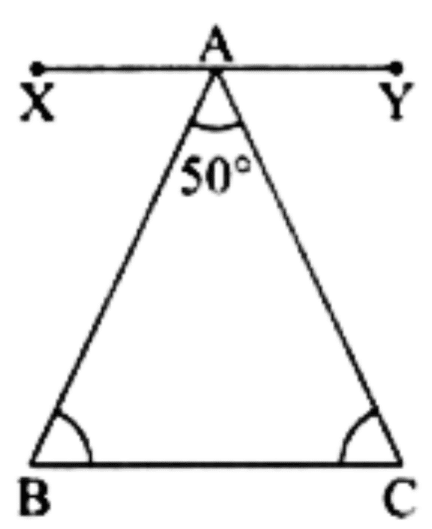
Also, ∠XAB + ∠BAC + ∠YAC = 180°
⇒ ∠B + 50° + ∠C = 180° [Using (i)]
∠B + ∠C = 180° – 50° = 130°
⇒ 2∠B = 130°
⇒ ∠B = 65° = ∠C
40
Answer
The angle formed between the extension of a side of a triangle and the other side is called an exterior angle of the triangle. In this figure, ∠ACD is an exterior angle.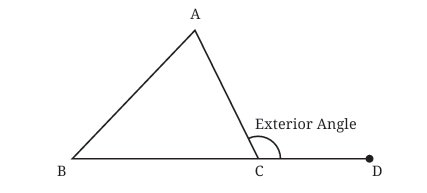
41
Answer
∠ACB = 180° - (50 + 60) = 70°.
∠ACD = 180° - ∠ACB = 110° (straight angle).
42
Q: Find the exterior angle for different measures of ∠A and ∠B. Do you see any relation between the exterior angle and these two angles?
[Hint: From angle sum property, we have ∠A + ∠B + ∠ACB = 180°.] We also have ∠ACD + ∠ACB = 180°, since they form a straight angle. What does this show?
Answer
The exterior angle (e.g., ∠ACD) is equal to the sum of the two non-adjacent angles (∠A + ∠B).Example: If ∠A = 50°, ∠B = 60°:
∠ACB = 180° - (50° + 60°) = 70°.
∠ACD = 180° - 70° = 110°.
Also, ∠A + ∠B = 50° + 60° = 110°, which matches ∠ACD.
This relation holds for any triangle: Exterior angle = sum of the two opposite angles.
43
Answer
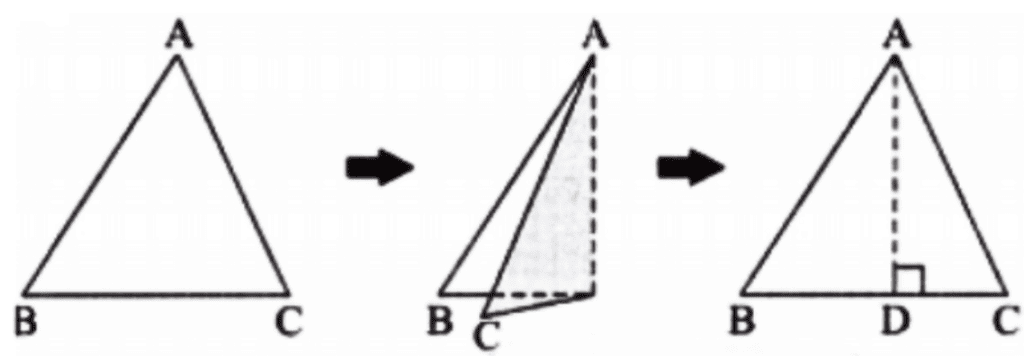
The perpendicularity happens because the shortest distance between a point, i.e., a vertex, and a line, i.e., the base is always a perpendicular line.By folding the paper, we construct the shortest distance, ensuring the crease is perpendicular to the base.
44
Answer
An acute-angled triangle is a triangle in which all three angles are less than 90°.
We cannot define it as a triangle with only one acute angle, because every triangle must have at least two acute angles (since the sum of all angles in a triangle is always 180°).
If a triangle has:
- One right angle → it is a right-angled triangle.
- One obtuse angle → it is an obtuse-angled triangle.
So, just having one acute angle does not make a triangle acute-angled.
To be called acute-angled, all angles must be acute (less than 90°).
45
Answer
Steps of Construction:
Step 1: Draw the base AB = 6 cm.
Step 2: Using a compass, construct a sufficiently long arc of radius 5 cm from A.
Step 3: Construct another arc of radius 5 cm from B such that it intersects the first arc.
Step 4: The point where both the arcs meet is the required third vertex C. Join AC and BC to get ∆ABC.
Step 5: Keep the ruler aligned to BC. Place the set square on the ruler such that one of the edges of the right angle touches the ruler.
Step 6: Slide the set square along the ruler till the perpendicular edge of the set square touches the vertex A.
Step 7: Draw the altitude through A to BC using the perpendicular edge of the set square.
46
Answer
Steps of Construction:
Step 1: Construct a side TR of length 7 cm.
Step 2: Construct ∠R = 140° by drawing the other arm of the angle.
Step 3: Mark the point Y on the other arm such that RY = 4 cm.
Step 4: Join TY to get the required triangle.
Step 5: Keep the ruler aligned to RY. Place the set square on the ruler such that one of the edges of the right angle touches the ruler.
Step 6: Slide the set square along the ruler till the perpendicular edge of the set square touches the vertex T.
Step 7: Extend the line YR and then draw the altitude through T on YR using the perpendicular edge of the set square.
47
[Hint: Note that the other measurements can take any values. Take AC as the base. What values can ∠A and ∠C take so that the other angle is 90°?]
Answer
Given, ∠B = 90°, and AC = 5 cm (hypotenuse)Since ∠B = 90°, ∠A and ∠C add upto 90°.
If we fixed AC = 5 cm and ∠A and ∠C vary, then there are infinitely many triangles possible.
Because the shape of the triangle can change with the different values of angles A and C.
One such example is given here:
48
Also construct an isosceles triangle that is (i) right-angled (ii) obtuse-angled.
Answer
An equilateral triangle that is right-angled and obtuse-angled is not possible because each angle of an equilateral triangle is always 60°.An isosceles right-angled triangle has one angle of 90° and the other two angles of 45° each.
An isosceles obtuse-angled triangle can have one angle as 120° and the other two angles of 30° each.
49
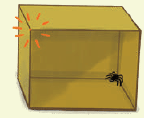
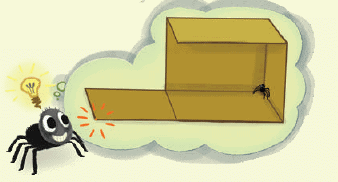
Take a cardboard box and mark the path that you think is the shortest from one corner to its opposite corner. Compare the length of this path with that of the paths made by your friends.
Hint:
Answer
Imagine unfolding the box into a flat shape (like opening up a cardboard box).
Now, the path becomes a straight line on this flat surface!
This helps the spider take the shortest route, just like a straight line is the shortest distance between two points.
The image in the hint shows how the box can be opened to make it flat. The spider’s path is then shown as a red straight line.
So, By unfolding the box and drawing a straight line, you get the shortest path from one corner to the opposite corner on the surfaces.