NCERT Solutions for Chapter 6 The Crisis of Democratic Order Class 12 Political Science
Book Solutions1
(a) It was declared in 1975 by Indira Gandhi.
(b) It led to the suspension of all fundamental rights.
(c) It was proclaimed due to the deteriorating economic conditions.
(d) Many Opposition leaders were arrested during the emergency.
(e) CPI supported the proclamation of the Emergency.
Answer
(a) Correct(b) Correct
(c) Incorrect
(d) Correct
(e) Correct
2
(a) The call for ‘Total Revolution’.
(b) The Railway Strike of 1974
(c) The Naxalite Movement
(d) The Allahabad High Court verdict
(e) The findings of the Shah Commission Report
Answer
(c) The Naxalite Movement3
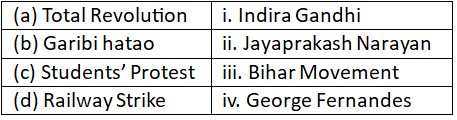
Answer
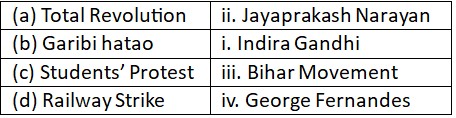
4
Answer
The Janata Party lacked guidance, leadership, and a unified platform. They were too preoccupied with fighting with one another to coordinate their plans.
The Janata Party government could not bring a fundamental change in policies pursued by Congress.
There was a split in Janata Party and the government led by Morarji Desai which lost its majority in less than 18 months.
Charan Singh government was formed due to support of Congress party which later decided to withdraw its support resulting in resignation of Charan Singh government within four months.
5
Answer
The Shah Commission was appointed in May 1977 by the Janata Party government, led by retired Chief Justice of the Supreme Court of India J.C. Shah, to investigate allegations of abuse of authority, excesses, and malpractices, as well as actions taken in the name of the emergency declared on June 25, 1975.
The commission examined various evidence to give testimony, even calling Indira Gandhi to appear before it, but she refused to respond to any questions.
Findings of Shah Commission:
• It found many ‘excesses’ committed during Emergency.
• Under preventive detention laws nearly one lakh eleven thousand people were arrested.
• Press censorship took place without any proper legal sanctions.
• Even general manager of Delhi Power Supply Corporation received verbal orders from the officers of the Lt. Governor of Delhi to cut electricity to all newspapers press at 2 a.m. on 26 June 1975.
6
Answer
Economic Crisis: The war between India and Pakistan in December 1971, though won by India, placed a heavy strain on the Indian economy. In 1974 prices increased over 30 percent. The failure of monsoon in 1972-73 led to a downfall in agricultural production. Poverty and unemployment remained very high, creating dissatisfaction among the masses.
Railway Strike: In April 1974, there was a massive strike of Railway employees which severely affected the Indian economy.
Gujarat Movement: In January 1974, students in Gujarat started an agitation against hostel food price hikes, which expanded into the Nav Nirman Movement supported by opposition parties. Congress lost the Assembly elections in June 1975.
Bihar Movement: Led later by Jayaprakash Narayan, this movement called for ‘Total Revolution’ against misrule, unemployment, corruption, and rising prices.
Allahabad High Court Judgement: On 12 June 1975, Justice Jagmohan Lal Sinha annulled Indira Gandhi’s election, making her ineligible for six years. Though the Supreme Court allowed her to remain PM under restrictions, this judgement was a major trigger for declaring Emergency.
Opposition Demonstration at Ramleela Ground: JP Narayan and other leaders called for Indira Gandhi’s resignation and mass civil disobedience, even urging government employees not to follow unconstitutional orders.
7
Answer
• Imposition of Internal Emergency: Seen as Indira Gandhi’s move to prolong her rule. Opposition leaders were jailed.• Sanjay Gandhi’s Role: He emerged as an extra-constitutional centre of power, influencing administration heavily.
• Excesses During Emergency: Civil liberties and freedoms were suppressed, creating widespread resentment.
• 42nd Constitutional Amendment: The amendment curtailed judiciary’s independence and made it subservient to the legislature.
• Rising Prices: Inflation worsened people’s hardships.
• Compulsory Sterilization: A harsh family planning measure under Sanjay Gandhi.
• Abolition of Bonus: Angered workers in public sector.
• Alternate Leadership: JP Narayan emerged as a respected leader symbolising democracy.
8
(a) Effects on civil liberties for citizens
(b) Impact on relationship between the Executive and Judiciary
(c) Functioning of Mass Media
(d) Working of Police and Bureaucracy
Answer
(a) Civil Liberties: Article 19 rights were suspended. Strikes, protests, and demonstrations were banned. Preventive detention was widely misused.
(b) Executive and Judiciary: 42nd Amendment curtailed judicial power. Courts could not challenge elections of top leaders. Right to move courts for enforcement of Fundamental Rights was suspended.
(c) Mass Media: Strict censorship was imposed. Newspapers required prior approval before publishing. Independent magazines like Seminar and Mainstream stopped publication. Many journalists were jailed.
(d) Police and Bureaucracy: They became completely subservient to the executive. Strikes were banned. Many arrests were carried out without trials.
9
Answer
• Opposition leaders were arrested, paralysing their parties.• Political agitation, strikes, and protests were banned.
• Democratic functioning of parties was affected due to censorship and suspension of liberties.
• The opposition united under Janata Party, which was formed by leaders in jail.
• In 1977 elections, opposition votes consolidated, defeating Congress. Emergency thus ended dominance of one-party rule.
10
“Indian democracy was never so close to a two-party system as it was during the 1977 elections. However, the next few years saw a complete change. Soon after its defeat, the Indian National Congress split into two groups…. The Janata Party also went through major convulsions.”
— Partha Chatterjee
(a) What made the party system in India look like a two-party system in 1977?
(b) Many more than two parties existed in 1977. Why then are the authors describing this period as close to a two-party system?
(c) What caused splits in Congress and the Janata Parties?
Answer
(a) The imposition of Emergency in 1975 and subsequent opposition unity in 1977 elections made India look like a two-party system.
(b) Though many parties existed, they grouped broadly into two camps: Congress vs Non-Congress (mainly Janata Party).
(c) The Congress split earlier during the Presidential candidate elections in 1969, while Janata Party split later in 1979 due to leadership struggles among Morarji Desai, Charan Singh, and Jagjivan Ram.