NCERT Solutions for Chapter 4 International Organisations Class 12 Political Science
Book Solutions1
1: Mark correct or wrong against each of the following statements about the veto power.
(a) Only the permanent members of the Security Council possess the veto power.
(b) It’s a kind of negative power.
(c) The Secretary-General uses this power when not satisfied with any decision.
(d) One veto can stall a Security Council resolution.
(a) Only the permanent members of the Security Council possess the veto power.
(b) It’s a kind of negative power.
(c) The Secretary-General uses this power when not satisfied with any decision.
(d) One veto can stall a Security Council resolution.
Answer
(a) Correct(b) Correct
(c) Wrong
(d) Correct
2
2: Mark correct or wrong against each of the following statements about the way the UN functions.
(a) All security and peace related issues are dealt with in the Security Council.
(b) Humanitarian policies are implemented by the main organs and specialised agencies spread across the globe.
(c) Having consensus among the five permanent members on security issues is vital for its implementation.
(d) The members of the General Assembly are automatically the members of all other principal organs and specialised agencies of the UN.
(a) All security and peace related issues are dealt with in the Security Council.
(b) Humanitarian policies are implemented by the main organs and specialised agencies spread across the globe.
(c) Having consensus among the five permanent members on security issues is vital for its implementation.
(d) The members of the General Assembly are automatically the members of all other principal organs and specialised agencies of the UN.
Answer
(a) Correct(b) Correct
(c) Correct
(d) Wrong
3
3: Which among the following would give more weightage to India’s proposal for permanent membership in the Security Council?
(a) Nuclear capability
(b) It has been a member of the UN since its inception
(c) It is located in Asia
(d) India’s growing economic power and stable political system
Answer
(d) India’s growing economic power and stable political system4
4: The UN agency concerned with the safety and peaceful use of nuclear technology is:
(a) The UN Committee on Disarmament
(b) International Atomic Energy Agency
(c) UN International Safeguard Committee
(d) None of the above
(a) The UN Committee on Disarmament
(b) International Atomic Energy Agency
(c) UN International Safeguard Committee
(d) None of the above
Answer
(b) International Atomic Energy Agency5
5: WTO is serving as the successor to which of the following organisations
(a) General Agreement on Trade and Tariffs
(b) General Arrangement on Trade and Tariffs
(c) World Health Organisation
(d) UN Development Programme
(a) General Agreement on Trade and Tariffs
(b) General Arrangement on Trade and Tariffs
(c) World Health Organisation
(d) UN Development Programme
Answer
(a) General Agreement on Trade and Tariffs6
6: Fill in the blanks.
(a) The prime objective of the UN is …………….
(b) The highest functionary of the UN is called …………….
(c) The UN Security Council has ……………. permanent and ……………. non permanent members.
(d) ……………. is the present UN Secretary-General.
(a) The prime objective of the UN is …………….
(b) The highest functionary of the UN is called …………….
(c) The UN Security Council has ……………. permanent and ……………. non permanent members.
(d) ……………. is the present UN Secretary-General.
Answer
(a) to maintain peace and security.(b) the Secretary-General
(c) 5, 10
(d) António Guterres
7
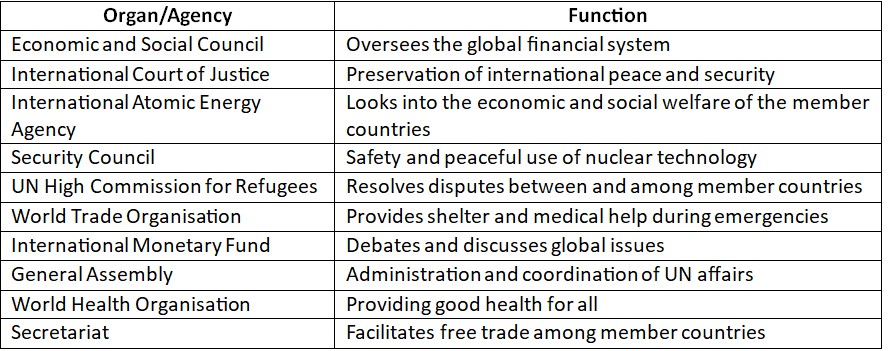
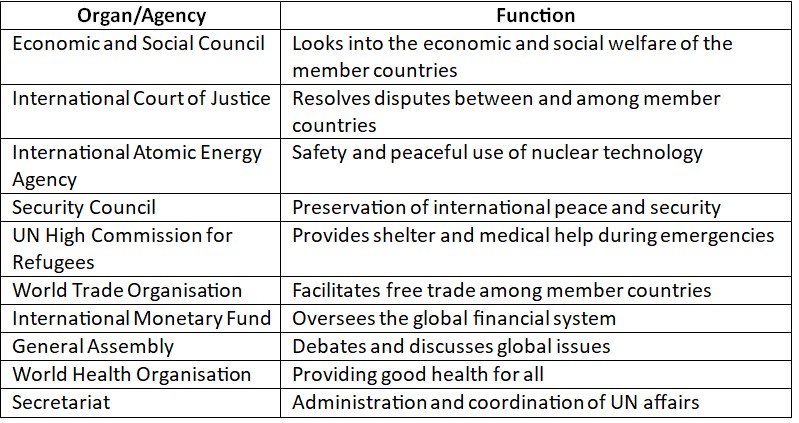
7: Match the principal organs and agencies of the UN with their functions:
Answer
8
8: What are the functions of Security Council?
Answer
The functions of the Security Council are:• The Security Council recommends methods to adjust disputes among nations.
• Security Council can take military action if required.
• Security Council elects the judges of International Court of Justice and appoints the Secretary General by recommending to the General Assembly.
• Security Council can apply economic sanction also to stop any aggression.
• The Security Council can investigate the disputes in case a friction arises.
9
9: As a citizen of India, how would you support India’s candidature for the permanent membership of the Security Council? Justify your proposal.
Answer
As a citizen of India, I am of the view that India should be made permanent member of the Security Council. India rightly deserves a permanent seat in the Security Council because it fulfils almost all the criteria laid down by the U.N.• India is the second most populous country in the world comprising almost one-fifths of the world population.
• India is the largest democratic country in the world.
• India has full faith in the U.N. and it has actively participated in all initiatives of the United Nations.
• India has played an important role in the peace-keeping efforts of the U.N.
• India has made regular financial contributions to the U.N.
• India’s economy is increasing rapidly. India is now a developing country. Its economy is on sound footing.
• India has always helped the dependent countries in the attainment of freedom.
• India has played a very important role in furthering the efforts of the non-aligned movement for peace, security and development.
• India has conducted nuclear tests successfully to safeguard the security of India.
10
10: Critically evaluate the difficulties involved in implementing the suggested reforms to reconstruct the UN.
Answer
The difficulties involved in implementing the suggested reforms to reconstruct the UN are:• There was no specification regarding how big an economy can become a part of the UN Security Council.
• There was also no specification regarding the required military strength of a nation for membership.
• No target regarding the required budget contribution.
• There was a clash between basis of determination of UNSC membership i.e. between geography and economic development.
• The basis of cultural representation was also unresolved. How could one divide the world by culture and civilisation when nations contain several cultures within their borders?
11
11: Though the UN has failed in preventing wars and related miseries, nations prefer its continuation. What makes the UN an indispensable organisation?
Answer
Despite the UN’s failure in preventing wars and related miseries, countries favour its survival because the world would be worse off without it:• There is a need for an international organisation that monitors the various actions taking place around the globe to ensure that no one country dominates over others.
• The UN and its specialist organisations provide financial aid to emerging nations in order to maintain the global economy.
• UNICEF, UNESCO, WHO, UNDP etc are all international UN organisations made for humanitarian activities and are the need of the hour for the world.
• The UN works as a forum to solve any international dispute among nations and sort out the best possible way.
• The United Nations facilitates interdependence and globalisation. The World Trade Organisation facilitates global trade and controls it to ensure open and fair trade.
12
12: ‘Reforming the UN means restructuring of the Security Council’. Do you agree with this statement? Give arguments for or against this position.
Answer
I completely agree with this statement. In fact, if we are serious about changing the United Nations, we must first reform the Security Council. Security Council is one of the most important organs of the United Nations. Security Council is mainly responsible for maintaining international peace and security. The Security Council may decide measures not involving the use of armed forces, to be employed to give effect to its decision. The Security Council consists of 15 members, five of which are permanent members of the Security Council. The permanent members enjoy Veto power. The Security Council reflects the global power structure of 1945, when many nations of the world were still under colonial rule. Security Council is geographically unbalanced and not properly represented.