NCERT Solutions for Chapter 3 Politics of Planned Development Class 12 Political Science
Book Solutions1
(a) It was a blueprint for India’s economic future.
(b) It supported state-ownership of industry.
(c) It was made by some leading industrialists.
(d) It supported strongly the idea of planning.
Answer
(a) It was a blueprint for India’s economic future.2
(a) Planning
(b) Liberalisation
(c) Cooperative farming
(d) Self sufficiency
Answer
(b) Liberalisation3
3: The idea of planning in India was drawn from:
(a) The Bombay plan
(b) Experiences of the Soviet bloc countries
(c) Gandhian vision of society
(d) Demand by peasant organisations
i. (b) and (d) only
ii. (d) and (c) only
iii. (a) and (b) only
iv. All of the above
Answer
iv. All of the above4
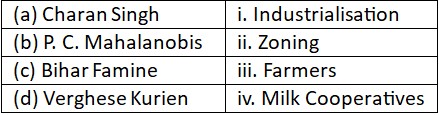
Answer
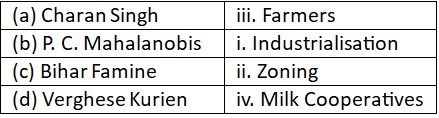
5
Answer
At the time of Independence India had before it, two models of development: the Liberal-Capitalists Model and the Socialist Model. Liberal-Capitalists Model was followed by Europe and United States, while the Socialist Model was followed by U.S.S.R. and other communist countries.
In India there were many leaders and scholars who were highly impressed by the Soviet Model of development. The Communist Party, Socialist Party and even Democratic Socialists like Pt. Nehru within the Congress were supporters of the Soviet Model of development. There were few supporters of the Capitalist Model of development.
Yes, the debate was resolved and India came up with the Five Year Plan (FYP) on the lines of the USSR. In this, the government prepares a document for five years where all its income and expenditure for the next five years is planned.
6
Answer
The First Five Year Plan (1951-1956) aimed to address poverty in India. The Plan focused mainly on the agrarian sector, investing in dams and irrigation.• Huge allocations were made for large-scale projects like the Bhakhra Nangal Dam.
• Land reforms were identified as the key to the country’s development.
• The planners aimed to increase the level of national income by pushing up savings.
The first Five Year Plan differed from the second Five Year Plan:
• In the Second FYP, heavy industrialization was stressed upon whereas in the First FYP, agriculture and irrigation were focused upon.
• The Second Five Year Plan wanted to bring quick structural transformation in all possible directions.
7
Answer
The Green Revolution was introduced to strengthen India’s weak agriculture, especially in food grains like wheat and rice, through High Yielding Varieties (HYV) of seeds, fertilizers, and scientific irrigation.
The government offered HYV seeds, fertilizers, pesticides, and better irrigation facilities at subsidised prices to farmers. The government also fixed prices to purchase the produce of farmers at a given rate.
Positive consequences of the Green Revolution:
• India became self-sufficient in food and it raised the availability of food in the country.
• The Green Revolution also resulted in the rise of middle peasant sections, who soon emerged as politically influential in many parts of the country.
Negative consequences:
• Some regions like Punjab, Haryana and western Uttar Pradesh became agriculturally prosperous, while others remained backward.
• The Green Revolution delivered only a moderate agricultural growth especially in wheat production.
8
Answer
The Second Five Year Plan (FYP) in India was drafted by a team of economists and planners led by P. C. Mahalanobis.
Ch. Charan Singh, initially a Congress leader but later the founder of Bharatiya Lok Dal, advocated for placing agriculture at the forefront of India’s planning efforts. He believed that planning policies were favouring urban and industrial sectors at the expense of farmers and rural communities, leading to a widening prosperity gap.
Others argued that poverty could not be eradicated without a boost in the industrial sector. The planners felt that the country, with its vast natural and human resources, was ideally suited for industries. Rapid industrialisation was seen as an essential condition for the development of not only agriculture but also all other sectors in the country.
9
Answer
The above statement is not entirely accurate because following independence, state intervention was necessary to regulate the country’s economy. India did not adhere strictly to either the capitalist or socialist model of development. Instead, India adopted a mixed economy model where both private and public sector played key roles.• The State helped the private sector to make profits by intervening only in those areas where the private sector was not prepared to go.
• If the private sector were given free play in the economy, it would have led to monopoly in the market.
• If private players had been given a free hand, only urban areas would have experienced development while rural areas would have continued to struggle for basic necessities.
10
10: Read the following passage and answer the questions below:
“In the early years of Independence, two contradictory tendencies were already well advanced inside the Congress party. On the one hand, the national party executive endorsed socialist principles of state ownership, regulation and control over key sectors of the economy in order to improve productivity and at the same time curb economic concentration. On the other hand, the national Congress government pursued liberal economic policies and incentives to private investment that was justified in terms of the sole criterion of achieving maximum increase in production.” — Francine Frankel
(a) What is the contradiction that the author is talking about? What would be the political implications of a contradiction like this?
(b) If the author is correct, why is it that the Congress was pursuing this policy? Was it related to the nature of the opposition parties?
(c) Was there also a contradiction between the central leadership of the Congress party and its state level leaders?
Answer
(a) The author is talking about the contradiction between capitalist and socialist models regarding the adoption of an economic model. The political implication of this was conflicts within parties and among members.
(b) The author is correct. The Congress was pursuing this policy under political compulsion. This was definitely related to the nature of opposition parties.
(c) No, there was not a contradiction between the central leadership of the Congress Party and its state level leaders. The states emphasized the importance of state ownership, regulation, and control over key sectors to enhance productivity, while the central leadership pursued liberal economic policies and provided incentives for private investment.