NCERT Solutions for Chapter 1 The End of Bipolarity Class 12 Political Science
Book Solutions1
(a) Socialism was the dominant ideology
(b) State ownership/control existed over the factors of production
(c) People enjoyed economic freedom
(d) Every aspect of the economy was planned and controlled by the State
Answer
(c) People enjoyed economic freedom2
(a) Soviet invasion of Afghanistan
(b) Fall of the Berlin Wall
(c) Disintegration of Soviet Union
(d) Russian Revolution
Answer
(d) Russian Revolution (1917)(a) Soviet invasion of Afghanistan (1979)
(b) Fall of the Berlin Wall (Nov 1989)
(c) Disintegration of Soviet Union (1991)
3
(a) End of the ideological war between the US and USSR
(b) Birth of CIS
(c) Change in the balance of power in the world order
(d) Crises in the Middle East
Answer
(d) Crises in the Middle East4
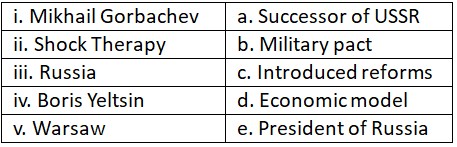
Answer
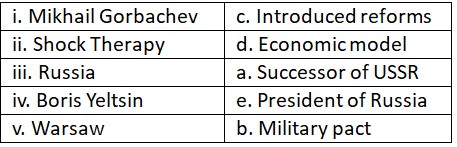
5
(a) The Soviet political system was based on ……….. ideology.
(b) ……….. was the military alliance started by the USSR.
(c) ……….. party dominated the Soviet Union’s political system.
(d) ……….. initiated the reforms in the USSR in 1985.
(e) The fall of the ……….. symbolised the end of the Cold War.
Answer
(a) Communist(b) Warsaw Pact
(c) Communist Party
(d) Mikhail Gorbachev
(e) Soviet Union (USSR)
6
Answer
The Soviet economy was opposed to capitalism because the essence of capitalism is the concentration of economic power in the hands of a few and the consequent exploitation of the rest. But American economy is based on capitalism. U.S.A. is the biggest capitalist country in the world.
Soviet economy was fully controlled by the state. In U.S.S.R. all means of production were owned and controlled by the state.
In Soviet economy there was no existence of private property. However, in U.S.S.R. the citizens were allowed to own small houses for living and small shops for earnings. But in U.S.A. private ownership and private property is the basic element of American economy.
7
Answer
• The Soviet Union lagged behind the West in technology, infrastructure, etc.• The Soviet System was very bureaucratic and authoritarian and citizens were not happy with the political system. Absence of freedom of speech and political rights created frustration among the people.
• Communist Party controlled the government and all institutions and was not responsible to the people. There was no opposition party and no democratic values.
• The Soviet Union failed in fulfilling the political and economic aspiration of the citizens.
• Invasion of Afghanistan weakened the Soviet Union economically and politically.
8
Answer
The disintegration of Soviet Union ended Bi-polarity of world politics and there emerged Uni-polarity in world politics. The U.S.A. became the sole superpower and no other country was in position to challenge the supremacy of U.S.A.
In the economic area, financial aid from Soviet to India almost dried due to the disintegration of the USSR. This was also one of the reasons for balance of payments crisis of India in 1991.
Following U.S.S.R. India adopted planned economy in the beginning. But since 1990 policy of liberalisation has been followed in India.
Supported by U.S.A. the capitalist economy has become now the dominant economic system internationally. The importance of World Bank and International Monetary Fund has increased because they give loans to these countries.
Although India had always been a non-aligned state, it was more inclined towards USSR and had friendly relations with it. India and USSR had a healthy trade of economic and military goods.
9
Answer
Shock therapy was a process of transition from an authoritative socialist system to a democratic capitalist system after the collapse of communism. The model of transition in Russia, Central Asia and East Europe came to be known as shock therapy. Although its speed and intensity varied depending on the former second world country, its general path and characteristics remained the same.
Shock therapy was not the best way to transition from communism to capitalism because:
• It was a sudden and immediate change that uprooted the entire existing system and wrecked havoc over the economy of the state.
• In Russia the huge industries controlled by the state almost collapsed and 90 percent of them were put up for sale to private individuals and companies. This was called as ‘the largest garage sale’ in history as the industries were undervalued and sold away at throw away prices.
• The value of Ruble, the Russian currency went down dramatically. Inflation grew uncontrollably leaving the Russian economy in a battered state.
• The collective farming system disintegrated leaving people without food and security.
• The already miserable state of economy was further worsened by privatisation which widened the gap between poor and rich even more.
• The old system of social welfare was destroyed with the defeat of socialism and the withdrawal of government subsidies pushed a lot of people into poverty.
10
10: Write an essay for or against the following proposition:
“With the disintegration of the second world, India should change its foreign policy and focus more on friendship with the US rather than with traditional friends like Russia”.
Answer
India has been a nonaligned country since its freedom. India was born in a bipolar world characterised by a cold war between two superpowers. Russia is and has always been a friendly nation for India. Russia provides numerous advantages to India, ranging from technology to nuclear and energy supplies. As a result, it would be unwise for India’s foreign policy to overlook Russia in support of the United States.
Russia and India share a vision of multipolar world order i.e. co-existence of several world powers internationally, collective security, greater regionalism, democratisation with the decision-making through bodies like the UN. More than 80 bilateral agreements have been experienced between India and Russia as a part of the Indo-Russia Strategic Agreement of 2001.
India has been benefitted from its relationship on the issues like Kashmir, energy supplies, sharing information on international terrorism, access to Central Asia and balancing its relation with China.
Russia is also important for India’s nuclear energy plane and assisting India’s space industry by giving cryogenic rocket to India whenever needed.
Russia is also benefitted from India on ground of the second largest arms market for Russia. Indian military gets most of its hardware from Russia. Russia and India have collaborated on various scientific projects also.