NCERT Solutions for Ch 6 Say the Right Thing Class 7 English Poorvi
Book Solutions1
QI: Work in pairs and discuss.
1: What does 'Athithi Devo Bhava' mean?
Answer
It means "Guest is God." It teaches us to treat guests with respect and kindness, like they are divine.
2
Answer
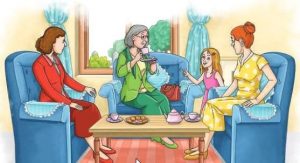
Being polite makes guests feel welcome and happy. It shows respect and builds good relationships.3
1. Offer the guests a glass of water.
2. Enquire about the well-being of the guests.
3. Ask the guests when they would leave.
4. Comment critically about the habits of guests.
5. Accompany the guests to the door when they leave.
Answer
The statements that display polite behaviour include:1. Offer the guests a glass of water.
2. Enquire about the well-being of the guests.
3. Accompany the guests to the door when they leave.
4
Answer
1. Tell them to speak calmly and listen to each other.2. Remind them to use polite words like "please" and "sorry."
3. Suggest taking turns to share their ideas without interrupting.
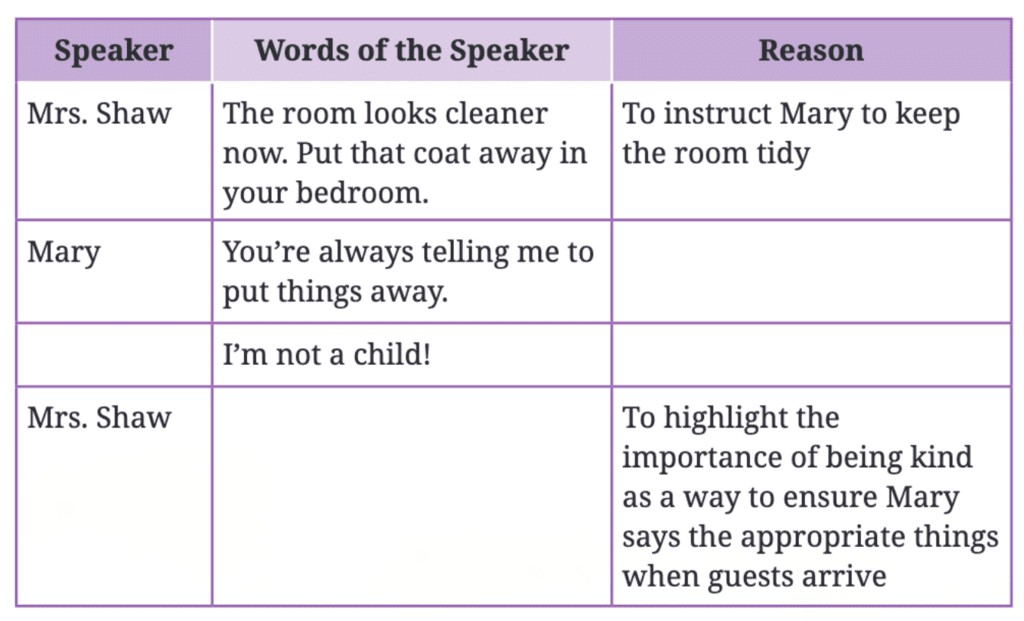
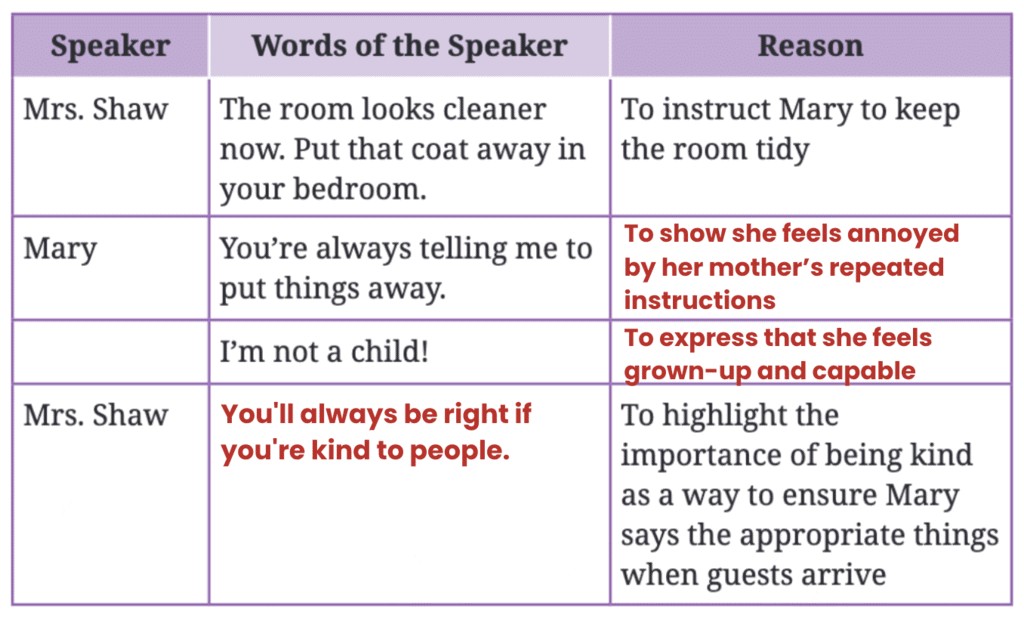
5
Answer
6
Answer
No, Mary might not follow her mother’s advice successfully. She is overconfident and doesn’t fully understand how to be polite. She talks too much and might say the wrong things.7
QI: Rectify the false statements given below from Scene II of the play. An example has been done for you. Share your answers with your classmates and the teacher.
1: Mrs. Harding states that they do not like London as it is not the same as Lanfield.
Answer
Rectification: Mrs. Harding states that they like Lanfield very much even though it is not the same as London.
Mrs. Harding says, "Yes, we like it very much. It's not the same as London," showing they like Lanfield.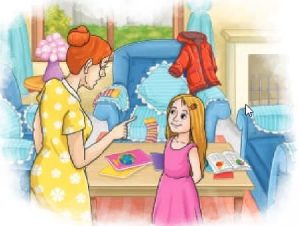
8
Answer
Rectification: Mrs. Harding was not pleased because she has no children, and Mary’s comment made her uncomfortable.Mrs. Harding says, "I have no children; believe me," showing she was not happy with Mary’s assumption.
9
Answer
Rectification: Mrs. Shaw said she liked Mrs. Best because she is a nice woman, not because she read newspapers.Mrs. Shaw says, "She’s a nice woman. I like her," not mentioning newspapers.
10
Answer
Rectification: Mrs. Shaw says she likes blue dresses and red coats, and Mrs. Harding wears them, so they don’t think it’s unfashionable.Mrs. Harding says she wears a blue dress with a red coat, and Mrs. Shaw supports it by saying, "I like blue dresses and red coats."
11
Answer
Rectification: Mary says she doesn’t like the dog and calls it dirty, not cute.Mary says, "It always looks very dirty. I don’t like dogs," showing she doesn’t find it cute.
12
QI: Read the extracts given below and answer the questions that follow.
1: Mary : What are you going to talk about?
Mrs. Shaw : I don’t know. All kinds of things. One day you’ll have to go to some of these houses yourself and talk to the people there.
Mary : I can talk now. I’ve been able to talk for a long time.
Mrs. Shaw : Yes, that’s true. You always talk too much. But does anyone want to hear the things that you say?
Mary : I can talk very well when I like. I’ll stay with you today and talk to them when they come.
Mrs. Shaw : Oh, I don’t think so. You can go out for a walk. It will be better if you do that.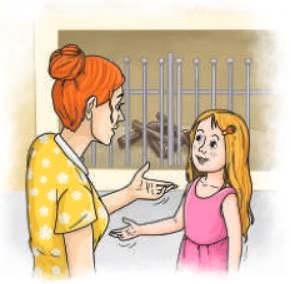
(i): What does Mrs. Shaw imply when she says, "One day you'll have to go to some of these houses yourself and talk to the people there"?
A. She believes Mary should start learning about hosting guests then.
B. She thinks Mary is ready to visit these houses independently.
C. She wants Mary to develop social skills for the future.D. She hopes Mary will avoid these social interactions entirely.
(ii): Complete the following sentence with the correct option from the brackets.
Mrs. Shaw and Mary are discussing how to __________ (have a polite conversation/ get to know people better)
(iii): Why did Mary insist on staying with her mother when the guests arrived?
(iv): Match the following character traits to the characters in the extract:
Answer
(i) C. She wants Mary to develop social skills for the future.Mrs. Shaw means Mary needs to learn how to talk politely to people, which will help her in the future when she visits others.
(ii) have a polite conversation.
Mrs. Shaw gives Mary advice on how to talk kindly and politely to guests, like saying nice things and asking them to stay longer.
(iii) Mary wanted to prove she could talk well and handle the guests. She says, "I can talk very well when I like. I’ll stay with you today and talk to them."
(iv) • Mary: A. eager – She is excited to stay and talk to the guests.
• Mary: B. inexperienced – She doesn’t know how to talk politely yet.
• Mrs. Shaw: C. cautious – She worries Mary might say the wrong things and suggests she go for a walk.
13
2: Mary : I saw Mrs. Cotter this afternoon. I met her in the street. No one sees her in the morning because she always stays in bed then. And she’s always asking the doctor to go to see her. I can’t understand women who stay in bed in the morning. And why must she always ask for the doctor? I’ve never been to a doctor in my life.
Mrs. Harding : I stay in bed in the morning myself.
(i): Complete the following sentence suitably.
Mary could spot Mrs. Cotter in the street because ______________.
(ii): What does Mary's comment about Mrs. Cotter staying in bed and calling the doctor suggest about her understanding?
A. She is worried about why Mrs. Cotter stays in bed all morning.
B. She is unable to understand why people need medical help.
C. She thinks Mrs. Cotter is scared and lonely for staying in bed.
D. She believes Mrs. Cotter is right to rest and take care of herself.
(iii): How can we say that Mary enjoyed good health?
(iv): Identify whether the following statement is true or false.
Mary might have unintentionally offended Mrs. Harding.
Answer
(i) she often walks there in the afternoon.Mary says, "I saw Mrs. Cotter this afternoon. I met her in the street," meaning she saw her while passing by.
(ii) B. She is unable to understand why people need medical help.
Mary says, "I can’t understand women who stay in bed in the morning," and "I’ve never been to a doctor," showing she doesn’t get why someone might need a doctor.
(iii) Mary says, "I’ve never been to a doctor in my life," which means she has never been sick and is healthy.
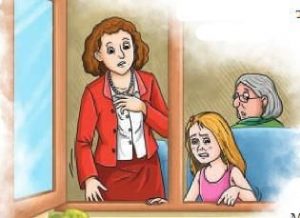
(iv) True.
Mary talks about Mrs. Cotter staying in bed, but Mrs. Harding says, "I stay in bed in the morning myself," so Mary’s comment might have made her feel bad.
14
QII: Answer the following questions.
1: What does Mary's comment about Mr. Best's routine and profession reveal about her viewpoint on bankers and their way of life?
Answer
Mary thinks bankers like Mr. Best have a boring life. She says, "He lives in trains! What kind of life is that?" and "bankers can’t think," showing she doesn’t respect their job or lifestyle.15
Answer
Mary doesn’t understand polite conversation. She says rude things, like calling Mrs. Best’s clothes funny and criticizing the dog, which upsets the guests. She doesn’t follow her mother’s advice to be kind.16
Answer
It shows the room becomes awkward and silent. Mary’s rude comments make the guests uncomfortable, so they don’t know what to say, and the mood becomes tense.17
Answer
At first, Mary is confident and eager to talk to the guests. But after making mistakes, she feels sorry and embarrassed, saying "Oh, I’m sorry" many times. At the end, she still says the wrong thing, asking, "Can’t you go?"18
Answer
Mrs. Harding and Mrs. Lee are polite but firm. They correct Mary, like when Mrs. Harding says, "I have no children," and Mrs. Lee says, "My brother’s a banker." They stay calm but leave early, showing they are patient but not happy with Mary’s rudeness.19
Answer
The play shows that polite conversation makes people feel comfortable and happy. Mary’s rude words upset the guests, making the visit awkward. Her mother’s advice to be kind shows that politeness helps build good relationships.20
I: Study the following words taken from the text.
humorous, hilariously, coming, beautiful
The given words are made by adding word endings like -ous, -ly, -ing, and -ful to the root words humour, hilarious, come, and beauty. Such word endings are called suffixes.
• humour + -ous
• hilarious + -ly
• come + -ing
• beauty + -ful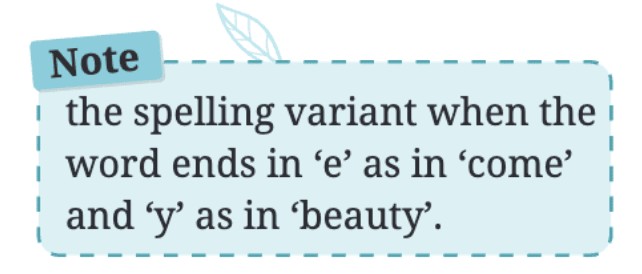
Q1. Now, divide the following words from the text as root words and suffixes. Check your answer with the teacher.
Answer
• Gladly: glad + -ly• Banker: bank + -er
• Guidance: guide + -ance
• Quietly: quiet + -ly
• Walking: walk + -ing
21
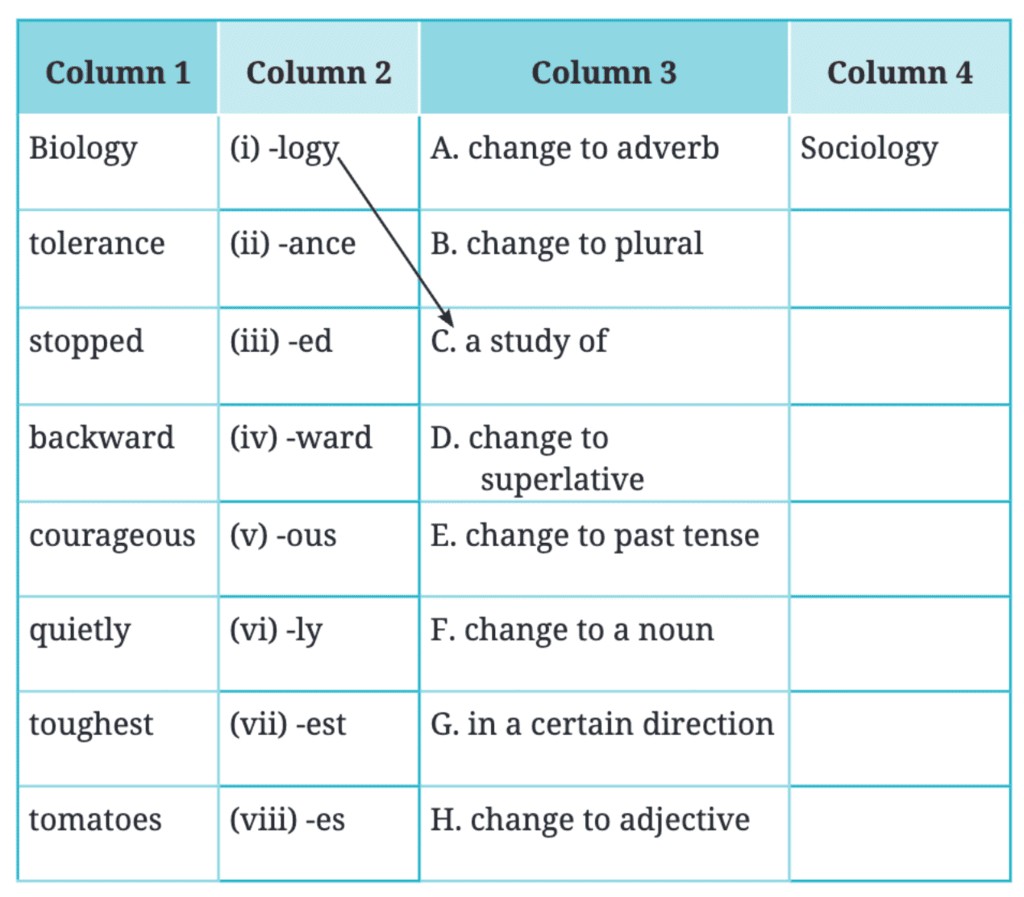
Answer
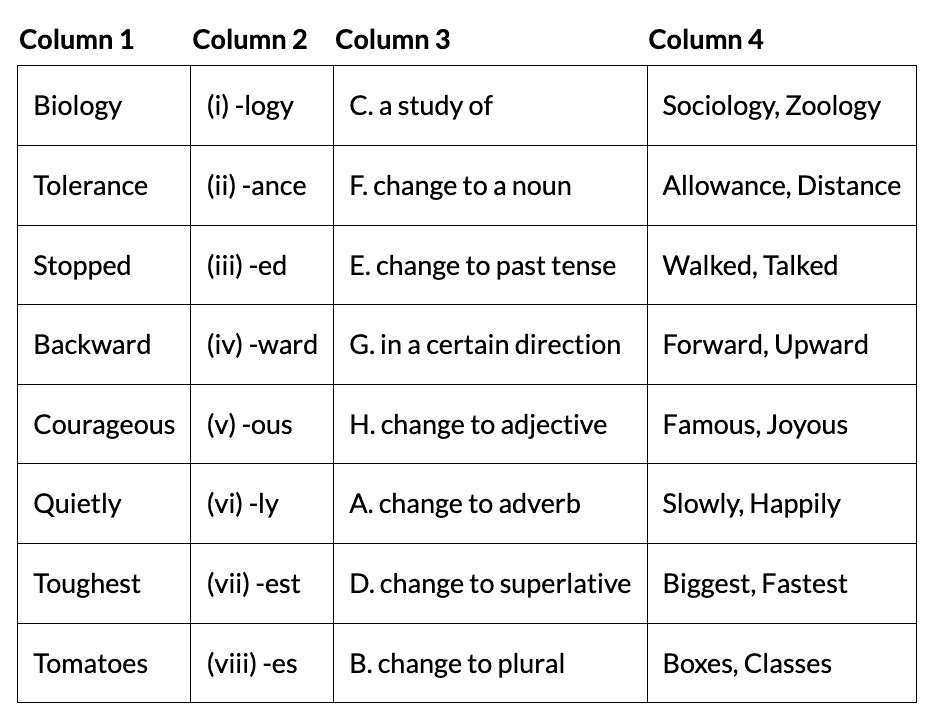
22
Q3: Fill in the blanks using words given in the brackets by adding suitable suffixes.
To communicate (i) ___________ (effective), choose your words and topics (ii) ___________ (wise). Avoid (iii) ___________ (discuss) things you don’t know much about or that could upset someone. Remember to be (iv) ___________ (respect) towards others, including yourself, and express your (v) ___________ (appreciate). Finally, always be(vi) ___________ (response) by replying promptly to communicate.
Answer
(i) To communicate effectively (effective).(ii) Choose your words and topics wisely (wise).
(iii) Avoid discussing (discuss).
(iv) Remember to be respectful (respect).
(v) Express your appreciation (appreciate).
(vi) Always be responsive (response).
23
II: Read the highlighted words in the following sentences from the text.
• But does anyone want to hear the things that you say?
• I can’t tell you everything.
Select the correct answer.
Is there a difference in the meanings of ‘say’ and ‘tell’? (Yes/ No)
• ‘Say’ focuses on the message and does not always require a listener.
• ‘Tell’ focuses on who receives the message and always needs a listener.
1: Fill in the blanks with suitable words from the sets of words given in the box below. Make changes in the verb forms (tense), if necessary.
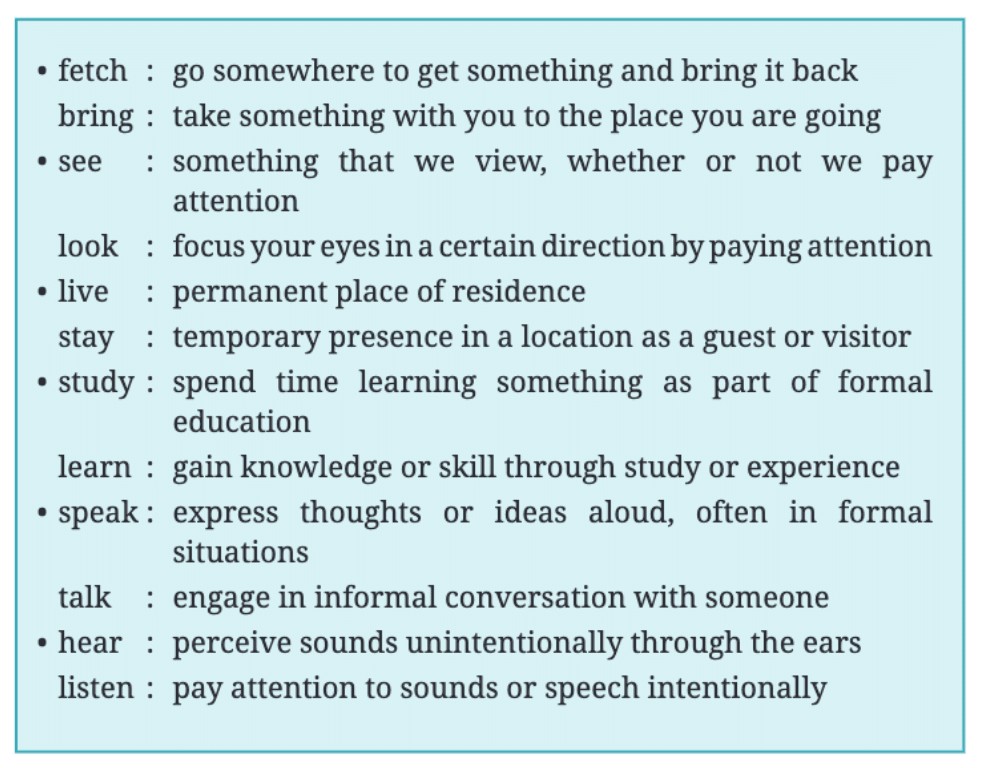
(i) I _________ at the photo, but I didn’t _________ anyone familiar.
(ii) I’d better go and _________ my mother from the station, and then_________ her home.
(iii) I need to _________ for my mathematics exam this weekend, so I hope to _________ new concepts along the way.
(iv) I can _________ the music from my neighbour’s house, but I need to _________ to it carefully to understand the lyrics.
(v) “Could I _________ to Mrs. Kalpana, who is going to _________ to us about gardening,” said Ritu.
(vi) I _________ in a small town, but I often _________ with my relatives in the city
Answer
(i) I looked at the photo, but I didn’t see anyone familiar.(ii) I’d better go and fetch my mother from the station, and then bring her home.
(iii) I need to study for my mathematics exam this weekend, so I hope to learn new concepts along the way.
(iv) I can hear the music from my neighbour’s house, but I need to listen to it carefully to understand the lyrics.
(v) “Could I speak to Mrs. Kalpana, who is going to talk to us about gardening,” said Ritu.
(vi) I live in a small town, but I often stay with my relatives in the city.
24
QIII: Read the following sentences from the text and underline the verbs.
• They lived in London before.
• I met her in a shop and asked her to come.
As you know, the verbs you have underlined are in the simple past tense. (actions that happened in the past or distant past)
Read the following sentence from the text and underline the verb.
She has been staying with them for a while.
The verb you have underlined is in the present perfect continuous tense.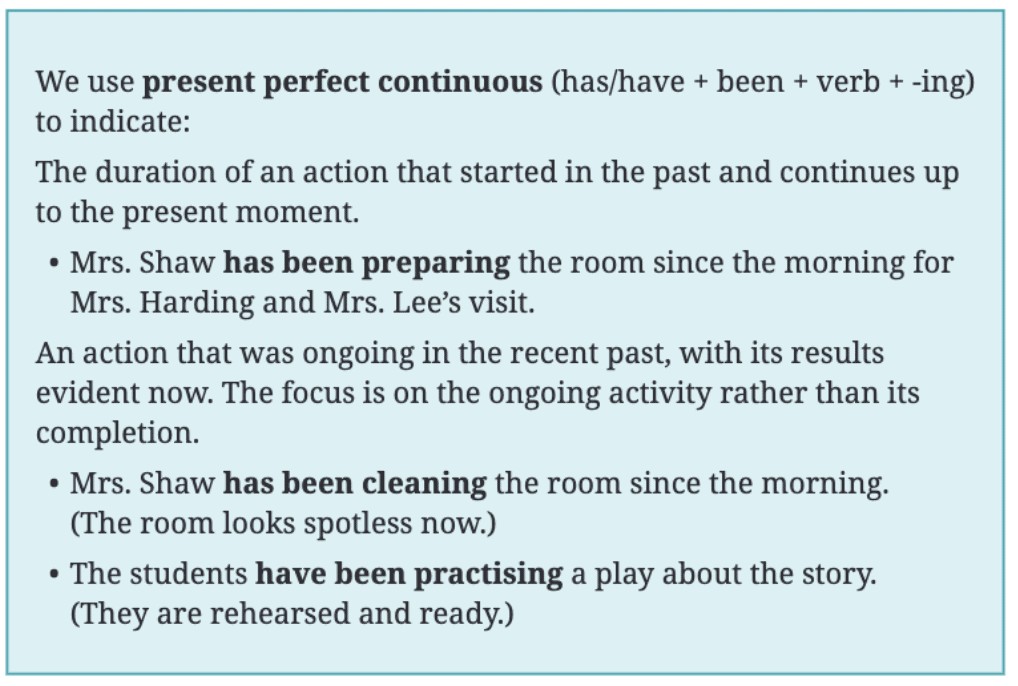
1: Fill in the blanks using the verbs given in brackets in the present continuous or present perfect continuous tense.
The students (i) ______________ (organise) a play and setting up the stage. They (ii) ______________ (prepare) for weeks to make everything perfect. The performers (iii) ______________ (rehearse) every day, and their excitement (iv) ______________ (grow). The sound in-charge (v)______________ (test) the microphones to check the sound quality.Everyone (vi) ______________ (work) hard, and now the place (vii)______________ (buzz) with energy and excitement.
Answer
(i) The students are organising (organise) a play and setting up the stage.(ii) They have been preparing (prepare) for weeks to make everything perfect.
(iii) The performers are rehearsing (rehearse) every day.
(iv) Their excitement is growing (grow).
(v) The sound in-charge is testing (test) the microphones to check the sound quality.
(vi) Everyone is working (work) hard.
(vii) Now the place is buzzing (buzz) with energy and excitement.
25
IV: Read the explanation about the kinds of sentences given in the table below.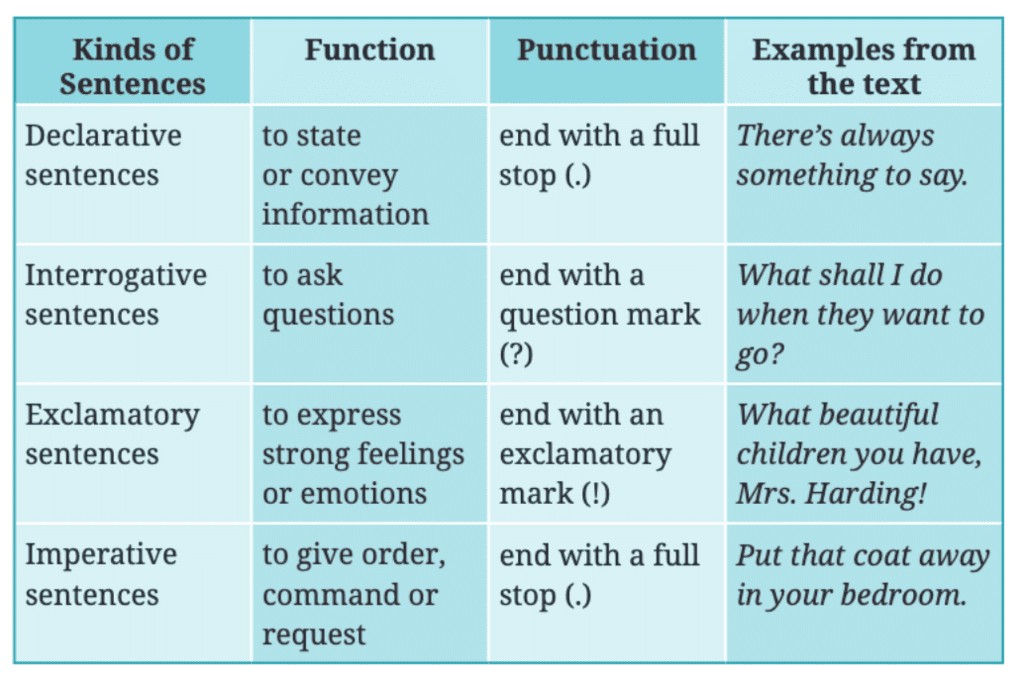
1: Identify the kinds of sentences and punctuate them appropriately.
(i) The meeting starts at 10.00 a.m. in the conference room.
(ii) What an exciting adventure it was!
(iii) How did you solve the problem so quickly?
(iv) What is the weather forecast today?
(v) How beautiful is the rainbow!
(vi) Clean up your room before dinner.
(vii) The children are planning a surprise party for their mom.
(viii) Turn off the music.
Answer
(i) Declarative(ii) Exclamatory
(iii) Interrogative
(iv)Interrogative
(v)Exclamatory
(vi) Imperative
(vii) Declarative
(viii)Imperative
26
(I) Mrs. Shaw wanted Mary to learn to say the right thing. You will listen to a conversation between a mother and her son about basic manners. As you listen, fill in the blanks given below by selecting the correct option. (Transcript for the teacher on pg. 89 )
Mother : Why were you getting impatient in the grocery store?
Son : Was I really? I just didn’t like waiting so long.
Mother : I know waiting can be boring, but remember, we always stand in queues and wait for our turn. It’s fair for everyone, right?
Son : Hmm, I guess. Even if it takes a lot of time?
Mother : Well, that’s when we practise patience. And when it’s our turn, what do we say to the shopkeeper?
Son : We say, ‘Thank you’. And ‘Please’ if we ask for something, right?
Mother : Yes! Those are polite words. Why do you think they’re important?
Son : Maybe because they make people feel respected?
Mother : Exactly! It shows gratitude and kindness. And what about yesterday when you bumped into that lady with the blue sari?
Son : Oh, I said sorry right away. You always tell me it’s important to apologise.
Mother : That’s true. Why do you think it’s important to apologise?
Son : Um… so people know I didn’t mean to do it and that I care?
Mother : Yes, it shows you’re responsible. And how about when we’re in places like the library? What kind of voice should we use?
Son : Oh, I know this! We speak softly so we don’t bother others.
Mother : Right again! It’s called using an ‘inside voice’.
Son : I know. I also know that we should cover our mouth when we yawn, sneeze or cough in a gathering or a public place.
Mother : Absolutely! You’re getting really good at remembering these things. And when we talk at home or school, what should we do when someone else is speaking?
Son : We wait for our turn. It’s not well-mannered to interrupt.
Mother : You’ve got it, Rohan. You’re becoming a really polite young man.
Son : Thanks, Ma. So, do you think I’ll be ready to handle the grocery queue next time?
Mother : Certainly! And maybe we can get some ice cream as a reward if you do it well. Son : Deal! And… thank you!
Answer These:
1. How did the son behave in the grocery queue?
(i) strangely
(ii) impatiently
(iii) politely
2. The mother finally refers to her son as a __________________.
(i) polite young man
(ii) responsible son
(iii) grateful person
Answer
1.(ii) impatiently2. (i) polite young man
27
1. The mother uses the grocery store incident as an opportunity to teach her son about patience and fairness.
2. The son recognises the value of apologising and understands that it shows he notices others.
3. The son is gradually learning the importance of polite words and actions from his mother’s guidance.
4. The mother discourages her son from speaking softly in public, suggesting that people should adjust to his voice level.
5. The son feels that covering his mouth when coughing is only important when he’s at home.
6. The son receives all advice readily while understanding its importance.
7. The mother uses praise to support the polite behaviours she wants her son to continue practising.
Answer
True statements:
1. The mother uses the grocery store incident as an opportunity to teach her son about patience and fairness.
2. The son recognises the value of apologising and understands that it shows he notices others.
3. The son is gradually learning the importance of polite words and actions from his mother’s guidance.
7. The mother uses praise to support the polite behaviours she wants her son to continue practising.
False statements:
4. Statement 4 is false because the mother encourages her son to speak softly in public, especially in places like the library.
5. Statement 5 is false because the son mentions that covering his mouth when coughing, sneezing, or yawning is important in public places, not just at home.
6. Statement 6 is false because the son sometimes questions or reflects on the advice before understanding and accepting it. He does not always receive it immediately or without hesitation.
28
As you know
• Intonation is the rise and fall of the pitch of tone while speaking.
Let us learn about sentence stress.
• Sentence stress is laying emphasis on certain word (s) in a sentence.
→ The emphasis on particular words helps to convey the meaning and importance of the sentence.
→ Content words like book, run, beautiful, quickly, etc., are mostly stressed instead of function words like she, in, is, etc., in a sentence.
QI: Speak the given declarative sentence aloud.
I saw Mrs. Cotter this afternoon.
Answer
Say it with falling intonation at the end and stress "Mrs. Cotter."Stress "Mrs. Cotter" to emphasise who was seen, and use falling intonation for a declarative sentence.
Remember, stress does not mean to say the word louder than others. Itmeans to say a word with more emphasis than others.
29
Answer
1. The room looks cleaner now.2. You always talk too much.
3. You leave your clothes all over the house.
30
Answer
1. I didn’t hurt anyone today. – (iv) I, specifically, did not hurt anyone, possibly implying someone else might have.2. I didn’t hurt anyone today. – (iii) The action of hurting anyone did not occur.
3. I didn’t hurt anyone today. – (i) I might have done other things but did not hurt anyone.
4. I didn’t hurt anyone today. – (v) I may have spoken a lot many things but not a single person was hurt.
5. I didn’t hurt anyone today. – (ii) I might cause hurt usually, but not anyone on this day.
31
Answer
Say it with rising intonation at the end and stress "Mrs. Cotter."Remember: The way we use stress and intonation in a sentence can change the meaning of what we wish to say if we are not careful.
32
Rewrite the play ‘Say the Right Thing’ as a short story, focusing on Mary’s interactions with her mother and the guests.
• Ensure the story captures the main events, character emotions, and humorous moments effectively.
• Use paragraphs to organise your story and include descriptive language to bring the characters and events to life.
You may refer to the following hints:
• Begin with an introduction: describe Mary and Mrs. Shaw, their relationship and the setting of the story.
• Explain Mrs. Shaw’s instructions to Mary before the guests arrive and Mary’s confidence in handling the situation.
• Narrate the events when Mrs. Harding and Mrs. Lee visit, highlighting Mary’s remarks and the guests’ reactions.
• Include key moments of humour and awkwardness to maintain the tone of the play.
• Conclude by commenting on how the visit ended and Mary’s impact on the situation.
Answer
Say the Right Thing
A Short Story
Mary Shaw was a lively young girl who loved to talk. She lived with her mother, Mrs. Shaw, in the quiet town of Lanfield. Mrs. Shaw was careful and proper in her ways and believed in good manners, especially while speaking to others. Mary, on the other hand, often spoke without thinking, which sometimes led to trouble.
One afternoon, Mrs. Shaw was busy cleaning the living room. She informed Mary that two guests were coming over—Mrs. Harding, the wife of a wealthy man who had recently moved to Lanfield, and her sister-in-law, Mrs. Lee. Mrs. Shaw hoped to make a good impression, and she was nervous about how Mary might behave during the visit.
Although Mrs. Shaw suggested Mary go out for a walk, Mary insisted on staying. She was confident that she could speak politely and promised to follow her mother’s advice. Mrs. Shaw reminded her to speak kindly, make people feel welcome, and to say things that would make others happy. She also warned Mary to look sad when the guests got up to leave and say something like, “Must you go? Can’t you stay?”
Mary listened carefully and repeated the polite phrases out loud to remember them. She then changed into a clean dress, determined to show her mother that she could handle the guests well.
Soon, Mrs. Harding and Mrs. Lee arrived, and Mrs. Shaw welcomed them warmly. After a short conversation about Lanfield, there was a pause. Mrs. Shaw looked at Mary, hoping she would say something pleasant. Mary smiled and said, “What beautiful children you have, Mrs. Harding! I’ve seen them walking down the road.” Mrs. Harding, looking slightly uncomfortable, replied, “I haven’t any children.” Mary insisted she had seen them, making the moment awkward.
Trying to steer the conversation in another direction, Mrs. Shaw mentioned Mr. Best, a man who lived nearby. But Mary made things worse. She laughed and said that Mr. Best lived “in trains” because he travelled to London every day and read newspapers instead of books. Then she added, “But he’s only a banker, and bankers can’t think.” Mrs. Lee quietly replied, “My brother is a banker.” Mary was embarrassed and quickly apologised.
Unfortunately, that was not the end of Mary’s blunders. She laughed at someone’s clothes, not realising that Mrs. Harding wore the same outfit. She criticised people who stayed in bed in the morning and often called the doctor—only to find out that both Mrs. Harding and Mrs. Lee did exactly that. Mary then called Mrs. Grantley, one of Mrs. Shaw’s close friends, “too talkative,” which offended Mrs. Lee, as her mother was also very talkative.
The most embarrassing moment came when Mary complained about a dirty dog she had seen near their house. Mrs. Harding calmly replied that the dog, named Towzer, belonged to her. Mary turned red and said she didn’t know. She then made fun of a man riding a horse and practising shooting, only to hear that Mrs. Lee’s brother did those things and had even moved to Lanfield for them.
By this time, the room was filled with silence and discomfort. Mrs. Harding gently said that they should leave. Mrs. Shaw politely invited them to stay longer, hoping to fix the situation. But Mary, completely forgetting her mother’s advice, blurted out, “Oh, must you stay? Can’t you go?”
The guests left soon after, and the visit ended in an awkward silence. Mary had tried her best to be polite, but her careless remarks turned the meeting into a comedy of errors. While it was an uncomfortable afternoon for Mrs. Shaw, it was also a humorous reminder that knowing what to say—and when to say it—is a very important part of growing up.
33
• Allot a specific role to each member in the group. For example: director, narrator, and characters.
• Include the actions and expressions as indicated in brackets in the play.
Answer
• Form a group with your classmates.Assign roles to everyone. Some ideas:
• Director – guides the group and gives instructions
• Narrator – introduces the scene and explains actions
• Characters – like Mary, Mrs. Shaw, Mrs. Harding, and Mrs. Lee
• Choose a funny or important scene from the play.
• Include actions and expressions mentioned in the brackets (e.g., Mary turns red with shame, Mrs. Harding smiles, etc.).
• Practice and perform it in class for fun and learning!
34
Answer
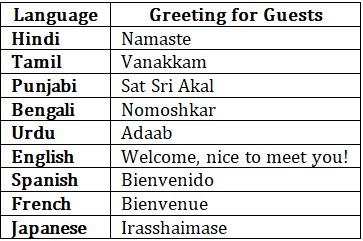
35
Answer

This saying highlights the interconnectedness of all people, suggesting that humanity is part of a single global family. It encourages unity, cooperation, and treating others with kindness and empathy, regardless of differences in nationality, race, or religion. The message is often used to promote global peace and mutual understanding among diverse cultures and nations. ‘Vasudhaiva Kutumbakam’ was chosen as the theme for the G20 Summit which captured the essence of global unity, common bonds, and shared aspirations for a better future.