NCERT Solutions for Ch 10 Living Creatures: Exploring their Characteristics Class 6 Science
Book Solutions1
Answer
Seed is a living thing. Seed can grow into a plant under right conditions.2
Answer
Larvicides (a substance used to kill larvae) target larvae in the breeding habitat before they can mature into adult mosquitoes and disperse. Larvicide treatment of breeding habitats helps reduce the adult mosquito population in nearby areas.Liquid larvicide products are applied directly to water using backpack sprayers and truck or aircraft-mounted sprayers. Tablet, pellet, granular, and briquet formulations of larvicides are also applied by mosquito controllers to breeding areas.
3

Answer
Table: Effect of certain conditions on seed germination
4
Answer
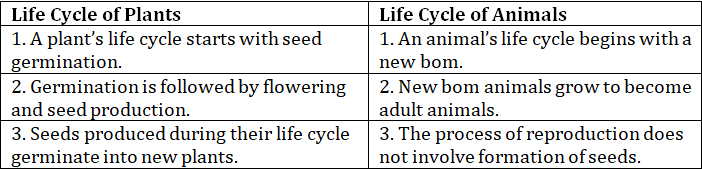
Similarities:
• Life cycles of both, plants and animals, begin with an initial stage which is followed by several stages of its growth and development and finally death.
• In life cycle of both, the process of reproduction maintains the continuity of its kind.
Differences:
5
Answer
6
Answer
To ensure proper storage of grains and pulses and prevent germination:• Keep Dry
• Cool Storage
• Airtight Containers
7
Answer
• The tail in the tadpole stage of a frog provides• Swimming Ability: It helps the tadpole swim efficiently in water to find food and escape predators.
• Balance and Stability: Assist in maintaining balance while moving in water.
8
Answer
• Against Charan: The wooden log was once part of a living tree, which was alive and exhibited characteristics of living beings.• Against Charu: Once the wood is separated from the tree, it no longer exhibits growth, reproduction, or other life processes, making it non-living.
9
Answer
Similarities
• Both begin life as eggs.
• Both have a larval stage (tadpole in frogs, larvae in mosquitoes) that is aquatic.
Distinguishing Features
Mosquitoes have four stages
Egg → Larva → Pupa → Adult
Respiration: Larvae and pupae breathe through siphons.
Frog has four stages
Egg → Tadpole → Froglet → Adult
Respiration: Tadpoles have gills, adults have lungs and can respire through their skin.
10
Answer
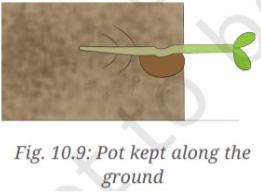
Expected observations• Shoot: Growth upwards, towards the light source.
• Root: Growth downwards, into the soil for stability and nutrient absorption.
Reasons
• Shoots grow towards light (phototropism) for photosynthesis.
• Roots grow downwards (gravitropism) for – nutrient absorption.
11
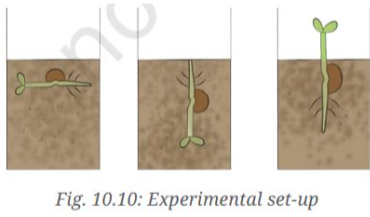
Answer
Tara and Vijay are likely trying to understand how the orientation of a seed affects the growth direction of the shoot (the green ^art above ground) and the root (the part below ground). Observation: If the shoot always grows upwards (towards the light) and the root always grows downwards (into the soil), regardless of how the seed is placed, this shows that plants have natural mechanisms (like phototropism and gravitropism) that guide their growth direction.12
Answer
AIM: Experiment to Check the Effect of Temperature on Seed Germination
Materials: Identical pots, soil, seeds, thermometers, and different tem¬perature-controlled environments (e.g., refrigerator, room temperature, heated environment).
Procedure
(i) Fill each pot with the same type of soil.
(ii) Plant seeds in each pot.
(iii) Place each pot in a different environment with controlled temperatures (e.g., cold, room temperature, warm). For example, keep one pot outside in balcony to get sunlight. Put another in shade in the room. Keep the third one in basement or at coldest part of the house.
(iv) Water each pot equally.
(v) Record the number of seeds germinated in each environment daily for two weeks.
Observation: Measure and compare the rate of germination and growth in different temperatures.
Conclusion: Determine the optimal temperature for seed germination based on observations.