Mechanical Properties of Solids
Book Solutions1
Answer
Length of the steel wire, L1 = 4.7 m
Area of cross-section of the steel wire, A1 = 3.0 × 10⁻⁵ m2
Length of the copper wire, L2 = 3.5 m
Area of cross-section of the copper wire, A2 = 4.0 × 10⁻⁵ m2
Change in length = ΔL1 = ΔL2 = ΔL
Force applied in both the cases = F
Young’s modulus of the steel wire:
Y1 = (F1 / A1) (L1 / ΔL1)
= (F / 3 X 10⁻⁵) (4.7 / ΔL) ....(i)
Young’s modulus of the copper wire:
Y2 = (F2 / A2) (L2 / ΔL2)
= (F / 4 × 10⁻⁵) (3.5 / ΔL) ....(ii)
Dividing (i) by (ii), we get:
Y1 / Y2 = (4.7 × 4 × 10-5) / (3 × 10-5 × 3.5)
= 1.79 : 1
The ratio of Young’s modulus of steel to that of copper is 1.79 : 1.
2
9.2. Figure 9.11 shows the strain-stress curve for a given material. What are (a) Young’s modulus and (b) approximate yield strength for this material?

Answer
(a) It is clear from the given graph that for stress 150 × 106 N/m2, strain is 0.002.
∴Young’s modulus, Y = Stress / Strain
= 150 × 106 / 0.002 = 7.5 × 10¹⁰ Nm-2
Hence, Young’s modulus for the given material is 7.5 ×10¹⁰ N/m2.
(b) The yield strength of a material is the maximum stress that the material can sustain without crossing the elastic limit. It is clear from the given graph that the approximate yield strength of this material is 300 × 106 Nm/2 or 3 × 10⁸ N/m2.
3
9.3. The stress-strain graphs for materials A and B are shown in Fig. 9.12.

The graphs are drawn to the same scale.
(a) Which of the materials has the greater Young’s modulus?
(b) Which of the two is the stronger material?
Answer
(a) From the two graphs we note that for a given strain, stress for A is more than that of B. Hence, Young's modulus (=stress/strain) is greater for A than that of B.
(b) A is stronger than B. Strength of a material is measured by the amount of stress required to cause fracture, corresponding to the point of fracture.
4
9.4. Read the following two statements below carefully and state, with reasons, if it is true or false
(a) The Young’s modulus of rubber is greater than that of steel;
(b) The stretching of a coil is determined by its shear modulus.
Answer
(a) False, because for given stress there is more strain in rubber than steel and modulus of elasticity is inversely proportional to strain.
(b) True, because the stretching of coil simply changes its shape without any change in the length of the wire used in the coil due to which shear modulus of elsticity is involved.
5

Answer
Elongation of the steel wire = 1.49 × 10⁻⁴ m
Elongation of the brass wire = 1.3 × 10⁻⁴ m
Diameter of the wires, d = 0.25 m
Hence, the radius of the wires, r = d/2 = 0.125 cm
Length of the steel wire, L1 = 1.5 m
Length of the brass wire, L2 = 1.0 m
Total force exerted on the steel wire:
F1 = (4 + 6) g = 10 × 9.8 = 98 N
Young’s modulus for steel:
Y1 = (F1/A1) / (ΔL1 / L1)
Where,
ΔL1 = Change in the length of the steel wire
A1 = Area of cross-section of the steel wire = πr12
Young’s modulus of steel, Y1 = 2.0 × 10¹¹ Pa
∴ ΔL1 = F1 × L1 / (A1 × Y1)
= (98 × 1.5) / [ π(0.125 × 10⁻²)2 × 2 × 1011] = 1.49 × 10⁻⁴ m
Total force on the brass wire:
F2 = 6 × 9.8 = 58.8 N
Young’s modulus for brass:
Y2 = (F2/A2) / (ΔL2 / L2)
Where,
ΔL2 = Change in the length of the brass wire
A1 = Area of cross-section of the brass wire = πr12
∴ ΔL2 = F2 × L2 / (A2 × Y2)
= (58.8 X 1) / [ (π × (0.125 × 10⁻²)2 × (0.91 × 1011) ] = 1.3 × 10⁻⁴ m
Elongation of the steel wire = 1.49 × 10⁻⁴ m
Elongation of the brass wire = 1.3 × 10⁻⁴ m.
6
Answer
Edge of the aluminium cube, L = 10 cm = 0.1 m
The mass attached to the cube, m = 100 kg
Shear modulus (η) of aluminium = 25 GPa = 25 × 109 Pa
Shear modulus, η = Shear stress / Shear strain = (F/A) / (L/ΔL)
Where,
F = Applied force = mg = 100 × 9.8 = 980 N
A = Area of one of the faces of the cube = 0.1 × 0.1 = 0.01 m2
ΔL = Vertical deflection of the cube
∴ ΔL = FL / Aη
= 980 × 0.1 / [ 10-2 × (25 × 109) ]
= 3.92 × 10⁻⁷ m
The vertical deflection of this face of the cube is 3.92 ×10⁻⁷ m.
7
Answer
Mass of the big structure, M = 50,000 kg
Inner radius of the column, r = 30 cm = 0.3 m
Outer radius of the column, R = 60 cm = 0.6 m
Young’s modulus of steel, Y = 2 × 10¹¹ Pa
Total force exerted, F = Mg = 50000 × 9.8 N
Stress = Force exerted on a single column = 50000 × 9.8 / 4 = 122500 N
Young’s modulus, Y = Stress / Strain
Strain = (F/A) / Y
Where,
Area, A = π (R2 – r2) = π ((0.6)2 – (0.3)2)
Strain = 122500 / [ π ((0.6)2 – (0.3)2) × 2 × 1011 ] = 7.22 × 10⁻⁷
Hence, the compressional strain of each column is 7.22 × 10⁻⁷.
8
Answer
Length of the piece of copper, l = 19.1 mm = 19.1 × 10⁻³ m
Breadth of the piece of copper, b = 15.2 mm = 15.2 × 10⁻³ m
Area of the copper piece:
A = l × b
= 19.1 × 10–3 × 15.2 × 10–3
= 2.9 × 10⁻⁴ m2
Tension force applied on the piece of copper, F = 44500 N
Modulus of elasticity of copper, η = 42 × 109 N/m2
Modulus of elasticity, η = Stress / Strain
= (F/A) / Strain
∴ Strain = F / Aη
= 44500 / (2.9 × 10-4 × 42 × 109)
= 3.65 × 10⁻³.
9
Answer
Radius of the steel cable, r = 1.5 cm = 0.015 m
Maximum allowable stress = 108 N m–2
Maximum stress = Maximum force / Area of cross-section
∴ Maximum force = Maximum stress × Area of cross-section
= 108 × π (0.015)2
= 7.065 × 10⁴ N
Hence, the cable can support the maximum load of 7.065 × 10⁴ N.
10
Answer
The tension force acting on each wire is the same. Thus, the extension in each case is the same. Since the wires are of the same length, the strain will also be the same.
The relation for Young’s modulus is given as:
Y = Stress / Strain
= (F/A) / Strain = (4F/πd2) / Strain ....(i)
Where,
F = Tension force
A = Area of cross-section
d = Diameter of the wire
It can be inferred from equation (i) that Y ∝ (1/d2)
Young’s modulus for iron, Y1 = 190 × 109 Pa
Diameter of the iron wire = d1
Young’s modulus for copper, Y2 = 120 × 109 Pa
Diameter of the copper wire = d2
Therefore, the ratio of their diameters is given as:

11
Answer
Mass, m = 14.5 kg
Length of the steel wire, l = 1.0 m
Angular velocity, ω = 2 rev/s = 2 × 2π rad/s = 12.56 rad/s
Cross-sectional area of the wire, a = 0.065 cm2 = 0.065 × 10⁻⁴ m2
Let Δl be the elongation of the wire when the mass is at the lowest point of its path.
When the mass is placed at the position of the vertical circle, the total force on the mass is:
F = mg + mlω2
= 14.5 × 9.8 + 14.5 × 1 × (12.56)2
= 2429.53 N
Young's modulus = Strss / Strain
Y = (F/A) / (∆l/l)
∴ ∆l = Fl / AY
Young’s modulus for steel = 2 × 10¹¹ Pa
∆l = 2429.53 × 1 / (0.065 × 10-4 × 2 × 1011) = 1.87 × 10⁻³ m
Hence, the elongation of the wire is 1.87 × 10⁻³ m.
12
Answer
Initial volume, V1 = 100.0l = 100.0 × 10 –3 m3
Final volume, V2 = 100.5 l = 100.5 ×10 –3 m3
Increase in volume, ΔV = V2 – V1 = 0.5 × 10⁻³ m3
Increase in pressure, Δp = 100.0 atm = 100 × 1.013 × 105 Pa
Bulk modulus = Δp / (ΔV/V1) = Δp × V1 / ΔV
= 100 × 1.013 × 105 × 100 × 10-3 / (0.5 × 10⁻³)
= 2.026 × 10⁹ Pa
Bulk modulus of air = 1 × 10⁵ Pa
∴ Bulk modulus of water / Bulk modulus of air = 2.026 × 10⁹ / (1 × 10⁵) = 2.026 × 10⁴
This ratio is very high because air is more compressible than water.
13
Answer
Let the given depth be h.
Pressure at the given depth, p = 80.0 atm = 80 × 1.01 × 105 Pa
Density of water at the surface, ρ1 = 1.03 × 10³ kg m–3
Let ρ2 be the density of water at the depth h.
Let V1 be the volume of water of mass m at the surface.
Let V2 be the volume of water of mass m at the depth h.
Let ΔV be the change in volume.
ΔV = V1 - V2
= m [ (1/ρ1) - (1/ρ2) ]
∴ Volumetric strain = ΔV / V1
= m [ (1/ρ1) - (1/ρ2) ] × (ρ1 / m)
ΔV / V1 = 1 - (ρ1/ρ2) ......(i)
Bulk modulus, B = pV1 / ΔV
ΔV / V1 = p / B
Compressibility of water = (1/B) = 45.8 × 10⁻¹¹ Pa-1
∴ ΔV / V1 = 80 × 1.013 × 105 × 45.8 × 10-11 = 3.71 × 10⁻³ ....(ii)
For equations (i) and (ii), we get:
1 - (ρ1/ρ2) = 3.71 × 10⁻³
ρ2 = 1.03 × 10³ / [ 1 - (3.71 × 10⁻³) ]
= 1.034 × 10³ kg m-3
Therefore, the density of water at the given depth (h) is 1.034 × 10³ kg m–3.
14
Answer
Hydraulic pressure exerted on the glass slab, p = 10 atm = 10 × 1.013 × 105 Pa
Bulk modulus of glass, B = 37 × 109 Nm–2
Bulk modulus, B = p / (∆V/V)
Where,
∆V/V = Fractional change in volume
∴ ∆V/V = p / B
= 10 × 1.013 × 105 / (37 × 109)
= 2.73 × 10⁻⁵
Hence, the fractional change in the volume of the glass slab is 2.73 × 10⁻⁵.
15
Answer
Length of an edge of the solid copper cube, l = 10 cm = 0.1 m
Hydraulic pressure, p = 7.0 × 10⁶ Pa
Bulk modulus of copper, B = 140 × 109 Pa
Bulk modulus, B = p / (∆V/V)
Where,
∆V/V = Volumetric strain
ΔV = Change in volume
V = Original volume.
ΔV = pV / B
Original volume of the cube, V = l3
∴ ΔV = pl3 / B
= 7 × 106 × (0.1)3 / (140 × 109)
= 5 × 10⁻⁸ m3 = 5 × 10⁻² cm-3
Therefore, the volume contraction of the solid copper cube is 5 × 10⁻² cm–3.
16
Answer
Volume of water, V = 1 L
It is given that water is to be compressed by 0.10%.
∴ Fractional change, ∆V / V = 0.1 / (100 × 1) = 10-3
Bulk modulus, B = ρ / (∆V/V)
ρ = B × (∆V/V)
Bulk modulus of water, B = 2.2 × 10⁹ Nm-2
ρ = 2.2 × 109 × 10-3 = 2.2 × 10⁶ Nm-2
Therefore, the pressure on water should be 2.2 ×10⁶ Nm–2
17

Answer
Diameter of the cones at the narrow ends, d = 0.50 mm = 0.5 × 10⁻³ m
Radius, r = d/2 = 0.25 × 10⁻³ m
Compressional force, F = 50000 N
Pressure at the tip of the anvil:
P = Force / Area = 50000 / π(0.25 × 10⁻³)2
= 2.55 × 10¹¹ Pa
Therefore, the pressure at the tip of the anvil is 2.55 × 10¹¹ Pa.
18

Answer
a) Let a small mass m be suspended to the rod at a distance y from the end where wire A is attached.
Stress in the wire = Force / Area = F / a
If the two wires have equal stresses, then:
F1 / a1 = F2 / a2
Where,
F1 = Force exerted on the steel wire
F2 = Force exerted on the aluminum wire
F1 / F2 = a1 / a2 = 1 / 2 ....(i)
The situation is shown in the following figure:

Taking torque about the point of suspension, we have:
F1y = F2 (1.05 - y)
F1 / F2 = (1.05 - y) / y ......(ii)
Using equations (i) and (ii), we can write:
(1.05 - y) / y = 1 / 2
2(1.05 - y) = y
y = 0.7 m
In order to produce an equal stress in the two wires, the mass should be suspended at a distance of 0.7 m from the end where wire A is attached.
(b) Young's modulus = Stress / Strain
Strain = Stress / Young's modulus = (F/a) / Y
If the strain in the two wires is equal, then:
(F1/a1) / Y1 = (F2/a2) / Y2
F1 / F2 = a1Y1 / a2Y2
a1 / a2 = 1/2
F1 / F2 = (1 / 2) (2 × 10¹¹ / 7 × 10¹⁰) = 10 / 7 .......(iii)
Taking torque about the point where mass m, is suspended at a distance y1 from the side where wire A attached, we get:
F1y1 = F2 (1.05 – y1)
F1 / F2 = (1.05 - y1) / y1 ....(iii)
Using equations (iii) and (iv), we get:
(1.05 - y1) / y1 = 10 / 7
7(1.05 - y1) = 10y1
y1 = 0.432 m
In order to produce an equal strain in the two wires, the mass should be suspended at a distance of 0.432 m from the end where wire A is attached.
19

Answer
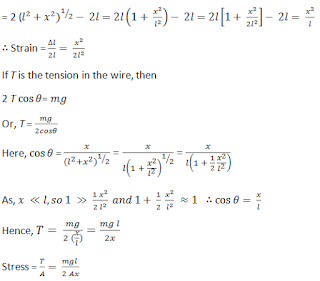
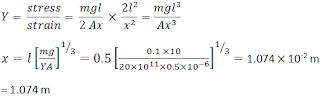
From the above figure,
Let x be the depression at the mid point i.e. CD = x.
In fig.,
AC= CB = l = 0.5 m ;
m = 100 g = 0.100 Kg
AD= BD = (l2 + x2)1/2
Increase in length, ∆l = AD + DB - AB = 2AD - AB
20
Answer
Diameter of the metal strip, d = 6.0 mm = 6.0 × 10⁻³ m
Radius, r = d/2 = 3 × 10⁻³ m
Maximum shearing stress = 6.9 × 10⁷ Pa
Maximum stress = Manimum load or force / Area
Maximum force = Maximum stress × Area
= 6.9 × 10⁷ × π × (r) 2
= 6.9 × 10⁷ × π × (3 ×10⁻³)2
= 1949.94 N
Each rivet carries one quarter of the load.
∴ Maximum tension on each rivet = 4 × 1949.94 = 7799.76 N.
21
Answer