NCERT Solutions for Chapter 5 Judiciary Class 8 Civics
Book Solutions1
You read that one of the main functions of the judiciary is 'upholding the law and Enforcing Fundamental Rights'. Why do you think an independent judiciary is necessary to carry out this important function?
Answer
The independence of the judiciary allows the courts to play a central role in ‘upholding the law and Enforcing Fundamental Rights’ as it ensures that there is no misuse of power by the legislature and the executive. Anyone can approach the courts if they believe that their rights have been violated and Politicians or other socially powerful people cannot use their power to change any judgement.
Exercises
Page Number 64
2
Re-read the list of Fundamental Rights provided in chapter 1. How do you think the Right to Constitutional Remedies connects to the idea of judicial review?
Answer
The Right to Constitutional Remedies allows an Indian citizen to move the court if he feels that any of his or her Fundamental Rights has been violated by the State. As thefinal interpreter of the Constitution, the judiciary has the power to review or even strike down any particular law passed by the Parliament if it believes that this law violates the basic structure of the constitution, which is called judicial review. In this way we find that the Right to Constitutional Remedies given in the Fundamental Rights is directly connected and supported by the idea of judicial review.
Exercises
Page Number 64
3
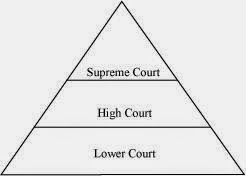
In the Following illustration, fill in each tier with the judgments given by the various courts in the Sudha Goel case. Check your responses with others in class.
Answer
Lower Court (Trial Court): Laxman, his mother Shakuntala and his brother-in-law Subhash Chandra were sentenced to death.
High Court: Laxman, Shakuntala and Subhash Chandra were acquitted.
Supreme Court: Laxman, Shakuntala were given life imprisonment while Subhash Chandra was acquitted for lack of sufficient evidence.
High Court: Laxman, Shakuntala and Subhash Chandra were acquitted.
Supreme Court: Laxman, Shakuntala were given life imprisonment while Subhash Chandra was acquitted for lack of sufficient evidence.
Exercises
Page Number 64
4
Keeping the Sudha Goel case in mind, tick the sentences that are true and correct the ones that are false.
(a) The accused took the case to the High Court because they were unhappy with the decision of the Trial Court.
(b) They went to the High Court after the supreme Court had given its decision.
(c) If they do not like the Supreme Court verdict, the accused can go back again to the Trial Court.
(a) The accused took the case to the High Court because they were unhappy with the decision of the Trial Court.
(b) They went to the High Court after the supreme Court had given its decision.
(c) If they do not like the Supreme Court verdict, the accused can go back again to the Trial Court.
Answer
(a) True
(b) They went to the High Court after the Trial Court had given its decision.
(c) If they do not like the Supreme Court verdict, the accused cannot go back again to the Trial Court since the Supreme Court is at the highest rung of the judiciary pyramid.
(b) They went to the High Court after the Trial Court had given its decision.
(c) If they do not like the Supreme Court verdict, the accused cannot go back again to the Trial Court since the Supreme Court is at the highest rung of the judiciary pyramid.
Exercises
Page Number 64
5
Why do you think the introduction of Public interest Litigation (PIL) in the 1980s is a significant step in ensuring access to justice for all?
Answer
The introduction of Public Interest Litigation (PIL) in the 1980s is a significant step in ensuring access to justice for all because it also keeps in mind the interests of the illiterate and poor who are not educated enough or cannot afford to access the Indian legal system for justice against exploitation or violation of their basic human and Fundamental Rights.
Exercises
Page Number 64
6
Re-read excerpts from the judgment on the Olga Tellis vs Bombay Municipal Corporation case. Now write in your own words what the judges meant when they said that the Right to Livelihood was part of the Right to Life.
Answer
In Olga Tellis vs. Bombay Municipal Corporation case, the judges said that the Right to Livelihood was part of the Right to Life. They stated that life does not merely imply an animal existence; it cannot be lived without a means of living, that is, "the means of livelihood". The judges conferred that eviction from a pavement or slum is deprivation of means of livelihood for the poor who cannot afford to live anywhere else. They take up small jobs in surrounding areas and to lose their pavement or slum would lead to loss of a job resulting in loss of a means of livelihood. Consequently, leading to "deprivation of life". This is how the judges connected Right to Livelihood to the Right to Life.
Exercises
Page Number 64
7
Write a story around the theme, ‘Justice delayed is justice denied’.
Answer
Suresh was the only bread earner of his family. In an accident, he was killed. He has a wife and two daughters in 1980. His widow filed a case for compensation and a job on compassionate ground. The court stayed the case for more than 28 years. In order to earn their livelihood, she worked on the fields and her daughters worked as domestic help. With hard work she was able to earn her livelihood. She borrowed money from landlord and got her daughters married to poor grooms.After all this case was decided and a compensation of ₹ 5 lakh was awarded to her but now this money does not hold any value for the widow. Since, her daughters were already married and at the time of need she did not get this money and so could not give proper education to her daughters. Justice has been delayed for 28 years. Hence, it is rightly said that justice delayed is justice denied.
Exercises
Page Number 64
8
Make sentences with each of the glossary words given on the next page.
Answer
• Acquit- The High Court acquitted Mr Verma of the charges of kidnapping a child.
• To appeal- Mr. Shyam approached the High Court to appeal against the water supply problem.
• Compensation- The High court directed state government to pay compensation to the teachers.
• Eviction- He received an eviction notice today from the landlord.
• Violation- Troops crossed the border in violation of the agreement.
• To appeal- Mr. Shyam approached the High Court to appeal against the water supply problem.
• Compensation- The High court directed state government to pay compensation to the teachers.
• Eviction- He received an eviction notice today from the landlord.
• Violation- Troops crossed the border in violation of the agreement.
Exercises
Page Number 64