NCERT Solutions for Chapter 5 Introduction to Euclid's Geometry Class 9 Maths
Book Solutions1
(i) Only one line can pass through a single point.
(ii) There are an infinite number of lines which pass through two distinct points.
(iii) A terminated line can be produced indefinitely on both the sides.
(iv) If two circles are equal, then their radii are equal.
(v) In the following figures, if AB = PQ and PQ = XY, then AB = XY.

Answer
(i) False
[If we mark a point O on the surface of a paper and using pencil and ruler, we can draw indefinite number of straight lines passing through O.]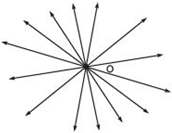
(ii) False
Many lines are passing through ‘P’. Also, there are many lines, passing through ‘Q’. But there is one and only one line which is passing through ‘P’ as well as ‘Q’.]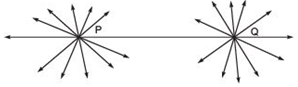
(iii) True
[∵ The postulate 2 says that “A terminated line can be produced indefinitely.”]
(iv) True
[∵ Superimposing the region of one circle on the other, we find them coinciding. So, their centres and boundaries coincide. Thus, their radii will coincide.]
(v) True
[∵ According to Euclid’s axiom, things which are equal to the same thing are equal to one another.]
2
(i) parallel lines
(ii) perpendicular lines
(iii) line segment
(iv) radius of a circle
(v) square
Answer
Yes, we need to have an idea about the terms, point, line, ray, angle, plane, circle and quadrilateral, etc. before defining the required terms.
Point: A small dot made by a sharp pencil on the surface of a paper gives an idea about a point.
It has no dimensions. It has only a position.
Line: A line is an idea that it should be straight and that it should extend indefinitely in both the directions. It has no end points and has no definite length.
Note: In geometry a line means “The line in its totality and not a portion of it. Whereas a physical example of a perfect line is not possible. A line extends indefinitely in both directions, so we cannot draw or show it wholly on a paper. That is why we mark arrow heads on its both ends, indicating that it extends indefinitely in both directions.
Ray: A part of line which has only one end point and extends indefinitely in one direction. A ray has no definite length.
Angle: Two rays having a common end-point form an angle.
Plane: Plane is a surface such that every point of the line joining any two points on it, lies on it.
Circle: A circle is the set of all those points in a given plane which are equidistant from a fixed point is the same plane. The fixed point is called the centre of the circle.
Quadrilateral: A closed figure made of four line segments is called a quadrilateral.
Definitions of the required terms are given below:
(i) Parallel Lines: Two lines ‘l’ and ‘m’ in a plane are said to be parallel, if they have no common point and we write them as l || m.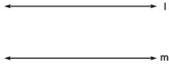
Note: The distance between two parallel lines always remains the same.
(ii) Perpendicular Lines: Two lines ‘p’ and ‘q’ lying in the same plane are said to be perpendicular if they form a right angle and we write them as p ⊥ q.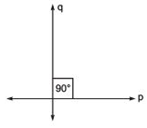
(iii) Line Segment: A line segment is a part of line having a definite length. It has two end-points.
In the figure a line segment is shown having end points ‘A’ and ‘B’. It is written as

(iv) Radius of a circle: The distance from the centre to a point on the circle is called the radius of the circle. In the figure, P is centre and Q is a point on the circle, then PQ is the radius.
(v) Square: A quadrilateral in which all the four angles are right angles and all the four sides are equal is called a square. In the figure PQRS is a square.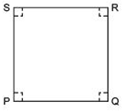
3
(i) Given any two distinct points A and B, there exists a third point C which is in between A and B.
(ii) There exist at least three points that are not on the same line.
Do these postulates contain any undefined terms? Are these postulates consistent?
Do they follow Euclid’s postulates? Explain.
Answer
Yes, these postulates contain undefined terms such as: Point and Line.Also, these postulates are consistent because they deal with two different situations as (i) says that given two points ‘A’ and ‘B’. There is a point ‘C’ lying on the line in between them. Whereas (ii) says that, given ‘A’ and ‘B’, you can take ‘C’ not lying on the line through ‘A’ and ‘B’.
No, these postulates do not follow from Euclid’s postulates, however they follow from the axiom: “Given two distinct points, there is a unique line that passes through them.”
4

Answer
∵ AC = BC [given]∴ AC + AC = BC + AC [If equals added to equals then wholes are equal]
or 2AC = AB [∵ AC + BC = AB]
or AC = (1/2)AB
5
Answer
Let the given line AB is having two mid points ‘C’ and ‘D’.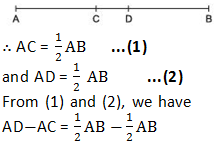
or AD – AC = 0
or CD = 0
∴ C and D coincide.
Thus, every line segment has one and only one mid-point.
6

Answer
We have:AC = BD [Given] ..(1)
Since, the point B lies between A and C,
∴ AC = AB + BC ...(2)
Similarly, the point C lies between B and D,
∴ BD = CD + BC ...(3)
From (1), (2) and (3)
AB + BC = CD + BC
[If equals are subtracted from equals, the remainders are equal]
⇒ AB = CD
7
Answer
In the given list of Euclid’s axioms, we have:“The whole is greater than the part”
This statement is true for all things and in all parts of Universe.
So, it is a ‘Universal truth’.
1
Answer
There are several easy equivalent versions of Euclid's fifth postulate. Playfair's axiom is one of the other equivalent versions of Euclid's fifth postulate which is easily understandable. According to it,
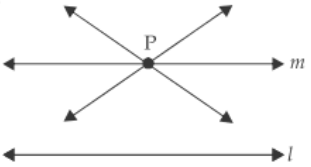
For every line l and for every point not lying on l, there exists a unique line m passing through point P and is parallel to l. Clearly, if all lines passing through the point P, only line m is parallel to line l.
2
Answer
Yes, If a straight line ‘l’ falls on two lines ‘m’ and ‘n’ such that sum of the interior angles on one side of l is two right angles, then by Euclid’s fifth postulate, the lines will not meet on this side of l. Also we know that the sum of the interior angles on the other side of the line l will be two right angles too. Thus, they will not meet on the other side also.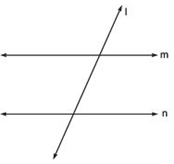
∴ The lines ‘m’ and ‘n’ never meet, i.e., they are parallel.