Electrochemistry
Book Solutions1
Answer
According to their reactivity, the given metals replace the others from their salt solutions in the said order: Mg : Al : Zn : Fe : Cu
2
Answer
The reducing power increases with the lowering of reduction potential. In order of given standard electrode potential (increasing order): K+/K < Mg2+/Mg < Cr3+/Cr < Hg2+/Hg < Ag+/Ag.
Thus, in the order of reducing power, we can arrange the given metals as: Ag< Hg < Cr < Mg < K.
3
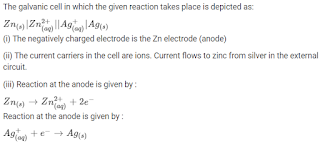
Represent the galvanic cell in which the following reaction takes place.
Zn(s) + 2Ag+(aq) → Zn2+(aq) + 2Ag(s)
Also find :
(i) The negatively charged electrode ?
(ii) Current carriers in the cell.
(iii) At each electrode, the individual reaction.
Answer
4
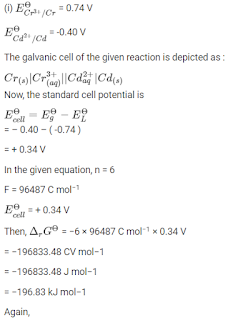
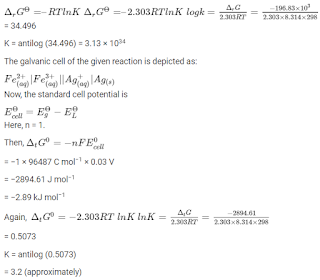
With the following reactions given, find the standard cell potentials of galvanic cells with given reactions.
(i) 2Cr(s) + 3Cd2+(aq) → 2Cr3+(aq) + 3Cd(s)
(ii) Fe2+(aq) + Ag+(aq) → Fe3+(aq) + Ag(s)
Calculate the ∆rGθ and equilibrium constant of the reactions.
Answer
5
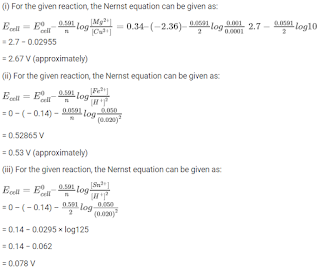
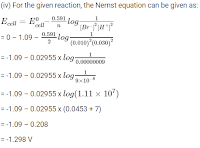
Write the Nernst equation and emf of the following cells at 298 K:
(i) Mg(s) | Mg2+(0.001M) || Cu2+(0.0001 M) | Cu(s)
(ii) Fe(s) | Fe2+(0.001M) || H+(1M)|H2(g)(1bar) | Pt(s)
(iii) Sn(s) | Sn2+(0.050 M) || H+(0.020 M) | H2(g) (1 bar) | Pt(s)
(iv) Pt(s) | Br2(l) | Br−(0.010 M) || H+(0.030 M) | H2(g) (1 bar) | Pt(s).
Answer
6
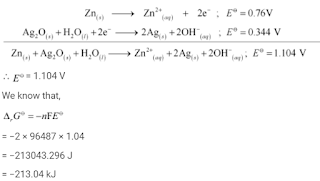
In the button cells widely used in watches and other devices the following reaction takes place:
Zn(s) + Ag2O(s) + H2O(l) → Zn2+(aq) + 2Ag(s) + 2OH−(aq)
Determine ΔrGΘ and E0 for the reaction.
Answer
7
Answer
Conductivity of a solution is defined as the conductance of a solution of 1 cm in length and area of cross – section 1 sq. cm. Specific conductance is the inverse of resistivity and it is represented by the symbol κ. If ρ is resistivity, then we can write:
At any given concentration, the conductivity of a solution is defined as the unit volume of solution kept between two platinum electrodes with the unit area of cross- section at a distance of unit length.
When concentration decreases there will a decrease in Conductivity. It is applicable for both weak and strong electrolyte. This is because the number of ions per unit volume that carry the current in a solution decreases with a decrease in concentration.
Molar conductivity –
Molar conductivity of a solution at a given concentration is the conductance of volume V of a solution containing 1 mole of the electrolyte kept between two electrodes with the area of cross-section A and distance of unit length.
Now, l = 1 and A = V (volume containing 1 mole of the electrolyte).
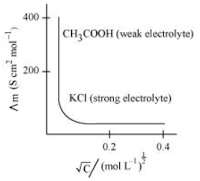
Molar conductivity increases with a decrease in concentration. This is because the total volume V of the solution containing one mole of the electrolyte increases on dilution. The variation of
8
The conductivity of 0.20 M solution of KCl at 298 K is 0.0248 Scm−1. Calculate its molar conductivity.
Answer
Given, κ = 0.0248 S cm−1
c = 20 M
Molar conductivity, Λm=k×1000/c
=0.0248×1000/0.2
= 124 Scm2mol-1
9
Answer
Given,
Conductivity, k = 0.146 × 10⁻³ S cm−1
Resistance, R = 1500 Ω
Cell constant = k × R
= 0.146 × 10−3 × 1500
= 0.219 cm−1
10
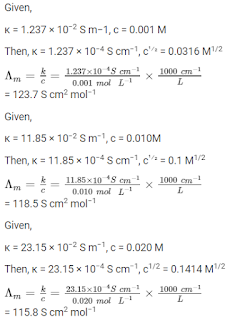
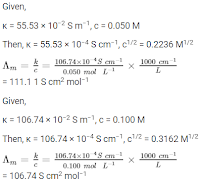
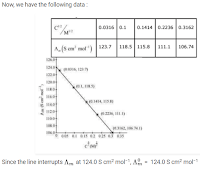
The conductivity of NaCl at 298 K has been found at different concentrations and the results are given below:
Concentration/M 0.001 0.010 0.020 0.050 0.100
102 × k/S m−1 1.237 11.85 23.15 55.53 106.74
Calculate
Answer
11
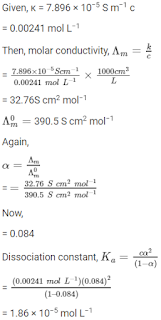
Find the molar conductivity of acetic acid if its conductivity is given to be 0.00241 M . Also, if the value of
Answer
12
How much charge is required for the following reductions of 1 mol of :
(i) Al3+ to Al.
(ii) Cu2+ to Cu.
(iii)
Answer
(i)
Required charge = 3 F
= 3 × 96487 C
= 289461 C
(ii)
Required charge = 2 F
= 2 × 96487 C
= 192974 C
(iii)
i.e
Required charge = 5 F
= 5 × 96487 C
= 482435 C
13
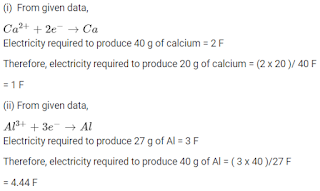
In the terms of Faraday, how much electricity is required to produce :
(i) From molten CaCl2, 20.0 g of Ca.
(ii) From molten Al2O3, 40.0 g of Al.
Answer
14
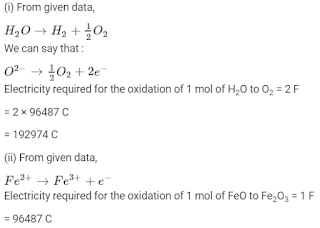
Answer
15
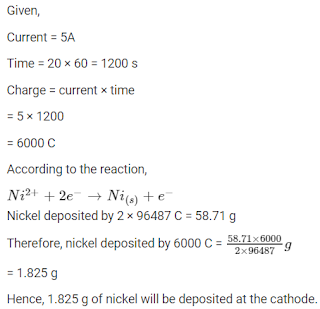
Answer
16
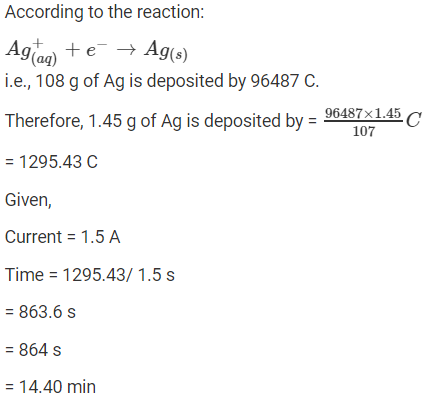
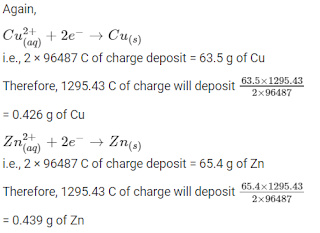
Answer
17
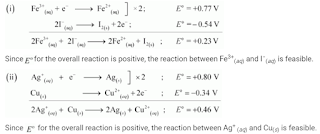
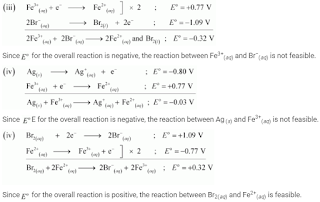
Using the standard electrode potentials given in Table 3.1, predict if the reaction between
the following is feasible:
(i)Fe3+(aq) and I−(aq)
(ii) Ag+ (aq) and Cu(s)
(iii) Fe3+ (aq) and Br− (aq)
(iv) Ag(s) and Fe3+ (aq)
(v) Br2 (aq) and Fe2+ (aq).
Answer
18
Predict the products of electrolysis in each of the following :
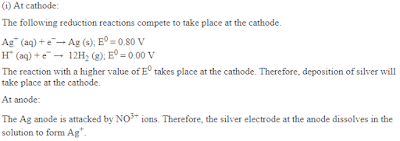
(i) An aqueous solution of AgNO3 with silver electrodes.
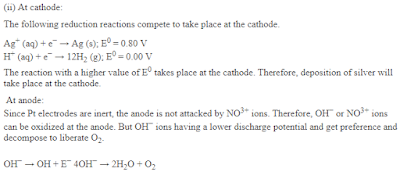
(ii) An aqueous solution of AgNO3with platinum electrodes.
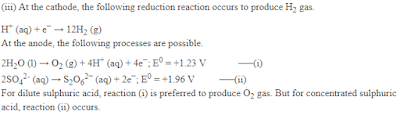
(iii) A dilute solution of H2SO4with platinum electrodes.
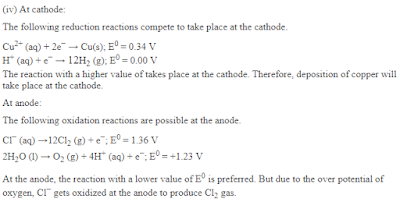
(iv) An aqueous solution of CuCl2 with platinum electrodes.
Answer