Classification of Elements and Periodicity in Properites
Book Solutions1
Answer
It is to characterize the elements in periods and groups as per their properties. So, this course of action makes the investigation of elements and compounds of elements in a simple one and methodical way. In this periodic table, elements with comparative properties are set in a similar group.2
Answer
Mendeleev organised the components in his periodic table, according to the order of their atomic weight. Mendeleev organized the components in groups and periods according to the increasing atomic weight. Mendeleev set the elements which are having comparative properties in the similar groups.
Nonetheless, he didn’t adhere to arrangement that he gave for long. He discovered that if the elements were organized according to their increasing atomic weights, then a few elements did not match within this plan of characterization.
In this manner, he overlooked the order of atomic weights now and again. For instance, the atomic mass of iodine is lower than atomic mass of tellurium.
Still Mendeleev set tellurium (in Group 6) ahead of iodine (in Group 7) essentially in light of the fact that iodine’s properties are so comparable to fluorine, chlorine, and bromine.
3
Answer
|
Mendeleev’s Approach
for periodic law |
Modern approach for
the periodic law |
|
Chemical properties
and Physical properties of the elements are the periodic functions of the
atomic mass of the corresponding elements. |
Chemical properties
and Physical properties of the elements are the periodic functions of the
atomic numbers of the corresponding elements. |
4
Answer
In a periodic table containing elements, a period shows the value of principal quantum number (n) for the furthest shells. Every period starts with the filling with the principal quantum number (n). And n’s value for the 6th period is equal to 6. Now, for n = 6, the azimuthal quantum number (l) can have “0, 1, 2, 3, 4” values.
As indicated by Aufbau’s rule, electrons will be added to various orbitals according to their increasing energies. Here, the 6d subshell is having much higher energy than the energy of 7s subshell.
In the sixth period, the electrons can occupy in just 6s, 4f, 5d, and 6 p subshells. 6s is having 1 orbital, 4f is having 7 orbitals, 5d is having 5 orbitals, and 6p is having 3 orbitals. In this way, there are a sum of 16 (1 + 7 + 5 + 3 = 16) orbitals accessible. As indicated by Pauli’s exclusion, one orbital can only accommodate at max 2 electrons.
Hence, sixteen orbitals can have 32 electrons.
Subsequently, the 6th period of period table ought to have 32 elements.
5
Answer
Elements whose atomic number is from Z = 87 to Z = 114 are available in the seventh period of periodic table. Therefore, the element having Z = 114 is available in the seventh period in periodic table.
In the seventh period, initial 2 elements with Z = 87 and Z= 88 are the elements of s-block and the following 14 elements except Z = 89 i.e., those from Z = 90 to Z = 103 are elements of f – block, and next 10 elements from Z = 89 and Z = 104 to Z = 112 are elements of d-block, next the elements from Z = 113 to Z = 118 are elements of p-block. In this manner, the element Z = 114 is the 2nd element of p-block in the seventh period of the periodic table.
Therefore, the element Z = 114 is available in the seventh period and fourth group in the periodic table.
6
What is the atomic number of element keeping in mind both the cases given below;
- Element is in 3rd period of periodic table.
- Element is in 17th group of periodic table.
Answer
First period is having 2 elements and second period is having 8 elements. So, the third period begins with element Z = 11. Presently, third period contains 8 elements. So, 18th element is the last element of the third period and this 18th element is present in 18th group. Thus, the element in the seventeenth group of the 3rd period is having atomic number 17 i.e. Z = 17.7
Which element are named by
a) Seaborg’s group
b) Lawrence Berkeley Laboratory?
Answer
a) Seaborgium (Sg) which has atomic number, Z = 106
b) Lawrencium (Lr) which has atomic number, Z = 103 and Berkelium (Bk) which has atomic number, Z = 97
8
Answer
The chemical and physical properties of any elements rely on the quantity of valence electrons. In periodic table elements are in same group are having same quantity of valence electrons. This is why elements present in the same group are having similar chemical and physical properties.9
Answer
Radius of an atom is known as atomic radius. It quantifies the size of an atom. On chance that the element is a metal, then its radius is termed as metallic radius, and if element is a non-metal, then its radius is termed as covalent radius. The metallic radius can be calculated as inter-nuclear distance between two molecules divided by 2. For instance, the inter-nuclear distance between two adjoining copper atoms is 256 pm in solid copper.
Metallic radius of copper =
Covalent radius can be measured as the interatomic distance between 2 atoms when they are together by a solitary bond in a covalent atom. For instance, the interatomic distance between 2 chlorine atoms of chlorine molecule = 198 pm.
Covalent radius of copper =
Radius of an ion (cation or anion) is known as ionic radius. Ionic radius is computed by measuring the inter-ionic distance between the cation and anion in an ionic crystal. Since cations are created by expelling an electron from outermost orbit of an atom, thus cation has less electrons compared to parent atom which results in increased effective nuclear charge.
In this way, a cation is small in size than parent atom. For instance, the ionic radius of
10
Answer
Atomic radius declines as we move from left to right in a period. It happens because in a period, the external electrons are available in a similar valence shell so, the atomic number increments from left to right in a period, which results in increase in the effective nuclear charge. Therefore, the attraction of electrons towards the nucleus is increased.
Also, atomic radius declines as we move from top to bottom in the group. It happens because as we move down in a group then there is increase in principal quantum number(n) which brings about increase in the distance between nucleus and the valence electrons.
11
Explain what is isoelectronic species? Give names of the species which will be isoelectronic species with each ion or atom given below.
- Ar
Rb+ F− Mg+
Answer
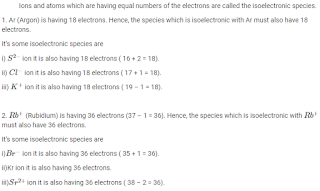
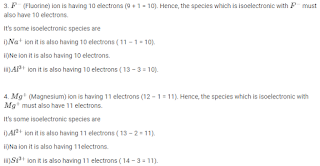
12
Consider the accompanying species: N3−,O2−,F−,Na+,Mg2+,andAl3+
(i) What is similar in them?
(ii) Arrange them in the according to their increasing order of ionic radii.
(i) What is similar in them?
(ii) Arrange them in the according to their increasing order of ionic radii.
Answer
The species that are given are having equal number of electrons i.e. 10 electrons. So, they are isoelectronic species.
Arrangement of the given ions according to their increasing order of nuclear charge is:
N3−
Arrangement of the given ions according to their increasing order of ionic radii is:
Al3+
13
Cation are having smaller radii then that of their parent atom and anion are having larger radii than their parent atom. Why?
Answer
Cations are formed by expelling an electron from outermost orbit of an atom, thus cation has less electrons compared to parent atom which results in increased effective nuclear charge but the total nuclear charge remains same which results in increased attraction of electrons towards nucleus than that of parent atom. Thus, cations are having smaller radii then that of their parent atom.
Anions are formed by gaining an electron in the outermost orbit of an atom, thus anion has more electrons compared to parent atom which results in decreased effective nuclear charge but the total nuclear charge remains same which results in increased distance the nucleus and the valence electrons as the attraction of electrons towards nucleus decreases than that of parent atom. Thus, anions are having larger radii then that of their parent atom.
14
State significance of following terms:
- “isolated gaseous atom”
- “ground state” in the definition of ionization enthalpy and electron gain enthalpy?
Answer
“Ionization enthalpy is the energy that is required to expel an electron from an isolated gaseous atom in ground state”. Despite the fact that in gaseous state the atoms are generally widely separated, there are a few measures of attractive forces between the atoms. To find the ionization enthalpy of any ion, it is difficult to isolate a solitary atom. This attractive force can be further diminished by bringing down the pressure. Hence, the term “isolated gaseous atom” is utilized as a part of the meaning of ionization enthalpy.
An atom’s ground state is the most stable state. Less energy is required to expel an electron if isolated gaseous atom is present in the ground state. In this way, for the purpose of comparison, electron gain enthalpy and ionization enthalpy must be calculated for an “isolated gaseous atom” and its “ground state”.
15
Energy of an electron in the ground state of the hydrogen atom is –2.18 × 10⁻¹⁸ J. Calculate the ionization enthalpy of atomic hydrogen in terms of J mol–1.
Answer
It is given that the energy of an electron in the ground state of the hydrogen atom is 2.18 × 10⁻¹⁸ J.
Therefore, the energy required to remove that electron from the ground state of hydrogen atom is 2.18 × 10⁻¹⁸ J.
Ionization enthalpy of atomic hydrogen = 2.18 × 10⁻¹⁸ J
Hence, ionization enthalpy of atomic hydrogen in terms of J mol–1 = 2.18 × 10–18 × 6.02 × 1023 J mol–1 = 1.31 × 10⁶ J mol–1
16
For some elements of the 2nd period the arrangement according to their ionization enthalpy is given as follows
Li
Explain Why?
1. ΔiH for O is lower than ΔiH of N and F.
2. ΔiH for Be is higher than ΔiH than B?
Answer
1. In nitrogen, there are three 2p-electrons and all of these 3 occupy 3 distinct atomic orbital. While in oxygen 2 out of 4, 2p – electrons occupy same 2p-orbital, so the repulsion between the electrons in the oxygen atom increases.
Thus, the energy required to expel 2nd 2p –electron in oxygen atom is higher than the energy required to expel 4th2p –electron in nitrogen atom.
Thus,
Fluorine atom is having one proton and one electron more than that in oxygen atom. As electron is added to a similar shell, the increment in attractive force between nucleus and electron (as proton is added) is higher than the increment in the repulsive force between electron-electron(as electron is added). Thus, valence electrons in the fluorine atom experiences higher effective nuclear charge compared to that, which is experienced by electron of oxygen atom. Thus, the energy required to expel an electron from fluorine is higher than the energy required to expel an electron from oxygen.
Thus,
2. During ionization process, the electron that can be expelled from Be(beryllium) – atom is 2s – electron, but the electron that can be expelled from boron is 2p – electron.
The attractive force between a 2s – electron and nucleus is higher than between a 2s – electron and nucleus.
Thus, the energy required to expel 2s – electron is higher than the energy required to expel 2p –electron.
Thus,
17
Answer
The 1st ionization enthalpy of magnesium is higher than 1st ionization enthalpy of sodium because,
1. Magnesium is having greater atomic size than sodium.
2. Magnesium is having higher effective nuclear charge than sodium.
Thus, energy required to expel an electron from sodium is lower than that in magnesium. Thus, the 1st ionization enthalpy of magnesium is higher than 1st ionization enthalpy of sodium.
The 2nd ionization enthalpy of magnesium is lower than 2nd ionization enthalpy of sodium is because after expelling an electron, there is still 1 electron remaining in the 3s-orbital of magnesium, whereas sodium achieves stable inert gas configuration after expelling an electron. So, magnesium still requires to expel 1 electron to achieve stable inert gas configuration.
Thus, energy required to expel 2nd electron from magnesium is lower than that in sodium. Thus, the 2nd ionization enthalpy of magnesium is lower than 2nd ionization enthalpy of sodium.
18
Answer
The factors because of which in elements of main group the ionization enthalpy decreases when we move down the group are given below:
1. “Increase in the shielding effect”: Inner shells increases as we move down the group. Thus, the shielding effect of valence electrons increases by inner core electrons from nucleus. Thus, the attractive force on electrons towards nucleus is very strong. So, energy required to expel a valence electron decreases as we move down the group.
2. “Increase in atomic size of elements”: Inner shells increases as we move down the group. Thus, the atomic size increases as we move down the group. Also, the distance between the valence electron and nucleus of an atom, as a result the electrons are not strongly bounded. So, valence electrons can be expelled easily. Thus, energy required to expel a valence electron decreases as we move down the group.
19
For the elements of group 13 the values of 1st ionization enthalpy is given below:
B | Al | Ga | In | Tl |
801 | 577 | 579 | 558 | 589 |
Answer
Inner shells increases as we move down the group. Thus, the shielding effect of valence electrons increases by inner core electrons from nucleus. Thus, the attractive force on electrons towards nucleus is very strong. So, ionization enthalpy decreases as we move down the group. Hence for elements of group 13 the ionization enthalpy decreases as we move down from B to Al.
Here, Ga is having high ionization enthalpy than that of Al. This is because Al comes after the s-blocks elements, while Ga comes after the d-blocks elements. The shielding that is provided by electrons of d-block elements is not effective. So, the valence electrons are not shielded effectively. Thus, valence electrons in Ga atom experience higher effective nuclear charge compared to Al.
Further on moving down from Ga to In, the value of ionization enthalpy is decreased because of the increase in the shielding effect and increase in atomic size.
But, Tl is having high ionization enthalpy than that of In. This is because Tl comes after the ‘4f and 5d electrons’. The shielding that is provided by these ‘4f and 5d electrons’ is not effective. So, the valence electrons are not shielded effectively. Thus, valence electrons in Tl atom experience higher effective nuclear charge compared to In.
20
Find out which of the pair given below will have high negative electron affinity?
a)F or Cl b) O or F
Answer
1) F and Cl are the elements of the same group in periodic table. On moving down the group the electron affinity becomes less negative. Here, the value of electron affinity of F is less negative than that of Cl. It is because atomic size of Cl is larger than that of F. In Cl, the electron will be added to n = 3 quantum level, whereas in F, the electron will be added to n = 2 quantum level. Thus, as the electron-electron repulsion is reduced in Cl so an extra electron can easily be accommodated. So, electron affinity of Cl is more negative compared to that of F.
2) O and F are the elements of the same period in periodic table. An F-atom is having 1 electron and 1 proton more than that of O-atom as electron is added in the same shell, Thus the atomic size of O-atom is larger than F-atom. As O-atom is having 1 proton less than F-atom. So, the nucleus of O-atom cannot attract an incoming electron that strongly as that of an F-atom. Also F-atom requires only 1 electron to achieve stable inert gas configuration. So, the electron affinity of F(Fluorine) is more negative than that of O(oxygen).
21
What is electron affinity of O(oxygen) atoms?
- Positive
- More negative
- Less negative
Justify the answer.
Answer
O− ion is formed when O-atom gains one electron and the energy is being released during this process. So the 1st electron affinity for O-atom is negative. O(g) + e−→O−g
If an electron is added in O− ion then it forms O2− ion, the energy is required to n e- given to counter the strong electronic repulsions. So, the 2nd electron affinity of O-atom is positive. O−(g) + e−→O2− g
22
Answer
Electron gain enthalpy | Electronegativity |
Tendency to gain electrons for an isolated gaseous atom is its electron gain enthalpy. | Tendency to attract the shared pairs of electrons for an atom which is in chemical compound is its electronegativity. |
23
Answer
Electronegativity is a variable property of any element. Electronegativity is different for different compounds. Hence the given statement “The electronegativity of Nitrogen on pauling scale measures 3.0 for all nitrogen compounds” is incorrect. Because the electronegativity of Nitrogen is different in NO2 and NH3.24
Answer
Ionization enthalpy of any atom relies on its number of protons and electrons. But, the isotopes of any element have equal number of electrons and protons. Thus, the 1st ionization enthalpy of two isotopes of a single element is same.25
Explain theories afflicted with radius of an atom for
- Expelling an electron
- Receiving an electron
Answer
1. As an atom expels a single electron, so the quantity of electron decreases by 1 but the nuclear charge does not change. Thus, the electron – electron repulsion decreases in an atom. So, there is increase in effective nuclear charge. Thus, there is decrease in a radius of an atom.
2. There is increase in size of an atom when it gains an electron. As it gains an electron than the quantity of an electrons raises by 1. Thus, the electron – electron repulsion increases in an atom. There is increase in effective nuclear charge as the quantity of proton remains unchanged. Thus, there is increase in a radius of an atom.
26
Answer
Metals | Non- metals | ||
a | They can easily expel an electron | a | They cannot easily expel an electron. |
b | They cannot easily receive an electron. | b | They can easily receive an electron. |
c | They form ionic compounds. | c | They form covalent compounds. |
d | Their oxides are having basic nature. | d | Their oxides are having acidic nature. |
e | Their ionization enthalpies are low. | e | Their ionization enthalpies are high. |
f | Their electron affinity is less negative. | f | Their electron affinity is highly negative. |
i | Their electronegativity is less. | i | Their electronegativity is more. |
j | Their reducing power is high. | j | Their reducing power is low. |
27
Answer the questions given below using periodic table.
- Determine the element with 5 electrons in outer subshell.
- Determine the element which is having tendency to gain 2 electrons.
- Determine the element which is having tendency to expel 2 electrons.
- Determine the group in the periodic table which is having liquid, gas, metal and non-metals as well at room temperature.
Answer
1. Element with 5 electrons in outer subshell is having electronic configuration ns2np5. Halogen group is having the same electronic configuration. So, the elements can be At, I, Br, Cl and F.
2. The elements that tend to gain 2 electrons are those who can achieve stable inert gas configuration by gaining these electrons. They are having electronic configuration ns2np4. Oxygen containing group is having the same electronic configuration.
3. The elements that tend to expel 2 electrons are those who can achieve stable inert gas configuration by expelling these electrons. They are having electronic configuration ns2. 2nd Group elements are having the same electronic configuration. So, the elements can be Ba, Sr, Ca, Mg, Be.
4. Elements of group 17 are having liquid, gas, metal and non-metals as well at room temperature.
28
The arrangement elements according to increasing reactivity for group 1 and 17 are given:
For group 1: Li
For group 17: F>Cl>Br>I
Answer
For group 1
- There is only 1 valance electron in the elements of group 1. So, their tendency is to expel this electron in order to achieve stable inert gas configuration. As we move down in group 1 the ionization enthalpies of the elements decreases. Thus, less energy will be required to expel the valence electron. As a result reactivity of elements increases as we move down in group 1.
For group 17
- In the elements of group 17, there is requirement of only 1 electron in order to achieve stable inert gas configuration. So, their tendency is to gain this 1 electron. As we move down in group 17 the ionization enthalpies of the elements increases. Thus, more energy will be required to expel the valence electron. As a result reactivity of elements decreases as we move down in group 17.
29
Answer
Element | General electronic configuration |
s-block | ns1−2; n = 2 to 7 |
p-block | ns2np1−6; n = 2 to 6 |
d-block | (n–1)d1−10ns0−2; n = 4 to 7 |
f-block | (n–2)f1−14d0−10ns2; n = 6 to 7 |
30
Assign the position of the element having outer electronic configuration
(i) ns2 np4 for n = 3 (ii) (n - 1)d2 ns2 for n = 4, and (iii) (n - 2) f7 (n - 1)d1 ns2 for n = 6, in the periodic table.
Answer
1. Here, n = 6 so the element is in sixth period. The element is an ‘f-block element’ because the last electron enters in the f-orbital. As the f-block elements are in third group. They are having electronic configuration
2. Here, n = 3 so the element is in third period. The element is in ‘p-block element’ because the last electron enters in the p-orbital. It contains 4 electrons in p-orbital.
For group of the element
= No. of s – block groups + No. of d – block groups + No. of p – block groups
= 2 + 10 + 4 = 16
Thus, the given element is in third period and sixteenth the group in the periodic table. Thus, the required element is Sulphur.
3. Here, n = 4 so the element is in fourth period. The element is in ‘d-block element’ because the last electron enters in the d-orbital but this orbital is incompletely filled. It contains 2 electrons in d-orbital.
For group of the element
= No. of s – block groups + No. of d – block groups
= 2 + 2 = 4
Thus, the given element is in fourth period and fourth the group in the periodic table. Thus, the required element is Titanium.
31
Elements | (ΔiH) | (ΔiH) | (ΔegH) |
1 | 520 | 7300 | -60 |
2 | 419 | 3051 | -48 |
3 | 1681 | 3374 | -328 |
4 | 1008 | 1846 | -295 |
5 | 2372 | 5251 | +48 |
6 | 738 | 1451 | -40 |
Give the answer of the question given below using the above table:
- Which is the most reactive among all the elements given in above table?
- Which is the least reactive among all the elements given in above table?
- Which is the least reactive non – metal among all the elements given in above table?
- Which is the most reactive non – metal among all the elements given in above table?
- Which metal can easily form predominantly stable covalent halide having formula MX; X = halogen.
- Which metal can easily form stable binary halide having formula MX2; X = halogen.
Answer
1. As element 5 is having highest 1st ionization enthalpy and is having a positive electron affinity, so it is the most reactive among all the elements given.
2. As element 2 is having lowest 1st ionization enthalpy and is having a negative electron affinity, so it is the least reactive among all the elements given.
3. As element 5 is having high 1st ionization enthalpy and is having a positive electron affinity, so it is the least reactive non-metal.
4. As element 3 is having high 1st ionization enthalpy and is having a negative electron affinity, so it is the most reactive non-metal.
5. As element 1 is having low 1st ionization enthalpy and high 2nd ionization enthalpy. Thus, metal can easily form predominantly stable covalent halide having formula MX; X = halogen.
6. As element 6 is having low 2nd ionization enthalpy and is having a negative electron affinity so, it is a metal. Thus, metal can easily form stable binary halide having formula MX2; X = halogen.
32
Give the formulas for stable binary compounds that can be formed by adjoining the pairs of elements given below.
- Fluorine and element 71
- Iodine and Aluminium
- Nitrogen and magnesium
- Oxygen and Lithium
- Oxygen and silicon
- Fluorine and phosphorus
Answer
- Lutetium (Lu) is the element 71. It is having valency 3. Thus, the required formula is LuF3.
AlI3 - Mg3N2
- LiO2
- SiO2
- PF5 or PF3
33
Period in Modern periodic table indicates:
- Value of atomic mass
- Value of atomic number
- Value of azimuthal quantum number
- Value of principal quantum number.
Answer
4. Period in Modern periodic table indicates the value of ‘n’ i.e. principal quantum number.34
For modern periodic table some statements are given below, find out the incorrect one.
- The d- block contains 8 columns, as maximum 8 electrons can be accommodate the orbitals of d- subshell.
- The p- block contains 6 columns, as maximum 6 electrons can be accommodate the orbitals of p- shell.
- For each block,No. of columns = No. of electrons that can be accommodate in that subshell
- For each block,No. of columns
> No. of electrons that can be accommodate in that subshell
Answer
4. For each block,
No. of columns
35
“ Anything that influences the valence electrons will affect the chemistry of the element”.
Which of the factors given below is not affecting the valence shell?
- Nuclear charge (Z)
- Nuclear mass
- Number of core electrons
- Valence Principal quantum number (n)
Answer
2. Nuclear mass36
F−, Ne and Na+ are isoelectronic species. Their size is affected by _____.
1. Valence Principal quantum number (n)
2. The interaction between electron – electron in outer orbitals
3. Nuclear charge (Z)
4. None as all of them are having same size.
Answer
3. Nuclear charge (Z)
Because, for isoelectronic species:
The atomic size decreases with increase in nuclear charge (Z).
Example: the arrangement according to increasing order of nuclear charge (Z) for F−, Ne and Na+ is: F− < Ne < Na+
And the arrangement according to increasing order of atomic size for F−, Ne and Na+ is: Na+ < Ne < F−
37
For ionization some statements are given below, find out the incorrect one.
- For every successive electron there is increase in ionization enthalpy.
- For orbitals having lower value of ‘n’ the removal of an electron is easy compared to the orbitals having higher value of ‘n’.
- The great increase is noticed in ionization enthalpy when an electron is removed from core inert gas configuration.
- End of valence electrons is set apart by a major bounce in the ionization enthalpy.
Answer
2. For orbitals having lower value of ‘n’ the removal of an electron is easy compared to the orbitals having higher value of ‘n’. Because the electrons of orbitals having lower value of ‘n’ are highly attracted to nucleus than that of the electrons of orbitals having higher value of ‘n’
38
For B, Mg, K and Al
Which of the following is the correct arrangement according to their metallic characteristic?
- Al > B > Mg > K
- Mg > K > Al > B
- K > Mg > Al > B
- Al > Mg > B > K
Answer
3. K > Mg > Al > B
Reason:
As we move from left and right in a period the metallic characteristic of the elements decreases. Thus, Mg > Al.
As we move down from a group the metallic characteristic of the elements decreases. Thus, Al > B.
From the above two statements it can be stated that K > Mg.
Thus, K > Mg > Al > B
39
For B, F, Si and N
Which of the following is the correct arrangement according to their non- metallic characteristic?
- Si > B > N > C > F
- B > F > C > N > Si
- N > C > F > Si > B
- F > N > C > B > Si
Answer
4. F > N > C > B > Si
Reason:
As we move from left and right in a period the non- metallic characteristic of the elements decreases. Thus, F > N > C > B.
As we move down from a group the metallic characteristic of the elements decreases. Thus, C > Si.
From the above two statements it can be stated that B > Si.
Thus, F > N > C > B > Si
40
For F, O, N and Cl
Which of the following is the correct arrangement according to their chemical reactivity in the terms of their oxidizing property?
- Cl > O > N > F
- F > Cl > O > N
- N > Cl > O > F
- O > F > N > Cl
Answer
2. F > Cl > O > N
Reason:
As we move from left and right in a period the non- metallic characteristic of the elements increases. Thus, F > O > N.
As we move down from a group the metallic characteristic of the elements decreases. Thus, F > Cl. And the O is having higher oxidizing characteristic than Cl. So, O > Cl.
Thus, F > N > C > B > Si.